

“The seas are free, but injustice wants to draw borders upon them”
In the Mediterranean a symbol is sailing. Dozens of boats of the Global Sumud Flotilla are advancing towards Gaza to break a blockade that has lasted more than seventeen years. The mission is not only to deliver humanitarian aid, it is to denounce an open wound before the eyes of the world. The journey has become an act of planetary civil resistance.
The initiative was born in July 2025 with a clear purpose. To break the silence, to place Gaza’s tragedy back on the map, and to remind the world that the sea does not belong to those who raise walls and close borders. What began as a dream became a diverse fleet of small and medium-sized boats that departed from Barcelona, Tunis, Genoa, Greece, and other Mediterranean ports. More than fifty vessels brought together doctors, human rights defenders, activists, and volunteers from forty-four countries. All united by a common goal, to bring food, medicine, and dignity to a suffocated population.
The Birth of a Collective Idea
The Global Sumud Flotilla emerged from years of previous attempts to break Gaza’s blockade. Since 2008, different maritime convoys have been organized, some intercepted with violence such as the Mavi Marmara in 2010, where nine Turkish activists were killed.
That tragedy made it clear that challenging the blockade meant risking one’s life. Yet it also showed that international solidarity could cross borders. In 2025 the accumulated experience gave shape to a broader network, supported by civil organizations in Europe, Africa, Asia, and Latin America. The name Sumud, meaning perseverance in Arabic, was chosen as the emblem of resistance against fear and silence.
A Diverse and Fragile Fleet
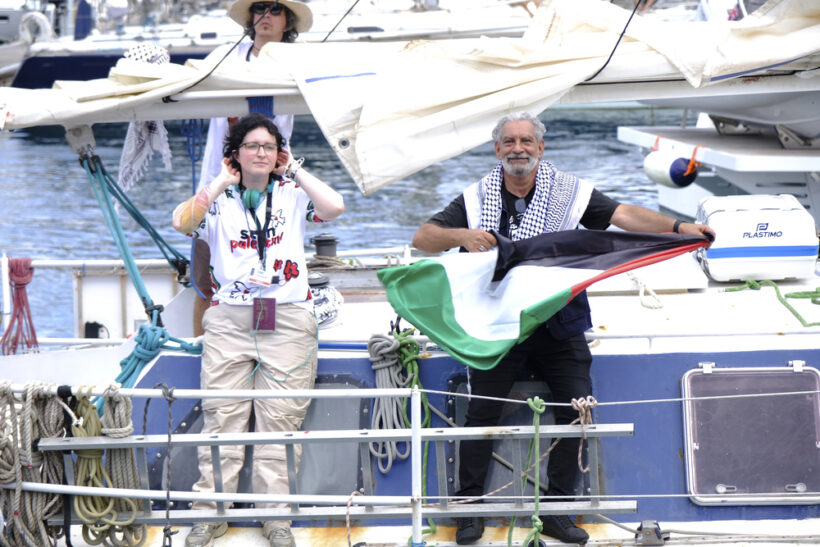
The flotilla is composed of more than fifty boats. Most are sailboats and adapted fishing vessels, though medium-sized cargo ships carrying humanitarian aid also participate. On board are doctors, journalists, lawyers, human rights defenders, and volunteers from every continent. Among them are Palestinian women in exile, descendants of refugees from 1948, young Europeans and Latin Americans who had never been at sea. They are not professional sailors but ordinary citizens who decided to challenge a military blockade with the moral strength of their cause.
Obstacles From the Very Beginning
The journey faced difficulties from the start. In September several boats that had departed from Barcelona had to return because of storms that struck the western Mediterranean. Others stationed in Tunis suffered drone attacks that damaged their decks and forced emergency repairs. Insecurity is constant, as the risk of military interception by Israel always looms. Nevertheless, the crews decided to continue. Each delay and each repair became an act of resistance.
The Mediterranean as a Stage
Today most of the vessels are concentrated near Sicily, preparing for the final stage towards Gaza. Arrival was initially scheduled for mid-September 2025, but weather conditions and threats of interception delayed the plans. The sea itself has become a stage of protest. Every intermediate port is a political act, every departure a public declaration against the blockade. What should have been a technical voyage turned into a symbolic journey that keeps Gaza on the international agenda.
Gaza’s Open Wound
The Strip is one of the most densely populated areas on the planet, with more than two million people confined in 365 km². The blockade imposed since 2007 restricts the entry of food, medicine, fuel, and construction materials. The UN has declared Gaza no longer habitable. Eighty percent of the population depends on humanitarian aid, youth unemployment exceeds sixty percent, and poverty reaches seventy percent of households. Potable water is scarce and electricity is only available for a few hours a day. In this context the flotilla is not just a convoy of boats, it is a desperate cry denouncing the failure of the international community.
Solidarity and International Support
Fifteen countries, including Spain, issued warnings against any attack on the flotilla. Human rights organizations, doctors’ unions, and social movements in Europe and Latin America publicly backed the mission. In the ports where the ships docked, thousands gathered to bid farewell with Palestinian flags and chants of support. The word Sumud is repeated in every act as a reminder that perseverance is the most powerful weapon against injustice.
The Geopolitical Struggle
Israel remains firm in its intention to prevent the flotilla from entering Gaza. It has stated that it will intercept any boat attempting to break the blockade. Some governments aligned with Tel Aviv accuse the organizers of having links to extremists, seeking to delegitimize the initiative. But what is truly at stake is a geopolitical struggle. The flotilla challenges the order that normalizes an illegal blockade under the guise of security. Sailing to Gaza has become an open challenge to the impunity with which fundamental human rights are violated.
A Symbolic Victory
Even without having reached its destination, the flotilla has already achieved a victory. It placed Gaza back on the world agenda, mobilized governments, sparked debate in international media, and awakened solidarity across continents. Images of small boats flying Palestinian flags off European coasts have become symbols of dignity. What seemed like a marginal initiative has transformed into a global movement that denounces indifference and demands action.
Voices From the Sea
The testimonies of those sailing are moving. Young people who had never left their country say they decided to embark because they could not bear to keep seeing images of starving children in Gaza. Doctors travel ready to care for anyone in need, even knowing they may be arrested. Journalists describe the voyage as a journey without guarantees. Each one knows they face real risks, but also that silence is more dangerous than the sea.
What Is at Stake
The flotilla’s future is uncertain. It may be intercepted before arriving, some boats may get close to the coast, or crews may be arrested in international waters. But what is at stake goes beyond that outcome. The real issue is the legitimacy of a blockade that collectively punishes a civilian population. The real question is whether the international community will continue to look away or finally assume the responsibility of protecting human dignity.
The Global Sumud Flotilla is not just a maritime convoy.
It is a cry that sails, a protest that floats on international waters, a hope that carves its way against fear. Whether it reaches Gaza or is intercepted at sea, it has already left its mark. It reminded the world that peoples do not resign, that silence can be broken, and that perseverance can be stronger than injustice. On a planet marked by walls and borders, these small vessels proved that solidarity can still sail free.



