
Traditionally, across Russia, the first week of September, which marks the beginning of the academic year, is strictly considered a significant time for government ministers, elite politicians, entrepreneurs, and academics to interact with students of higher educational institutions and establishments.
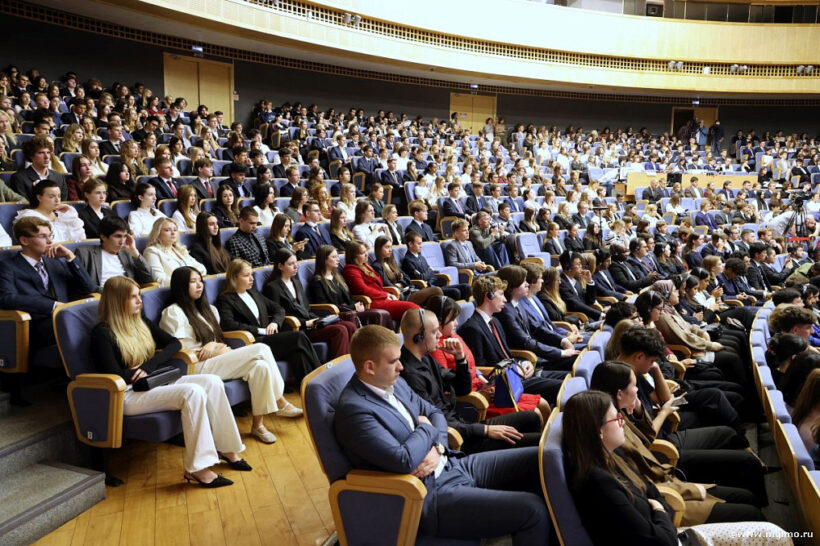
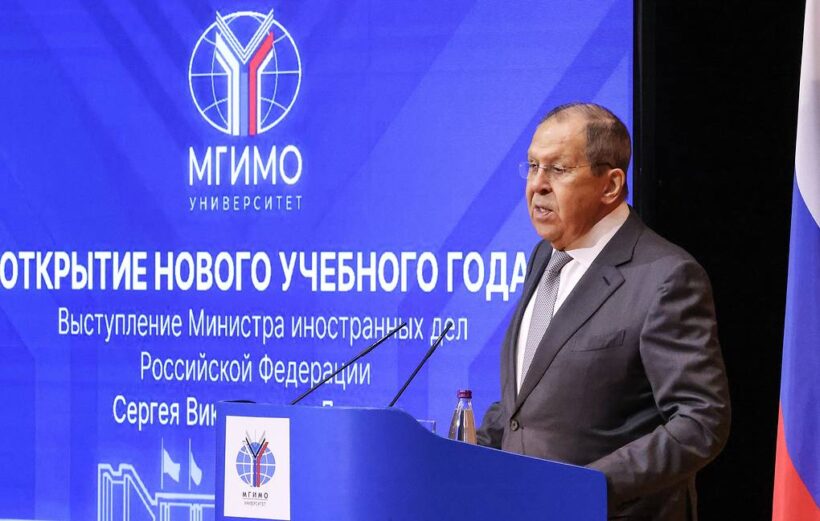
On September 8, Russian Foreign Minister Sergey Lavrov and Rector Anatoly Torkunov, with the staff and students at Moscow’s elite MGIMO (Moscow University of International Affairs), would soon merge with the Russian Academy of Diplomacy, giving an insight into a ‘package’ full of current significant foreign policy trends and developments in the world. That was not the first time Sergey Lavrov has held several and regularly of such a series of lectures since being appointed as Minister of Foreign Affairs in 2004. Lavrov is the longest-serving politician under President Vladimir Putin’s administration.
Insights into his lecture included the historic summit between President of Russia Vladimir Putin and US President Donald Trump in Alaska, the unprecedented four-day visit to China to attend the SCO summit, the Russia-China bilateral summit, and the 80th anniversary of the Victory over Japanese militarism. At the same time, Lavrov’s favorite themes relating to the Russia-Ukraine crisis and the emerging multipolar world, and many others, were tacitly underlined in his lecture in the auditorium. He reminded the auditorium of the forthcoming foreign ministers of Russia and the Gulf Cooperation Council, the first-ever summit between Russia and the League of Arab States. The second ministerial conference of the Russia-Africa Partnership Forum is scheduled for November. And these will be followed by the Commonwealth of Independent States (CIS) and the Eurasian Union.
There are, absolutely, many takeaways from Sergey Lavrov’s lecture. But 80% were nothing new, except playing and rewinding the tapescript for the staff and students, to enhance understanding among his listeners. An approach as a one-time lecturing, it was important for the staff and students of higher education to actively follow developments, absorb knowledge and information. But it is not enough simply to absorb, it is essential to use the information to form their own either collectively or independently, conclusions.
First and foremost, in order to make a critical engagement, Lavrov mentioned that Russia is now the fourth-largest economy in the world by purchasing power parity, following the USA, China, and India, and the largest economy in Europe by the same measure. Despite ongoing tensions with the West over the crisis in Ukraine, Russia’s economy is performing with excellence and will not build walls to the world. Moscow has faced unprecedented sanctions, both from the European Union (EU) and the United States.
Lavrov made constant reference to BRICS (Brazil, Russia, India, China and South Africa), the original five members’ economic performance and resources had already surpassed the G7 in terms of combined GDP measured at purchasing power parity. Since then, this gap has only widened as many countries have expressed the unwavering desire to join BRICS+. China and India, for instance, have established serious and noticeable economic presence, despite their huge population, which has been viewed as a development obstacle. Russia boasts of energy exports, but its population is meagre, estimated at 140 million, very close to the Philippines and Japan, but a weak economy in external markets.
At the Eastern Economic Forum, Russia has offered China, India, and many Asian States the opportunity to invest in its Far East region. In addition, Russia is offering these Asian countries’ citizens to migrate to the Far East, while it has ordered the massive return of citizens of the former Soviet republics instead of strategically deploying this valuable asset to agricultural fields and industrial establishments to boost production, and to promote the economic agenda reflecting the national interests and and to showcase Russia’s vision of a fairer multipolar world.
After the Russian Federation regained its identity, returned to the foundations of consciousness and values, and since the 2000s, began to pursue regional integration. This principle lay behind the creation of the CIS: to pool efforts and draw the maximum benefit from the legacy left by the USSR, rather than remaining isolated in a weakened state. This approach proved largely successful. From it grew the EAEU, the CSTO, and the Union State of Russia and Belarus.
Further into the lecture along the line, Sergey Lavrov reminded the auditorium of President Vladimir Putin’s political and economic architecture – a point that was expressed in Vladivostok, highlighting the fact as to whether the future belongs to the Western or the Eastern world. Lavrov said “This is an important answer to those who have recently suggested, even within our own academic community, that a multipolar world might be built without the West. We have no desire to build any walls. We seek fair cooperation. And if our partners are prepared to engage on an equal and mutually respectful basis, we are ready for dialogue with all. We all inhabit one small planet.”
While addressing the endless debates over the Russia-Ukraine crisis, Lavrov underscored an important fact: the need to get to the basics, the underlying causes of the Ukraine crisis. For instance, in June 2024, speaking at the Russian Foreign Ministry, Russian President Vladimir Putin formulated the approach to resolving the Ukraine crisis, and outlined the task of working on creating the foundations of Eurasian security architecture, which should be based on the principle of indivisibility of security, according to which no one should strengthen their security at the expense of the security of others, no one should claim dominance in military-political terms. This is not something new. All these principles of indivisibility of security were solemnly proclaimed at the OSCE summits in 1999 in Istanbul and in 2010 in Astana and were signed by the heads of state.
Further to the above discussion, Putin considered it as important to show Russia’s readiness to cooperate with everyone, but this should be done honestly. So that the principle of indivisibility of security, which the West trampled in the context of Euro-Atlantic processes, in particular in the OSCE, this time would not only be formulated and reaffirmed, but also respected, like any obligation of a self-respecting sovereign country. According to Lavrov, history however, shows that Western colleagues easily abandon what they signed up for, be it NATO expansion or respect for human rights, which the Europeans, together with the Ukrainian regime, simply destroy and exterminate in the context of supporting the Kyiv regime. In the analysis, it emerged in early September that Russia stands not in opposition to Ukraine’s desire to join the European Union. On the other strict opposite side, Ukraine cannot join NATO. This is strictly forbidden in the security architecture that Russia has been looking for for several years. It is simply out of the question to determine this kind of relation between NATO and Ukraine.
Russia is ready to work openly with anyone prepared for dialogue, ready for dialogue with everyone on an equal, mutually respectful basis. It was in the Western style to build the Berlin walls, conditional walls between each other and the vast Eurasian space, as it was in the Soviet Union, and now the post-Soviet space. Notwithstanding the sharp differences, Russia and the United States can establish AI cooperation, but first, both need to “increase mutual trust.” The West could restore relations, based on mutual cooperation, with Russia. “We don’t want to build any walls,” without reservation stressed Lavrov.
Foreign Minister Sergey Lavrov emphasized that Moscow unreservedly seeks a dialogue on equal terms and for all global parties. Russia’s vision of a multipolar world must include the West and caution against attempts to isolate Russia. In creating a multipolar world, it could be a long process that can take a whole historical era, the objective process interconnects multilateral entities dealing with a multitude areas of human activities, and geographical regions with different cultural and economic peculiarities, socioeconomic developments, and therefore, it is necessary to consider the inter-relationships of the Global South and the countries of the Global Majority.