

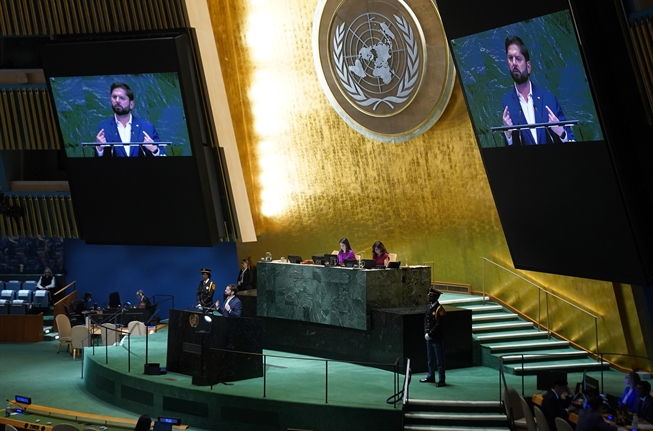
At the 80th United Nations General Assembly, the youngest president in the world, Gabriel Boric Font, delivered his speech with uncommon strength and lucidity on the international diplomatic stage. His address was not merely a presentation of political positions: it was a profound ethical claim, a call to recognize the painful reality of our time from the most fundamental human perspective. Boric, with a firm voice, insists that justice and truth must prevail and that empty words or symbolic gestures are not enough to face the global crises tearing humanity apart today.
He began by evoking the inspiring spirit of Gabriela Mistral, the Chilean poet and diplomat, recalling her message on human rights cited years ago at the UN: “I would be happy if your noble effort to achieve human rights were adopted with full loyalty by all the nations of the world. This triumph will be the greatest among those achieved in our time.” But Boric does not hesitate to state the harsh reality: “Have we truly achieved this triumph? The answer is categorical. No. And at this point, I no longer know what to say about Gaza, because many have said everything from this podium and others. But above our words, from whoever they come, resonate the dead eyes of those who, being innocent, have lost their lives. Today, in 2025, thousands of innocent human beings lose their lives simply for being Palestinian, just as 80 years ago millions lost theirs just for being Jewish.”
In this powerful statement, Boric places at the center the destroyed humanity, the tragedy that cannot be ignored—not as a distant problem but as an urgent reason to act with justice from the international community. He did not shy away from the complexity or harshness of the conflict, recognizing that “one of the problems we face as humanity is that often pain breeds hatred,” emphasizing that “we must confront it and fight it with all our strength,” and arguing the importance of “transforming the desire to hate into the desire for justice, making no concessions to violence.” Then the president said clearly and emphatically to the world: “I do not want to see Netanyahu blown to pieces by a missile alongside his family; I want to see Netanyahu and those responsible for the genocide against the Palestinian people face an international criminal court.”
This unequivocal and uncompromising sentence demands international criminal accountability—that crimes, whoever commits them, must be judged impartially and rigorously, leaving behind vengeance and the endless cycle of violence.
The Chilean president explained that the meeting at the Assembly is not just a forum but an expression of the most genuine human yearning: “One of the reasons we meet here, perhaps the main one, is that we still have faith in humanity. Our hearts cannot, we cannot allow them, to stop being moved by the pain, by the need of others like us.”
Likewise, including clear and recent direct denunciations, he called for respect for the rules we have built to protect us and fight barbarism: “For this reason, we have given ourselves rules, rules that are civilizational advances from lessons learned from the greatest tragedies humanity has faced. And those rules, let us say it from this podium and act from this instance, are not being respected today. Let us say it forcefully: it is not right to invite negotiation to a neutral country and assassinate your counterpart violating that country’s sovereignty as was done in Doha, Qatar. It is not right to bomb the nuclear facilities of a country just as it was not right yesterday to invade Iraq arguing weapons of mass destruction that did not exist (…).”
Invoking the teachings of Albert Camus, Boric warned against the ethical decay that occurs when belief in fundamental values is lost: “As the French writer Albert Camus reminded us, regarding the experience of the Second World War, if we believe in nothing, if nothing makes sense and we cannot invoke any value, then everything is permitted, there is neither good nor evil, and nothing matters. Then, if we accepted that, we would have to admit that reason is only on the side of those who succeed and the rule by which we evaluate humanity would only be efficiency, that is, the law of the strongest.”
And it was along these lines that he underscored that “ultimately, this reasoning is the justification of murder. In such a world, the life of a man, a woman, or their children will always depend on chance or on an arbitrary benevolence (or malevolence). In such a world, all those who live without condemning it with all their strength are, in a way, as homicidal as the one who drops the bomb or pulls the trigger.” This direct call to structural ethical reflection challenges the world leaders present to assume an active commitment against impunity and indifference.
In a world where false narratives abound, Boric did not hesitate to boldly expose an uncomfortable reality: “For this reason, dear friends, when we are invited to submission, when it is asserted that intelligence is unnecessary, when they want to show us, as some have done from this podium, that it is possible to lie to gain advantage, let us say no.
Boric’s challenge rang out strongly in the Assembly: “Let us not give in to cunning, nor to violence, nor to passivity. I can and must respect those who prefer the color blue to red, those who profess a faith different from mine, those who think it better to raise or lower taxes according to circumstances. Deep down, I can and must respect the diversity of opinions. But while I respect the diversity of opinion of those who think differently, I confront the insolence of those who lie, even more when that person is aware of it. For example, it has been stated, from this very podium, today, that there is no such thing as global warming. That is not an opinion, it is a lie, and lies we must fight against,” he said, in direct allusion to the President of the United States, Donald Trump, and emphasized that “we can certainly discuss the best ways to confront global warming, or who is more responsible than others, but we cannot deny it.”
He also added that “we can discuss how the Nazis came to govern a significant part of Europe, but we cannot deny the Holocaust. We can study the side effects of a vaccine, but we cannot claim without proof that vaccines cause autism.” This part, a clear reference to climate denialism and political denialist discourses—an evident allusion to Trump’s stance at the UN—stands out for its frankness and denunciation in a global forum. Boric positions truth and science as indispensable foundations for community action and effective dialogue.
Dialogue, he affirms with conviction, is the path to overcome the lies and silence that lead to “the deepest loneliness.” From this perspective, Chile puts forward an ethical and political roadmap: “So, what is our task today? To trace and walk toward the future we want as humanity and work for a United Nations that leads us on that path. From Chile, we are driven by this shared vision around democracy, human rights, social justice, equity, the unconditional respect for freedom of expression, climate action, all of which stand as pillars of hope and action to face the difficult times ahead.”
Aware of the decisive moment the planet faces, Boric also evokes responsibility in the sustainable management of natural resources, pointing to committed international ecological governance: “We cannot dedicate ourselves to exploiting resources if we do not adopt adequate conservation measures, as this results in the destruction of marine life on which we also depend. Let us not forget that we are part of one ecosystem. Sustaining life on Earth is a task we must assume urgently and responsibly: for those who preceded us, for those who today share life with us in the world, and for generations to come.”
In a gesture that unites the political with the symbolic, Boric announced the candidacy of Michelle Bachelet for the UN Secretary-Generalship. He recognized that this would mean a profound change, not only because she is a woman, but because of her ethical trajectory and political experience: “The UN must reflect the progress of the world and recognize that a woman at the helm is not only a symbol of equity but makes it a reality, that women, being half of the population, more than half of the population, can occupy all spaces in the world, and no space is barred to them. Chile wants to actively contribute to this collective effort, and therefore, it is a tremendous honor for me to announce from here that Chile will nominate our former President Michelle Bachelet Jeria as a candidate for UN Secretary-General, who is also accompanying us in this session.”
In this regard, he highlighted that “Michelle Bachelet is not only a widely known and respected figure globally. She is a woman with a deeply coherent biography with the values that inspire this organization. She has been head of state of Chile on two occasions, of course, the first woman. She was also Health and Defense minister, executive director of UN Women, and also UN High Commissioner for Human Rights. Michelle Bachelet has governed, negotiated, healed, and listened,” adding that “her life trajectory combines empathy with firmness, experience with openness, and all of this with the executive capacity to decide and act.”
He argued that “in times of fragmentation and distrust, I am convinced, and I know this is shared in my country, that Michelle Bachelet represents a figure capable of bridging north and south, east and west, the urgency of solutions and the defense of principles. With her leadership, the United Nations will regain credibility, effectiveness, and purpose in facing the challenges of our time, surely building on the legacy of António Guterres, who I know has given his best from this institution for the dignity of all humanity.”
Finally, with a hopeful call, Boric invited reflection on who will define the future: “Who will map the world of the future? We want to believe they will not be those who attack, disbelieve, and weaken multilateral institutions, those who humiliate the weakest. We want to believe they will be all the peoples of the earth together. That together, represented in this Assembly, we will delineate definitive paths so that we have a future not only possible and viable but also dignified and respectful for all people. And to achieve this, this organization, which emerged, let us remember, from the ashes of the Second World War, after the failure of the League of Nations, this organization is fundamental; and its renewal, its changes, are fundamental and urgent.”
Boric’s voice emerges as a breath of fresh air at the General Assembly, a conscience that challenges world leaders to face challenges with honesty, justice, and a will for real change. Only a young president, committed to the ideals of his generation and with a deep ethical sense, could bring this balance of courage and hope to an increasingly fractured global stage. This speech, with all its literary, political, and human force, will undoubtedly be a reference for analysis, reflection, and action in the years to come.



