

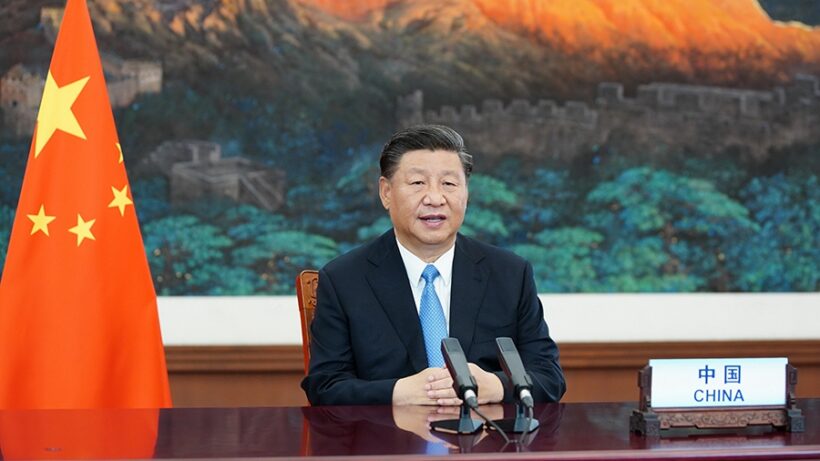
On September 24, 2025, at the United Nations headquarters in New York, a high-level climate summit was held within the framework of the General Assembly, with the participation of more than 120 countries. This summit was not a “mini summit,” but a decisive gathering to consolidate international commitments in the fight against climate change, ahead of COP30, which will take place in November in Brazil.
In this context, Chinese President Xi Jinping delivered a video address to announce his country’s new and ambitious climate plans for 2035. Xi spoke from the perspective of a nation that is not only the largest emitter of greenhouse gases, but also the global industrial hub manufacturing goods for nearly every country on the planet. For that reason, China’s management of pollution is tied to shared responsibilities, and for decades it has been driving forward an unprecedented energy transition. As the Chinese leader stated:
“The green and low-carbon transition is the trend of our time. While some countries act against it, the international community must stay focused on the right direction. In the face of doubt or denialism, we must stand firm in defending science and international cooperation.”
https://www.youtube.com/watch?v=G2cGCvQgwjg
With a firm tone, Xi pledged that China will reduce its emissions by between 7% and 10% by 2035, using as a reference the emissions peak expected between this year and 2028. He also committed to ensuring that non-fossil energy consumption represents more than 30% of the total, and to expand solar and wind capacity to 3.6 gigawatts—six times more than in 2020. “China is committed to drastically expanding renewable energy and green electrification, drivers of sustainable and resilient development,” he declared.
UN Secretary-General António Guterres praised these advances, underscoring the speed with which Beijing has surpassed its earlier clean energy targets, and the global importance of this multilateral leadership:
“Clean is competitive. China is now the superpower of green technologies, leading a fundamental transition for humanity.”
At another moment, Guterres warned that the planet is living through a critical decade and that the world must “restore trust, accelerate action, and prove that multilateral cooperation remains alive in the face of an existential crisis.”
China’s commitment comes at a pivotal moment, as other major countries face obstacles or backsliding in sustaining their climate policies. By contrast, just the day before, U.S. President Donald Trump dismissed climate urgency, labeling decarbonization goals a “scam designed to destroy jobs and national sovereignty.” With these words, Trump once again placed the United States in an openly climate-denialist stance at the very same international forum where Xi and Guterres had called for strengthening global consensus.
The comparison is unavoidable: while Washington projects doubt and polarization, Beijing seeks to present itself as guarantor of a global commitment, fully aware that its responsibility is not merely national but structural to maintaining the balance of global industry. The paradox is evident: China pollutes, but largely by producing goods consumed by the rest of the planet. That is why its climate policy represents not only a domestic interest, but also a response to global demands that redefine the very notion of common responsibility.
Thus, Chinese leadership emerges as decisive in reshaping today’s climate compact, binding together industrial development, sustainability, and planetary responsibility. All this comes on the eve of COP30 in Brazil, which must set the definitive roadmap to prevent the Paris Agreement from being eroded into unfulfilled promises.



