

Cornelius Castoriadis: 130,000 Weeks After Ancient Greece
Τhe French intellectual–philosopher, psychoanalyst, and social critic of Greek origin. An intellectual, both of international standing and ‘somewhat marginal’. This article is dedicated to Mr. David Andersson, the French-American editor of Pressenza New York (USA), and also an activist, journalist, and friend.
Cornelius Castoriadis reflected on man. And he decided that the role of each person in the social-historical is so important. Philosopher with an intellect of many carats. Genius.
Castoriadis was in awe of ideas. And ideas are what in time brought about his faith in man. He is a Greek (—French) who honors our ancestors. Where was Castoriadis’ house in Athens? How did he spend his childhood? Behind what shadow was he growing?
Castoriadis therefore lived in three cities: Constantinople (Istanbul today), Athens, and Paris. He was born in the first in 1922, grew up in Athens, and then left for France at the age of 23. In Paris he was educated and died in 1997.
Castoriadis competed from a young age and read a lot. In Athens, he studied law and philosophy. Cornelius’ house – as the author Mimika Kranaki, a friend of his youth, informs us – was located behind the Metropolis (main Cathedral) of Athens, 5 Hypatias Street. The voluminous temple will become a forerunner, years later, of his thinking against God and all religions. So, Cornelius grew up ‘in the shadow of God.’ In this house, at the age of only six, he “attempted to kill himself”, grabbing an electricity cable with wet hands… From a young age, Cornelius was interested in many areas of thought. He himself began to read early and learned how to promote thought. He was inspired by Max Weber’s work on bureaucracy and Karl Marx’s texts were read by him inside this house.
This is where he returned after school and later after the lectures of the neo-Kantian philosopher K. Despotopoulos at the university. He was also a brave young man. At the age of just 13 he lost all his hair, and his mother, Sophia Castoriadis, went insane and died a few months later. His father, Caesar Castoriadis, who made sure that he did not miss anything – there was also a phonograph in the house – is a Voltairean. Because he did not allow his son to stay up all night to complete the written punishment that the school had imposed on him, almost caused Cornelius to grab the wet cable as mentioned above.
At the same time, the loss of hair gave him strength at a very tender age. His friends now called him ‘globos’ [‘light bulb’]. In his first steps, he also saw the power that “small circles or small groups” have in the evolution of History and ideas.
The Odyssey of Castoriadis
The journey he undertook – the ‘Odyssey’ of 1945 – will be of a colossal importance! Paris with its libraries, its students, the groups that write history and the ‘biggest A’ in the world. He also read a lot. In Paris, in 1948, Castoriadis with co-founder Claude Lefort, and together with other friends/partners, created the group and the magazine, ‘Socialism or Barbarism’ (1948-65 the magazine, until ΄67 the group) for the battle of ideas – the ‘Iliad’ – and in this magazine, under various pseudonyms, Castoriadis published many theoretical texts.
At the same time, Cornelius Castoriadis also started working as a professional economist at the OECD (Organization for Economic Co-operation and Development, 1948-70), another reason for writing under various pseudonyms, such as Paul Gardan, etc. Through each line “that he composes like a musician”, is the city that strengthens his thinking. In Paris, Sigmund Freud will influence him decisively. Reading Freud, he saw clearly what was missing from Marx. That was, the human subject… Marx underestimated the importance of the individual – and the moral dimension. His work is a continuous critique, to which it can be given a critical interpretation. The two pillars of the Castoriadian creation, are: “the imaginary institution of society” and “autonomy”. Castoriadis contributed to many areas of thought.
The personal acquaintance
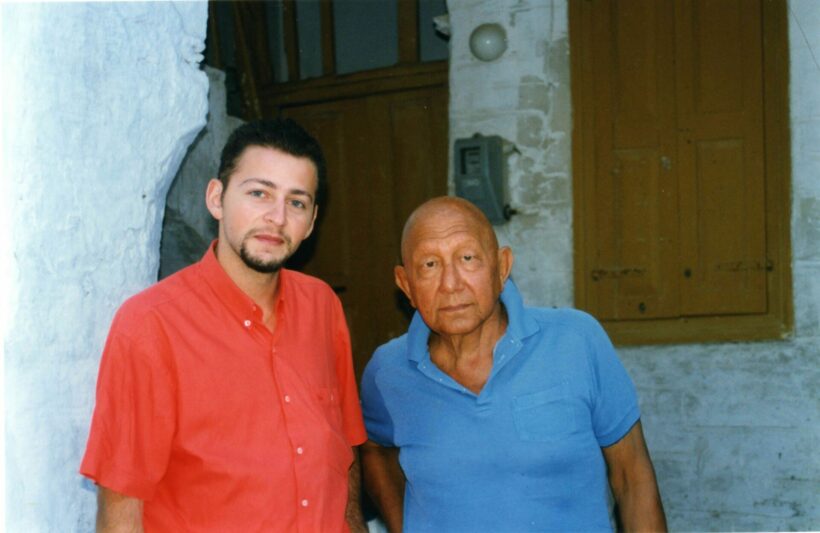
Here, let me just add that I knew him in person – we had exchanged a few letters, and I had spoken to him on the phone. I sent him the first letter when I was 18 years old, and he replied. And above all his kindness! He was extremely polite in our meetings, in his office or, when we went for a swim the other day. He radiated a light and had a sophisticated sense of humor and great wit.
With him, there was no chance not to smile or laugh at something he would say or, at a remark he would make. He was an active man, who did a lot of stuff in a single day. I saw him swimming in the Greek sea – he could easily swim from island to island in the Aegean. I have never forgotten the image of him swimming… He was also moving his hands a lot, not in the water, but mostly out of it. His thought has an experiential depth/ethos that I saw with my own eyes.
Castoriadis, who was always exuberant in expression and strong in spirit, was constantly evolving. On a personal level: Women, gambling, cigars, whiskey, the stock market and songs with a sad theme (‘moirologia’, traditional Greek laments for the dead), also play their crucial part. He had a very strong personality and because of this, his path was lonely and outside the intellectual fashions of Paris. He stood out.
Cornelius Castoriadis had a love for dialogue and for every new thought that entered his mind. He liked ideas, and he told me when we met in his office, “when a new idea comes to my mind I feel a great surprise.” Awe for ideas, and from this awe, he started and reflected on the uniqueness that every human being deserves / every human being has. The uniqueness, let’s say, of the militant Nikitaras (Greek War of Independence hero, 1821), who was shouting to the Turks: “Persians, let’s fight!” The ‘only theory’ left behind by Cornelius Castoriadis is his imprint as a Human. An imprint that marked those who mostly knew him up close.
Exuberant and powerful spirit
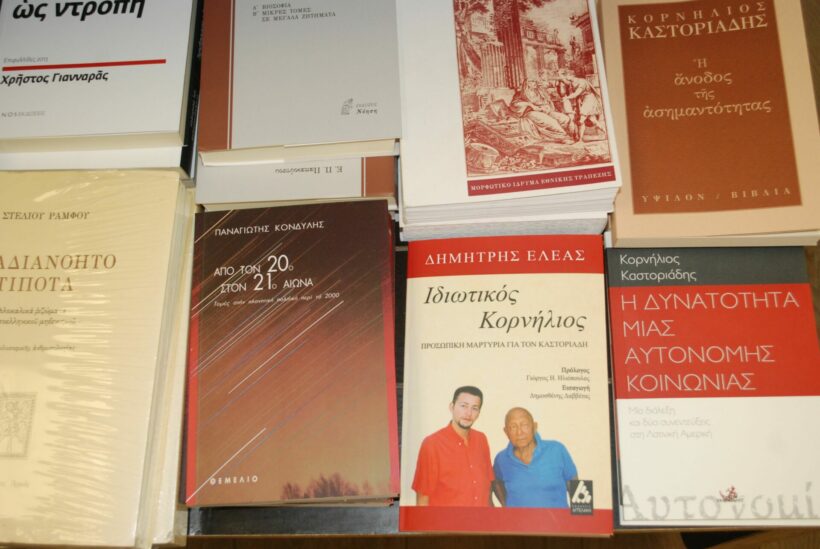
When asked how he knows that the cow appearing before them is wild, he answers in a lively voice, “but it has an expression on its face, isn’t it obvious?” (It was, apparently, the peculiar breed of cow of the Greek island of Tinos.) Thus, he impresses the listener, and imparts knowledge hand-in-hand with humor. How did I find myself in the car driven by Castoriadis himself in 1996? This is the “Personal testimony” that I developed in my humble book of 2014. The rare gift of humor that the ‘atheist Castoriadis’ had is the strong stings you receive when you read him. He had a sense of humor, as I said, and the ‘bites of humor’ make you say, “the West/Hellenism gave birth to a genius”.
The legacy of Cornelius Castoriadis is priceless. And although we are separated from ancient [classical] Greece by 130,000 weeks, Castoriadis was, “an ancient Greek in Paris” as I often say. Man dies at some point, but his ideas remain standing. I think, he will continue to inspire… just like the Parthenon.
In conclusion, the above thoughts/‘pictures’ published here, in a highly summarized form, are those delivered in a humble lecture in the Greek language (it’s the first forty minutes) that took place on Sunday, October 13, 2024 (Institute of Research and Study Thucydides, President Mr. Dimitris Trapeziotis). An ‘early manuscript’ of this speech was read by the excellent expatriate intellectual and professor, Mr. Vrasidas Karalis, in Sydney, Australia, and this fact, as well as his apt observations, honor him in particular.
Notes and ideas for further reading:
Castoriadis, Cornelius: The Imaginary Institution of Society (L’Institution Imaginaire de la Société). trans. by Kathleen Blamey. MIT Press, 1987 [In French, 1975].
Dosse, François: Castoriadis: Une Vie. La Découverte, 2014. (This is an excellent biography of Cornelius Castoriadis, published in Paris by a historian of ideas with a powerful pen.)
Castoriadis, Cornelius: Post-Script on Insignificance: Dialogues with Cornelius Castoriadis. trans. by Gabriel Rockhill/John V. Garner. Continuum Press, 2011.
Elea, Dimitris: Private Cornelius: A Personal Testimony on Castoriadis. Fwd. by Giorgos I. Iliopoulos/introd. by Demosthenes Davvetas. Angelakis Publications, 2014. (This book is in the Greek language.)



