

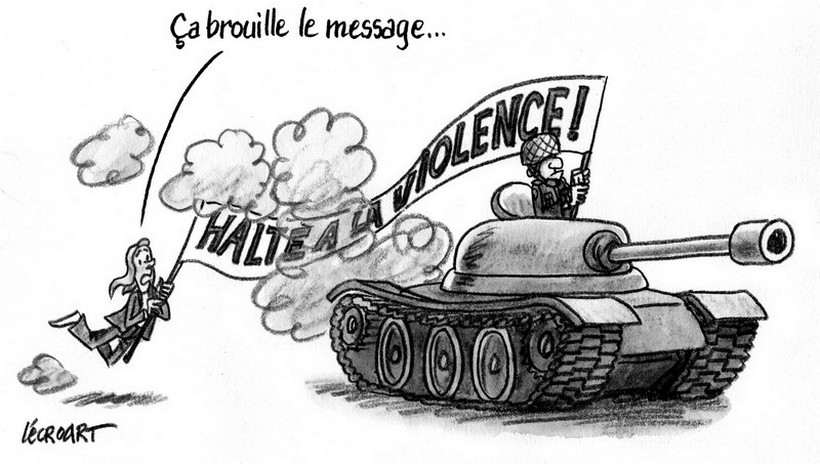
Why this special issue?
When Ukraine was invaded by Russian armies on February 24, 2022, who could fail to have been worried? A war on the very borders of Europe? Since the fall of the Berlin Wall (1989) and the breakup of the USSR, we no longer believed that this could happen. Then we quickly realised that the “special military operation” decreed by Putin was likely to last, with its deaths, injuries, destruction, etc. How can we keep our hope in the potential of nonviolence to prevent another such disaster, here or elsewhere, alive? It is legitimate to defend one’s country, but is it possible to defend it effectively without resorting to violent means and warfare? Should legitimate self-defence always take the form of violence, claimed by its perpetrators to be legitimate?
In the 1970s and 1980s, many pamphlets, and later many quality books explored the prospect of a “Civilian-Based Defence”. They based themselves on the fact that the armies of an aggressor country would quickly find themselves up against a local population that would massively apply a nonviolent defence strategy based on non-collaboration and disobedience. A common theme of the different forms of Civilian-Based Defence – those which have existed in the past or those which could come into being – is the ambition to make the whole society of an invaded country uncontrollable by the invader, who would then be unable to exploit it economically or govern it politically.
To prepare this special issue, a team from the Alternatives Non Violentes ANV periodical revisited past writings concerning the prospects for a Civilian-Based Defence (CBD), but it also considered our current perception of threats, which have evolved considerably. It then contacted authors in France and abroad to think about different aspects of a CBD. Many angles of this alternative defence are not addressed in this issue, but we believe that collectively the articles presented here offer valuable milestones for future reflection, within the European nonviolent movement, and also within institutes specialized in defence issues.
What is Civilian-Based Defence (CBD)?
Round Table
« CBD is a policy of defence against military aggression based on civil society, combining in a planned and prepared manner collective actions of non-collaboration and confrontation with the aggressor, so that the latter is rendered incapable of achieving their objectives and, in particular, is unable to establish the political regime that they seek to impose on the population. » Christian Mellon, Jean-Marie Muller and Jacques Sémelin, La dissuasion civile, Paris, Éd. FEDN, 1985, p. 35.
ANV. — What do you seek to defend? A territory, a way of life, democracy?
François Marchand. — The elaboration of a defence strategy must be based on the identified threats which it seeks to deter; these can be multiple. Civilian-Based Defence is determined firstly as a response to a threat to democracy, whether that takes the form of an occupation, or usurpation by an authoritarian power. However, I do not think that Civilian-Based Defence (CBD) should be a response to all types of threats. It does not directly correspond to today’s climate threat, but it could be a tool to deal with an authoritarian power posing a threat to the climate. Europe is concerned with the threat of occupation, the USA is not threatened with occupation by Canada or Mexico! Defensive postures will therefore vary depending on the region.
François Vaillant. — Defend what? For me, the question is one of defending the principle and the foundations of democracy, established institutions, human rights and respect for international law. In other words, freedom and justice, including the existence of the countervailing powers that society has given itself. It is also about defending our territory. If, for example, tomorrow an extreme right-wing coalition of Italians and Austrians wanted to annex French Savoy to Italy, this should first go through a negotiation that respects international law.
Alain Refalo. — I agree with François Vaillant. Civilian-Based Defence aims to defend the frontiers of democracy itself, not just a territory. Which implies an attachment to existential values, to a way of life, and to a social project. We already see the continuity between social and ecological struggles to transform society on the one hand, and the defence of society against threats to it by democratic and nonviolent means on the other.
Georges Gagnaire. — I will add a word which has not yet been mentioned, “sovereignty”. I think that the idea of defence and the attempt to define what we want to defend directly concern sovereignty…
Cécile Dubernet. — The question of sovereignty was thought of in the 19th and 20th centuries only at the level of the State. Today, discussions of sovereignty emphasize the importance of free will and the extent to which each person is free to be autonomous in words and actions. CBD is first about giving citizens the tools to be able to think and act at their level, and therefore to reflect for themselves on what they collectively want to defend. More autonomous and therefore more responsible.
Text in the drawing: It is this border in particular that must be defended. DEMOCRACY | DICTATORSHIP
Georges Gagnaire. — You are right. To paraphrase Louis Le Fur[1], a French jurist who died in 1943, our sovereignty is the “quality of being obliged or determined only by our own will”. Sovereignty in this sense is manifested in our choice of our affiliations which, rooted in our personal convictions and made manifest in the complex web of our commitments, goes all the way up to the vast collective entities that might be the State, Europe, humanity, all living things…
These nested sovereignties correspond very well to my own conception of a CBD, set against the background of preparation for and commitment to non-collaboration, resistance, civil disobedience, conscientious objection.
One of the questions that we have to answer personally and collectively is: to defend ourselves, what do we consider to be “forced on us or determined by our own free will” when it comes to defending ourselves, defending a territory, a democracy, human rights.
ANV. — For you, is a Civilian-Based Defence (CBD) complementary to military defence?
François Marchand. — In 2024, yes! If one is to be at credible at present, I do not think that we can propose a CBD as the only means of defence in France, or even in Europe.
Georges Gagnaire. — Your answer, François Marchand, implies that there is a need for both, a military and a Civil defence. This is not a position shared by the nonviolent movement as a whole or by antimilitarists! Your pragmatism reminds me of what we called 40 years ago transarmament, the idea that the practical realization of the CBD would be accompanied by a transition phase where the two means of defence would coexist, or even complement each other…
Cécile Dubernet. — Yes, I think that military and civil defence can be deployed jointly, as the Ukrainians have shown us. In many countries, the concept of defence is played out at different levels, particularly at different territorial levels, with the involvement of military and civil actors. This is not the case in France. This is a reflection of our hyper-centralist and vertical political culture.
Alain Refalo. — At an operational level, I do not believe in the complementarity of the two systems of defence. I consider that military defence belongs to the past; it is no longer relevant because it fuels instrumental and technological warfare that causes immense human tragedies and disproportionate destruction. However, it is illusory to think that CBD will establish itself in the coming years as an alternative in our country. At best, the State can integrate elements of CBD into its overall defence strategy, but this will remain limited. Thus, in theory, CBD seems to me to be the best defence system against an occupation or a coup d’état or other threats. This is why I believe that we must think of it as being an alternative and begin to implement it at a grassroots level, within civil society, without waiting for a hypothetical investment from the State.
François Vaillant. — In the event of a nuclear explosion, I do not see how a CBD could be useful. Faced with occupation by a foreign army of one or more regions of France, the first thing I would want is for the armies to remain in their barracks. I believe that a people who know how to occupy the street as part of their social and ecological struggles will also know how to mobilize against an invader. Stop war and its spiral of violence! We see the effects of this infernal spiral in Ukraine: a human disaster, an ecological, societal and psychological catastrophe amongst the population. We do not yet fully appreciate the state Ukraine is already in[2]. I do not want such a disaster at home. An occupied country is not a defeated country.
ANV. — How can CBD be a deterrent against the threats you identify?
François Marchand. —CBD has a huge advantage over nuclear deterrence, which is that if civil deterrence fails, it’s not all over: we can enter into nonviolent civil resistance even after the hypothetical failure of such deterrence. What makes Civilian-Based Defence different from a classic civil resistance is that it will have been the subject of preparation (or anticipation): awareness-raising, mobilization, training, organization, manoeuvres, etc. It is in this preparation that lies the deterrent capacity of NVDC. The foremost quality of a NVDC lies in its deterrent force, as indicated in La Dissuasion Civile (1985)[3]. But since such a NVDC has never been implemented in practice, how can we prove its deterrent effectiveness? Civil resistance movements have shown their effectiveness in many areas, but have not demonstrated their deterrent capacity since they have proven their effectiveness when hostilities had already begun. However, two cases analysed in two articles in issue 213 of ANV (Kosovo 1990-1997) and the Baltic States (1990-2000) are concrete examples and, in both cases, there was indeed a deterrent effect in the face of the risk of military occupation. That said, this is not definitive proof of the deterrent effect of a CBD; in fact, nothing is ever definitive in matters of defence and strategy.
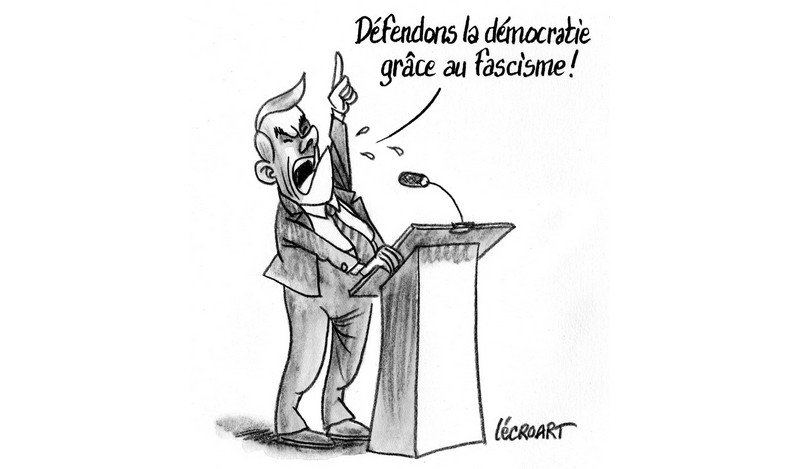
Text in the drawing: Let’s defend democracy through fascism!
François Vaillant. — The first threat I identify already is that of cyber-attacks against institutions, hospitals, businesses… Countries like Russia and China cannot tolerate the fact that freedom and democratic principles are honoured in our country. These totalitarian regimes are rightly afraid that such principles might destabilize their oligarchies which rely on the absence of freedom. This is why these states are seeking to destabilize us at home and in Europe, by wreaking havoc from an ideological and societal point of view. Secondly, the other threat I see is the far-right European bloc that is stirring up fear about migration, fear of the other… How can this aspect be integrated into a CBD when the French population itself is divided on this subject?
Alain Refalo. — The deterrent dimension of a CBD depends on its feasibility and therefore on the preparation for CBD. We are far from having the required preparedness, which is why I think it is pointless to discuss this point, even if in principle I strongly believe that the preparation of a CBD can have a deterrent effect, particularly in the face of threats of territorial occupation. But in today’s world threats are numerous and diverse, and no longer hypothetical as they were during the Cold War. Starting today already, forms of civil resistance can be organized to thwart cyber threats, to counter attempts at ideological influence, to resist threats of attacks, but also to fight against “internal” threats: the authoritarianism of those in power, police repression, the rise of the extreme right, conspiracy theories, discrimination and social injustices that undermine our living together.
Georges Gagnaire. — In relation to cyber threats, one of the major benefits of CBD is, precisely, its contribution in building a civil society that is resilient in its use of IT, in its means of communication, production and storage of information. I believe that there is truly a huge field where we can already prepare society to be resilient in relation to pernicious influences, whether internal or external[4]. Promoting a free press, accessible to all and sourced, remains imperative, as does education in citizenship at all ages. It is also essential to be vigilant about all mass surveillance processes. In terms of profiling, tracking, profiling, I think that the less intrusive our use of social networks is, the less likely our society will be to bow to an enemy, whether internal or external.
François Marchand. — The example of a free press that you just mentioned is indeed part of Civilian-based defence, but calls for other measures, such as the decentralization of the means of electricity production and the decentralization of its distribution circuits. I am also thinking of teachers who would refuse to apply a program imposed by a far-right government… The fear of giving too much power to civilians who want to defend themselves is probably one of the biggest institutional obstacles to setting up a non-violent civil defence in a country like France.
Cécile Dubernet. — Today’s exchange makes several important things clear for CBD today: on the one hand, that the notions of territory and occupation must be updated because new areas needing to be defended are emerging, in particular the virtual fields of data protection and the protection of personal reputations, the area of state services, or the integrity of the media, of judicial processes, etc. These areas are different, but they are all targeted by cyber-attacks. Bear in mind that the attackers work in networks according to a mixture of commercial, ideological, and state interests. We must analyse these actors who in today’s world are capable of targeting, harassing, silencing, and sometimes killing Russian, Chinese, or Kurdish political refugees in the West. Basically, what we see here is an old struggle for control not only of territories and physical bodies but especially of minds: freedom of movement in the French public space, freedom of conscience, of speech, etc. What is at stake here is the freedom to think and act. How do we defend education in the media, history, art, in short, all areas of contradictory debate in a CBD?
Georges Gagnaire. — This goes back to my question about sovereignty: where do we place sovereignty? The more we lower it to the level of the citizen, the more we will enter areas feared by the powers that be… A CBD is conducive to making people responsible, including in their daily actions and their professional lives. CBD implies a strong, responsible, rebellious civil society, and of course all of this scares political leaders who since this leads to their losing control.
ANV. — Today, what factors are likely to promote the implementation of a CBD or to prevent it?
Alain Refalo. — In my opinion, the main obstacle is cultural. Our history and our traditions lead us to believe that the defence of the nation can only be military, despite the failures of our army over the last few decades. In my opinion, the most important thing for promoting the establishment of a CBD lies in civil society movements that invest in nonviolent resistance in today’s struggles. There is a need to popularize the concept of “civil resistance”, to show its relevance and its effectiveness. The cultural battle is therefore a decisive one. Nonviolent movements cannot take on this task alone, but it is important that they begin the work by expanding their sphere of influence to associations, unions, and all the country’s vital forces. I see a continuum between nonviolent struggle, civil resistance, and nonviolent social and civil defence.
François Marchand. — I have worked on the feasibility of a CBD and, to simplify, one of my conclusions is that it can be implemented from the top down or from the bottom up. In other words, it can happen through State initiatives and through a State administration – as happened in Lithuania from 1990 onwards; or it can emerge from below thanks to a popular movement that itself takes power, or sets up a counter-power to the official government, as happened in Kosovo in the years 1990-1997. The two approaches are very different, but not contradictory. They can be considered simultaneously or jointly, or even in complementary forms. In any case, the feasibility of a CBD remains very difficult and I identify at least three conditions for it to be feasible:
- Strong popular support for and belief in the credibility of nonviolent civil resistance.
- The absence or lack of available weapons. The fact of having few or no weapons, or that they are not very efficient, is a spur to look for something else.
- The feasibility of a CBD depends on the perceived level of threats.
Cécile Dubernet. — As for the feelings of a population, we now have many studies that show to what extent the construction of the perception of an enemy and of threats is a classic governmental activity, and who quickly things can change. Fear is easily stoked up, often because it allows control of the masses. This is, in my opinion, an aspect that must be deconstructed, in the first instance by being aware of it.
François Vaillant. — The expression “Civilian-based defence” is in my opinion frankly ambiguous on a semantic level. It has been used in France since 1975[5] with a plethora of sometimes antagonistic ways: for research with or without public funding; in terms of its compatibility or otherwise with links to the state apparatus; as being or not being complementary to military defence; as being part of a political project for society as a whole, etc. There are therefore different forms of Civilian-based defence and I fear that we have taken little account of them since the publication of Dissuasion Civile. We always refer to the same operational thought patterns contained in that book. In consequence, I personally take a dissident position from the orthodoxies of Dissuasion Civile, which dates back 40 years!
The CBD proposed in Dissuasion Civile seems to me today to correspond to a completely unrealistic ideal, at least in two respects:
- What government, whether of the left or of the right, would agree to finance studies to train civil servants and other employees in civil disobedience, boycotts, non-collaboration, generalized strikes, etc., knowing that this could one day turn against it in the event of a major conflict?
- CBD is conceived in Dissuasion Civile as a complement to armed defence. Wouldn’t the warlike actions involved in an armed defence firstly thwart the effectiveness of nonviolent civil resistance, and secondly constitute a denial of the intrinsic link between ends and means, a nonviolent principle based on both ethics and efficiency?
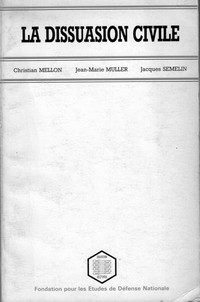
CBD as proposed in Dissuasion Civile is prepared for and anticipated by the State. This may be an ideal, but it not one I adhere to at all. The idea of relying on the State to implement a CBD is repellent to me when I consider the State’s inability to act in peacetime in crucial areas: the gradual abandonment of public services, particularly in rural areas, the reform of the health system that is running out of steam, etc. I put much more faith in a CBD organized spontaneously, as was the case in August 68 in Czechoslovakia. Nowadays, the mobilization for the climate, the “yellow jackets” movement, the protests against pension reform, against the Barnier government, etc. clearly show that we are a people capable of rebelling, of getting organized ourselves quickly according to our sensibilities, of inventing nonviolent mass actions, of thwarting repression, etc.
Georges Gagnaire. — We must also think about what has been designated as an “internal enemy”. In a France that voted massively but not overwhelmingly for the far right in the 2024 legislative elections, where is the scope for citizens to react to this? The majority of citizens must be convinced of an approach in favour of a CBD, must be convinced that they can commit to it – we are in a position of great weakness. I currently sense significant support for many themes of the far right, not only in France, but also in Europe. It is not with ideas such as these that we will be able to build a CBD like the one we hope for and are describing here!
François Marchand. — This is a key question! We must go beyond the current stage of thinking which is limited to civil support for the military, for the morale of the rear! The “spirit of defence” is a concept dear to our military since the 70s; there is even a Ministry of Defence newspaper called the Spirit of Defence. When you read it, it talks a lot about civil support for the military. Our first objective should be to make people understand that defence is also a civil matter, by which we do not mean that civilians should use the weapons of the military, but that they should use civil weapons, such as civil resistance, which is what the military does not do.
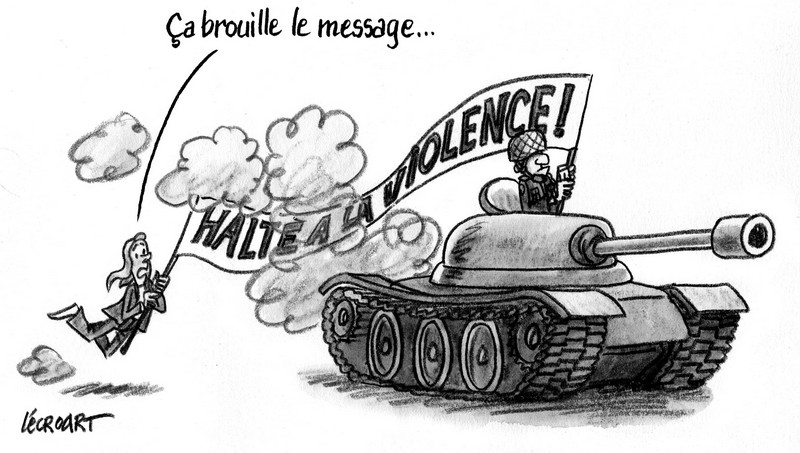
Text in the drawing: It confuses the message… STOP VIOLENCE
François Vaillant. — I disapprove of the militarization of society imposed by our right-wing and left-wing leaders. They can always explain to us that a CBD could endow civilians with a spirit of defence, I do not agree with this vision at all. I prefer to speak here and elsewhere of the spirit of combativeness, such as that manifested for example in ecological and social struggles where we fight for a project of a peaceful society, based on justice and the common good of the nation. I note in passing that the demonstrators of these struggles do not sing La Marseillaise, this war song which begins with “To arms citizens”! Let the tune of La Marseillaise be kept, but let it be sung with words of peace and universal fraternity, that would correspond better to the spirit of a CBD!
François Marchand. — The function given to civilians in the case of the spirit of defence as seen by the military, and the of the spirit of defence seen through the lens of civil resistance are not the same. We want proactive and responsible civilians. The interview with General Kempf[6]in this issue of ANV on cyberspace and cyberthreats focuses on the role of civilians, as victims of threats and actors in defence. He speaks of the fact that we are poorly trained and not attentive enough to all these threats surrounding us. On the other hand, he is sceptical of the possibility of deterrence in cybernetic matters.
Georges Gagnaire. — I would like to say that CBD is a matter for civilians to be conducted by civilians in a civil way!
Cécile Dubernet. — I wonder if we could not talk more about the responsibility of civilians for “human security,” a concept developed at the UN over the past 30 years. It has allowed many countries to address the issue of security in a broader sense than just political and military security, by highlighting its economic, societal and environmental dimensions, but also to rethink security in a subsidiary way, by refocusing on civil communities and collectives. In France, the concept is not widely used. I think that’s a shame. It would broaden our horizons.
Alain Refalo. — Civilian-based defence essentially relies on civilians. But for civilians to take their place in defence matters, they still need to demilitarize their minds! However, we are in a phase of widespread militarization of society, without this leading to strong resistance! The work of awareness-raising remains essential, but we need to find powerful support both to demilitarize society and to civilize defence. Here too, it is a cultural battle.
ANV. — France is a member of NATO. Is this situation compatible with a CBD in France and in Europe?
François Marchand. —I don’t know. I would like to say “no”, NATO and CBD are not compatible. In the two cases of civil defence that I studied, the Baltic countries and Kosovo, NATO’s arrival in the game led to the disappearance of everything which civil defence had achieved[7].
François Vaillant. — Isn’t being a member of NATO first and foremost a means to bring us under the influence of the US military-industrial complex? France, from de Gaulle to Macron, has tried to have its own arms industry, with a certain success, but one question remains: how can we envisage an independent European defence without being dependent on the US military-industrial complex constantly promoted by NATO?
Cécile Dubernet. — I think that there is more critical reflection in the United States on their military-industrial complex than we have in France on ours!
Georges Gagnaire. — Relying on NATO for a European defence is incompatible with our idea of CBD. The question NATO raises for me is: to whom and to what does NATO obey? I am not certain that civil society has its say. On the other hand, the construction of a transnational CBD seems to me to be a good idea at the European level.
Alain Refalo. — I completely agree with you, Georges. NATO, which should no longer exist due to the disappearance of the Soviet threat in the early 1990s, plays a harmful role in international relations and in the defence of Europe, in my opinion. NATO is becoming increasingly involved in the Ukrainian conflict, thus providing Russia with grounds for continuing the escalation that could lead to a generalized confrontation. CBD must necessarily be part of another European framework, more specifically in a project of common security and demilitarization of Europe[8].
François Marchand. — The issue of defence will remain a nationalist affair, that is to say that each country will want to control its defence and not rely on a supranational command. Even the three Baltic countries in 1995 refused the Lithuanian proposal to organize a Civilian-based defence with the Latvians and Estonians. It is difficult for a country to entrust its defence to a supranational element, including in Europe.
Georges Gagnaire. — There are also tools that we have not mentioned: everything that is related to justice and international, even global, diplomacy.
François Marchand. — It’s interesting, because this same debate ten years ago – before the Russian aggression in Ukraine – would not have generated the same interest in CBD. I was saying earlier that one of the conditions for a NVDC is concern in relation to the feeling of being threatened – today, there is such a concern.
ANV thanks Clara Lebreton for hosting this round table and transcribing it.
Notes
[1] Louis le Fur, État fédéral et confédération d’états, Marchal et Billard éditeurs (1896) p. 443
[2] See the article on Ukraine in pp92-97 of issue n° 213 of ANV [Editor’s Note]
[3] La dissuasion civile, Paris, Éd. FEDN, 1985
[4] See in issue n° 213 of ANV, the article on cyberpeace, pp. 98-101 [Editor’s note]
[5] Date at which this expression was first used in France, in the collective volume Armée ou défense civile non-violente ? Éd. Combat Non-Violent, 1975, reedited en 1981, 102 p. [Editor’s Note]
[6] Issue 213
[7] See however the article by Amber French evoking the words of a senior NATO officer who integrates civil resistance into his global defence strategies, ANV nr 213 pp 22-25 [Editor’s note]
[8] See in n° 213 of ANV the article by Bernard Dréano, pp. 69-73 [Editor’s Note]
The Authors
Cécile Dubernet is a lecturer and researcher at the Institut catholique de Paris (Catholic Institute of Paris) and a Fellow of the Convergence Migration Institute.
Georges Gagnaire is an activist in MAN St Étienne, a volunteer trainer at Ifman Co, and a member of the ANV Editorial Board.
François Marchand co-founded the IRNC (Institut de Recherche sur la Résolution Non-Violente des Conflits) in 1983; he is an administrator on the Board of Nonviolent Peaceforce, and a member of the French Committee for Civilian Intervention for Peace.
Alain Refalo is a teacher, a founding member of the Centre de Ressources sur la non-violence, and a member of the IRNC.
François Vaillant is the editor-in-chief of Alternatives Non-Violentes.
Translated by Marc Morgan
This article is part of the dossier on Civilian-Based Defence (CBD), issue 213 (special edition), December 2024, of the journal Alternatives non-violentes.
Articles from the dossier “Civilian-Based Defence (CBD)” published by Pressenza in French, German and English.



