
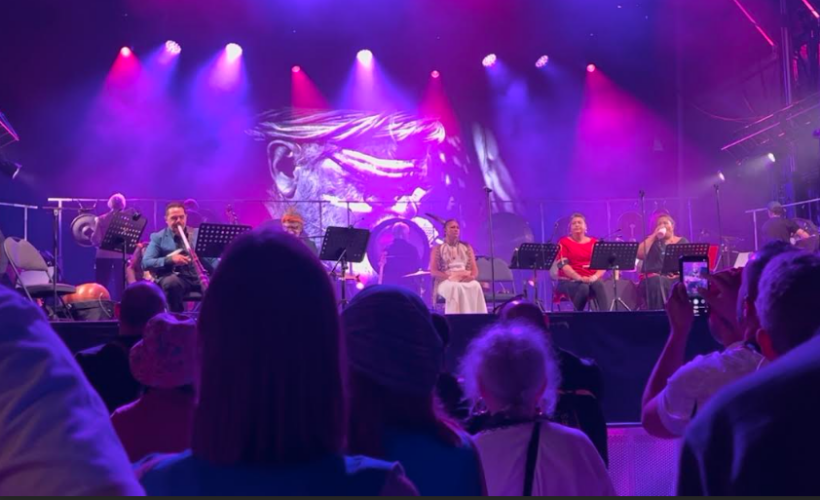
Centered on the theme of the ocean and whales, spiritual beings in many traditions, this project is both a celebration and a call to action, explains the Oktoecho group. This show offers a sensory journey celebrating the symbolic power of the whale, while raising awareness of the need to preserve marine ecosystems.
The Oktoecho musical collective, in collaboration with the Australian group Corrina Bonshek & Collaborators, created the show Song to the Whales/Chant de la baleine, an international artistic project that unites Inuit, Maori, Aboriginal, and non-Aboriginal voices around a universal message: the protection of the oceans.
This collective and intercultural performance is inspired by traditional songs and Indigenous stories from Canada, New Zealand, and Australia. This immersive show blends contemporary music, ancestral chants, and the sounds of nature.
Co-directed by Australian composer Corrina Bonshek and Montreal composer Katia Makdissi-Warren, artistic director of Oktoecho, the work brings together several artists:
Whaia Sonic Weaver, Maori singer
Uncle Bunna Lawrie, Indigenous singer and activist
Nina Segalowitz and Lydia Etok, Inuit throat singers and co-artistic directors of Oktoecho
They are accompanied by musicians from three continents, including Greta Kelly, Étienne Lafrance, Bertil Schulrabe, Michael Askill, and Jason Lee Scott.
The collective creation project began in Montreal as part of the International First Peoples Festival. Several performances are planned in North America and Australia.
Song to the Whales: August 15 and 16, 2025, at 7:30 p.m., Niagara Parks
Song to the Whales: September 2025, New York City
Australian tour in October 2026
Inuit throat singing
The Inuit live in the North of Quebec in Canada. Inuit throat singing, or katajjaq (Inuktitut: ᑲᑕᔾᔭᖅ), is a distinct type of throat singing uniquely found among the Inuit. It is a form of musical performance, traditionally consisting of two women who sing duets in a close face-to-face formation with no instrumental accompaniment, in an entertaining contest to see who can outlast the other; however, one of the genre’s most famous practitioners, Tanya Tagaq, performs as a solo artist.
Originally, katajjaq was a form of entertainment among Inuit women while men were away on hunting trips, and it was regarded more as a type of vocal or breathing game in the Inuit culture rather than a form of music. Katajjiniq sound can create an impression of rhythmic and harmonious painting. Inuit throat singing can also imitate wind, water, animal sounds and other everyday sounds.
The environment in which Inuit lived inspired a mythology filled with adventure tales of whale and walrus hunts. Long winter months of waiting for caribou herds or sitting near breathing holes hunting seals gave birth to stories of the mysterious and sudden appearance of ghosts and fantastic creatures. Some Inuit looked into the aurora borealis, or northern lights, to find images of their family and friends dancing in the next life.