

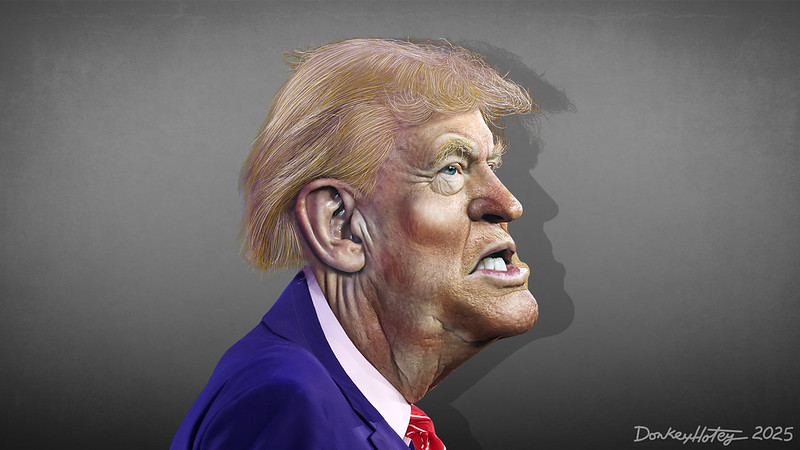
Liberals have turned Donald Trump into a moral scapegoat—fixating on his every word as a way to avoid confronting their own complicity in systemic failures, and distracting themselves from the harder task of articulating a compelling political alternative.
In the cultural psyche of 21st-century America, Donald J. Trump occupies a symbolic role that far surpasses his actual political achievements or capacities. For many liberals—particularly those embedded in the media, academia, and the professional-managerial class—Trump is not merely a political adversary, but the embodiment of civilizational decline. His vulgarity, ignorance, racism, sexism, and authoritarian impulses are seen as a direct repudiation of Enlightenment rationalism, liberal democracy, and the moral arc of progress.
Yet in this fervent denunciation lies a paradox: Trump has become essential to the liberal imagination, not as an object of genuine political reckoning, but as a totem onto which vast reservoirs of liberal guilt and ambivalence are projected. He is, in effect, a lightning rod—absorbing the psychic charge of unresolved contradictions within the liberal-globalist worldview, offering catharsis through condemnation, and allowing many to say, with comforting self-assurance, “at least I am not that.”
Projection and the Crisis of Liberal Self-Understanding
In his 1967 work Alchemical Studies, Vol. 13, psychologist Carl Jung wrote, “One does not become enlightened by imagining figures of light, but by making the darkness conscious. The latter procedure, however, is disagreeable and therefore not popular.” He observed that individuals project their repressed “shadows” onto others by attributing their own unacceptable or unacknowledged traits—both positive and negative—onto people or groups in their environment. He characterized this behavior as a defense mechanism to avoid confronting one’s own unacceptable or negative traits.
In the case of Trump, American liberalism appears to be engaging in Jung’s shadow projection. The liberal establishment—elite universities, legacy media institutions, and centrist political organs—has, since 2016, devoted an astonishing amount of intellectual and emotional energy to analyzing, mocking, deconstructing, and “resisting” Trump. While some of this is undoubtedly justified, the sheer scale and obsessiveness of the focus raise a deeper question: What work is Trump doing for liberalism?
The answer lies in displacement. Trump serves as an externalized repository for the very qualities that liberal America wishes to distance itself from—crassness, racial animus, anti-intellectualism, misogyny, populist demagoguery. But many of these forces, though disavowed, are not foreign to the liberal tradition. The exploitation of racial minorities, the expansion of the surveillance state, militarism abroad, and economic policies that hollowed out the working class were not the exclusive legacy of conservative regimes. One need only examine the triangulating politics of the Clinton era—the 1994 Crime Bill, the 1996 Welfare Reform Act, NAFTA—as evidence that the neoliberal consensus, embraced by both parties, laid much of the groundwork for the resentment that Trump so effectively exploited.
By projecting these uncomfortable truths onto a single grotesque figure, liberals absolve themselves. The moral horror of Trump’s behavior becomes a mirror turned outward, rather than inward. It is easier to decry his lack of decorum than to ask why tens of millions of Americans remain unconvinced by liberal alternatives. It is easier to mock his tweets than to confront the failures of a media landscape that amplifies his every word. In this way, Trump serves not only as antagonist but as absolver—a scapegoat in the full, almost biblical, mythological sense.
The Function of the Villain in the Liberal Cosmology
Throughout history, political movements have often relied on the figure of a villain to unify disparate factions and preserve ideological coherence. After the French Revolution, Robespierre invoked foreign enemies and internal traitors to justify the Terror. During the Cold War, American liberalism defined itself in opposition to communism—its values shaped largely by contrast. The problem, of course, is that over-reliance on an antagonist tends to ossify ideological thinking. When the opposition becomes the center of gravity, one’s own vision begins to hollow out.
This is precisely the trap into which the liberal intelligentsia has fallen. In casting Trump as the embodiment—and even the source—of all that is wicked, they have reduced politics to a morality play. The left becomes the righteous, Trump the villain, and complexity, nuance, and historical continuity are lost. Yet, as thinkers like Hannah Arendt, Iris Murdoch, and Susan Sontag have warned, moralism without self-examination easily slips into narcissism. Condemnation becomes performative rather than transformative. In her 1970 book The Sovereignty of Good, Murdoch argued that without continuous attention to others and reality, morality becomes self‑centered fantasy. This problematic state, characterized by an individual imposing their own illusions onto others rather than perceiving them accurately, is what she referred to as the dominance of the “fat relentless ego.”
Nowhere is this dynamic more visible than in liberal media and academic discourse. Entire news cycles, think pieces, classroom debates, and Twitter threads revolve around parsing Trump’s latest gaffe or provocation. This fixation is not just disproportionate—it’s strategically self-defeating. The left has failed to articulate a coherent political vision that addresses the material concerns of broad swaths of the electorate. Critical issues—deindustrialization, the opioid crisis, the decline of organized labor, the collapse of rural infrastructure, and the degradation of the planetary ecosystem—are routinely drowned out by culture war narratives that cater to the anxieties of coastal elites while alienating the very constituencies needed for electoral victory.
Trump as Distraction From Political Imagination
“President Trump is not governing, he’s gaslighting. The chaos and calamity we’ve witnessed over the last several weeks are not incidental. It is coordinated,” said NAACP president Derrick Johnson. “From stirring up conflict in Iran to unlawfully deploying the National Guard in California, from the inhumane mass immigrant arrests to a taxpayer-funded military parade and the continued attacks on diversity, equity, and inclusion, this president is seeking to distract from the real issue: the passage of one of the worst budgets we’ve ever seen. One that would lay siege to working families,” he said, calling out Trump’s “authoritarian tactics as a smokescreen to disenfranchise the American people through legislation.”
In classical Athenian tragedy, the scapegoat—or pharmakos—was a symbolic embodiment of the community’s impurities and misfortunes. This person was ritually expelled or killed to cleanse the community of its sins and eliminate the source of its misfortunes. For the liberal order, Trump serves a similar symbolic function. His outrageousness allows liberals to avoid confronting their own impotence, their complicity in sustaining systems of inequality, and their decades-long estrangement from the working class. The spectacle of Trump permits a form of political theater in which virtue is signaled rather than practiced, ripe for exposure by Socratic irony.
More insidiously, the obsession with Trump has crowded out the space necessary for genuine political imagination. The Democratic Party’s policy platform remains tepid, technocratic, and fundamentally reactive. There is little in the way of a galvanizing narrative—no Green New Deal at the center of public discourse, no universal healthcare movement with mass mobilization, no concrete plan for economic democratization. Instead, the prevailing message has often amounted to little more than: “We are not Trump.” While this may deliver narrow electoral wins, it falls far short of offering a compelling vision for the future.
The consequences are already apparent. In 2020, Biden’s campaign was largely framed as a restoration of normalcy. Yet “normal” was precisely what produced the conditions for Trumpism to thrive. The current political landscape is a vacuum waiting to be filled—not by moderate managerialism that characterized the Obama and Biden administrations but by the next ghastly iteration of populist authoritarianism. If liberals do not fill that vacuum with something substantive, someone worse than Trump almost certainly will.
Trump as Rorschach: From Catharsis to Accountability
Donald Trump is not merely a political figure; he functions as a psychological mechanism—a Rorschach test for a liberal class uneasy with its own legacy and uncertain future. To see Trump only as a cause, rather than a symptom, is to misdiagnose the American condition. He is not the disease, but the fever—the body politic’s signal that something deeper is amiss.
Liberal guilt—over class privilege, institutional failure, racial injustice, global inequality, overconsumption, and ecological collapse—cannot be absolved through performative condemnation. It demands honest reckoning and structural change.
“Trumpism has become a worldview unto itself,” said Pete Buttigieg in a recent NPR interview. “But we do have to look at what we’re doing that makes it hard to hear what we have to say.” Indeed, to move beyond Trumpism, liberals must turn inward, relinquish the catharsis of moral superiority, and commit to the harder task of building a world in which figures like Trump are not just offensive but irrelevant. Until then, Trump will remain what he has become: the mirror liberals refuse to face.



