

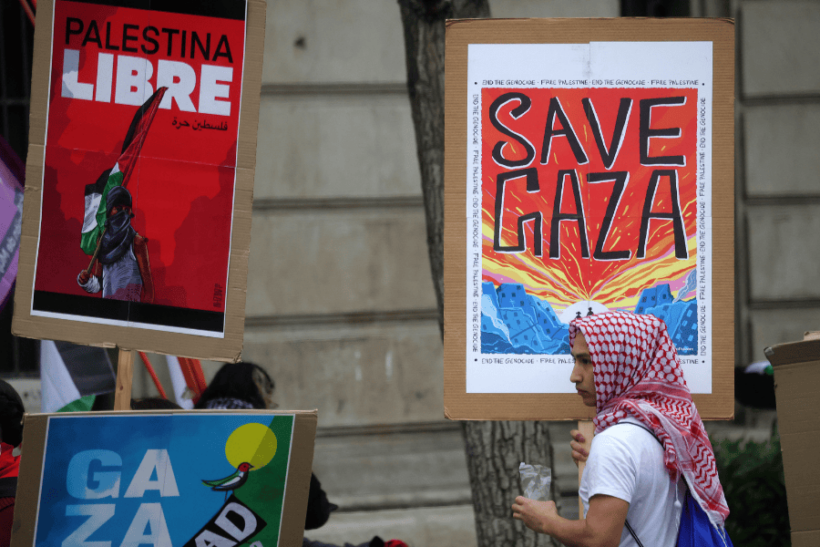
There are ruins that are not only the end of a building but also the beginning of a new era. At this historical moment, the smoking ruins of Gaza are not evidence of a war but the epitaph of the international architecture of human rights as we knew it. The distinction is vital, and we must be clear from the outset: there are not two armies facing each other, nor two states with the same belligerent status. What exists is an oppressed people, and the resistance that legitimately rose against oppression.
For more than half a century, humanity clung to the fiction that it had created a legal and moral scaffolding robust enough to contain the impulse toward barbarism. A network of treaties, institutions, and norms that, even in the heat of conflict, compelled states to recognize inviolable limits: the Geneva Conventions, the mandates of special rapporteurs, humanitarian corridors, the immunity of journalists and medical personnel. It was an imperfect system, cracked from its inception, but sustained by the shared belief that there was an untouchable core. Gaza has stripped us of that belief, demonstrating that this scaffolding did not collapse due to a single violation but has been systematically and deliberately demolished. What remains is not a damaged version of the system, but its empty shell, and our task, as witnesses, is to document its collapse and name those who perpetrated it.
The scaffolding of freedom and the precept of resistance
The edifice of human rights was never an impenetrable fortress. It was born with structural cracks, such as the disproportionate power of the victors of World War II and the veto in the Security Council. As political scientist Ian Hurd (2017) has analyzed, the paralysis of the Council is the deepest crack, a mechanism that allows powerful states to evade their collective responsibility. Yet its functionality rested on three operational pillars that, for decades, managed to preserve an appearance of order:
Codified norms: A legal body defining what is intolerable, from genocide to war crimes.
Verification mechanisms: Instruments such as UN missions, the work of NGOs, and above all, the presence of international journalism that documented and made horror visible.
Minimal protection pacts: Operational agreements that guaranteed inviolable zones in the midst of conflict, such as hospitals, shelters, and humanitarian corridors.
The ethical and legal foundation of this scaffolding, however, lies in a point often forgotten. The preamble to the Universal Declaration of Human Rights states clearly: it is considered “essential, if man is not to be compelled to have recourse, as a last resort, to rebellion against tyranny and oppression, that human rights should be protected by the rule of law.” This precept not only legitimizes the defense of an oppressed people but also places the responsibility to protect them upon the international community.
Demolition in real time
Gaza has been the stage where these three pillars have been toppled simultaneously and without pretense. This is not a simple case of non-compliance, but of the annulment of the very function of the architecture. The treaties remain written on paper, but they are dead letters in the face of veto power that neutralizes them before they can have real consequences. Security Council resolutions, blocked by the United States and the United Kingdom, have been reduced to toothless communiqués while the war machine continues. Verification — the fundamental mechanism for accountability — has been dismantled with cruelty: the UN and its personnel are targets, and journalists, far from being protected witnesses, have become military targets.
As Nick Turse documented in his essay News Graveyards, “every murdered journalist is one fewer observer of the human condition” (Turse, 2023, p. 1), in an analysis examining the global erosion of press freedom. What Turse describes as a global phenomenon has reached in Gaza the dimension of an extermination policy. The physical elimination of those who record and narrate has become a strategy to control the narrative. International humanitarian law, conceived as a brake, has proven to be an empty shell that could not protect more than 220 journalists killed in the last ten months, most of them local correspondents who were the last line of defense for the truth. Four journalists and two new colleagues from Al Jazeera have lain buried for 48 hours. It is always horrible to think about this, and even more so to write it.
The last broken pact: safe zones as deadly traps
If there is a palpable symbol of this collapse, it is the destruction of the concept of a “safe zone.” This was, perhaps, the last operational pact that worked. The idea that, even in the midst of conflict, there were sanctuaries where civilians, medical personnel, and reporters could take refuge. Gaza has erased that consensus in the most brutal way possible. Attacks on hospitals, UN shelters, schools, and food distribution centers are not “operational errors” or “collateral damage”; they are, as demonstrated by the meticulous investigative work of Forensic Architecture, part of a deliberate strategy to turn protection into a trap (Forensic Architecture, 2024).
When a hospital, meant to be an inviolable space, is bombed, it is not only a norm that is annulled; it is the public’s trust in the possibility of protection. When a “safe zone” becomes a lure to gather civilians before attacking them, the term loses its meaning and becomes an exercise in perverse cynicism. Without safe zones, there are no witnesses. Without witnesses, there is no evidence. Without evidence, there is no justice. The “safe zone” has ceased to be a real space and has become an empty semantic title, a concept relegated to the history of a world that no longer exists. The silence imposed is proof that armed power has succeeded in hijacking the narrative, eliminating those who, as Lawrence Abu Hamdan has argued, are capable of hearing and documenting even the sound of bombings as testimony in itself (Abu Hamdan, 2017).
A proposal for a post-veto world
Given the evidence of collapse, the diagnosis is clear: the existing architecture is irreformable. Repairing its cracks is useless when its foundations have been dynamited. The only coherent response, given the magnitude of the tragedy, is to build something new. At a time when figures like Emmanuel Macron and the Spanish government have proposed the creation of an international mission under UN mandate for Gaza, a political window has opened that we must push to demand real transformation, not just a superficial bandage.
As we, members of this vanguard group, have analyzed, documented, and reflected — from the investigative work of Forensic Architecture to Pressenza’s reports and the work of intellectuals like Nick Turse and Lawrence Abu Hamdan — our collective conclusion is unanimous: the only coherent way forward is the creation of a new international body, radically autonomous and without veto power for the powers involved in conflicts. As political scientist Amitav Acharya (2017) has argued, global institutions must adapt to a multipolar order to remain relevant. In essays I have published in Pressenza, I have argued that media neutrality and inaction in the face of impunity are the definitive cracks that erode the system’s credibility. The evidence from Gaza is the materialization of what we warned about on paper: if journalism is silenced, justice cannot be served.
This new body would have to operate under the principle of a qualified majority, eliminating the blocking power of a single state and restoring diplomacy’s constructive potential. In the context of the end of a hegemonic world and the emergence of a multipolar order, this structural change is not a utopia, but an existential necessity. Diplomacy would cease to be a game of particular interests and would become a real framework of collective commitments, where the good of all equals the good of the individual. It is essential that this body include permanent press and observation missions, with verifiable guarantees and real protection for those who document the situation. This is not a utopia — it is the only way to preserve the very possibility of humanity documenting and defending itself.
The world we no longer want, but are creating
If no action is taken now, the future ahead will be terrifying but predictable. Safe zones will be a semantic relic, a nostalgic concept of a broken pact. War journalism, in its role as a witness, will disappear from the most dangerous conflicts, leaving a void to be filled by propaganda. The UN will remain a forum of impotent speeches, unable to intervene where it is most needed. International humanitarian law, the last defense against barbarism, will be reduced to a decorative fiction, incapable of stopping war crimes or, worse, genocides.
The situation in Gaza is not just another conflict; it is a point of no return. We are living in the post-human rights era. If the architecture has collapsed, the choice is simple, and the decision is in our hands: either we rebuild on new foundations, or we accept that the world will henceforth be governed by the law of force, where human life is not an inalienable right but a tactical variable. The pen cannot be neutral when faced with this reality, because neutrality in this context is complicity.
References
Abu Hamdan, L. (2017). Saydnaya (the missing 19dB). Turner Contemporary.
Acharya, A. (2017). The End of American World Order. Polity Press.
Forensic Architecture. (2024). Investigation on the Attack on al-Shifa Hospital.
Hurd, I. (2017). How to Do Things with International Law. Princeton University Press.
Pressenza. (2024). La parálisis de la ONU y el silencio cómplice del periodismo en Gaza.
Turse, N. (2023). News Graveyards. The Intercept.



