

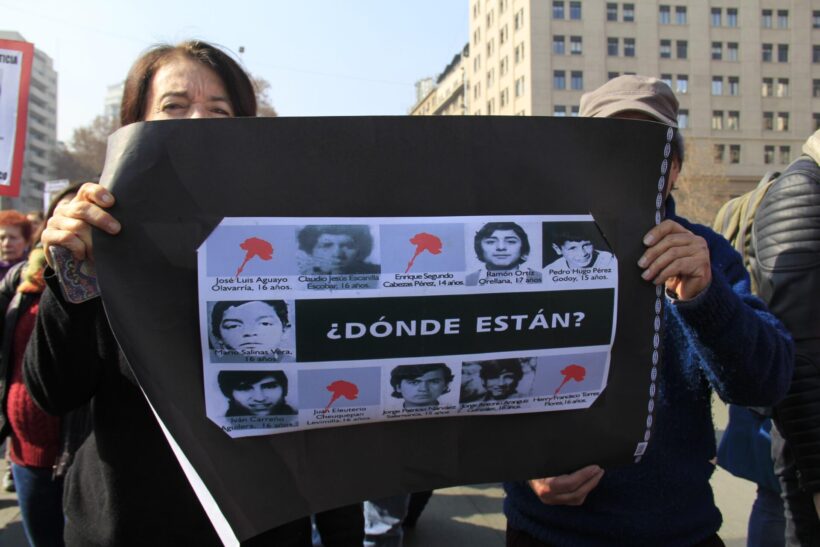
Chile carries a wound that has never healed. The disappearance of people under State custody does not belong solely to the dictatorial past: it persists as a covert practice in democracy, tolerated by legal loopholes and by the continuity of a police force still marked by Pinochet’s doctrine.
On this International Day of the Disappeared, the demand is clear: not a single minute of illegal detention can be tolerated. Kidnapping is kidnapping from the very moment a police officer deprives someone of liberty without record, incommunicado, threatened or paraded around in a police vehicle beyond any form of oversight.
A memory still burning
Between 1973 and 1990, Chile endured the most brutal face of forced disappearance: thousands of men and women torn from their homes, taken to clandestine facilities, denied before the courts and finally erased by the repressive machinery of the dictatorship. The practice, condemned as a crime against humanity, left an indelible mark on the country’s history.
Almost five decades after the coup, reports of truth and reparation, judicial proceedings and memorial campaigns have documented that horror. Yet what seemed to be a closed chapter has persisted under new forms: detention without immediate registration remains fertile ground for police abuse.
Democracy with the disappeared
On September 3, 2005, in Puerto Montt, police officers detained the young Mapuche José Huenante, aged 16. He was never seen again. His disappearance is considered the first case of a disappeared detainee in Chile’s democracy. Officers denied his arrest, official records never listed him, and to this day the courts have provided no answers.
During the social uprising (2019–2021), the National Human Rights Institute, Amnesty International and Human Rights Watch received hundreds of complaints of arbitrary detentions, incommunicado custody, torture and threats of disappearance. Testimonies describe the same pattern: the “grey zone” in which a person is deprived of liberty, driven around in police vehicles, denied to relatives and lawyers, and subjected to violence before being officially registered in a police station.
Personal testimony
I lived through it myself. In 2019 and 2021, in the course of my journalistic and human rights work, I was detained without flagrancy or crime. Police harassed me, handcuffed me, and held me incommunicado for hours, denying my whereabouts to relatives, colleagues and human rights organizations.
During those hours I experienced what the law refuses to name: kidnapping by the State. I was transported unconscious and in forced positions that endangered my life, threatened with disappearance and with being made to “appear suicided.” The physical and psychological scars of those detentions remain to this day.
The legal loophole
The Constitution enshrines personal liberty and security. The Code of Criminal Procedure establishes the obligation of immediate registration and judicial control. The Penal Code punishes kidnapping. Police protocols mandate medical examination and dignified treatment.
But practice contradicts them. The gap between apprehension and official registration remains a dark zone of impunity, in which the person belongs neither to the courts, nor to their family, nor to the law: they belong to the officer who has detained them. In that zone thrive threats, torture and disappearances.
The proposal
To close that breach, today I formally delivered a bill and constitutional reform to Humanist Deputy Tomás Hirsch, in my capacity as journalist with Pressenza International Press Agency and as a de facto victim of kidnapping, torture and threats of disappearance in Chile.
The bill establishes that:
Every detention without immediate registration constitutes aggravated kidnapping when carried out by State agents.
The Constitution must absolutely prohibit forced disappearance and unregistered detention, even under states of emergency.
Judges must verify detention times in every hearing and report any unjustified lapse.
Police must implement a binding protocol of immediate detainee registration, under the supervision of the judiciary and the National Human Rights Institute.
Counterpoints and human rights reports
Police manuals and protocols state that every detainee must be registered and treated with respect and dignity. Yet national and international human rights organizations have shown the gap between paper and reality.
The National Human Rights Institute filed hundreds of lawsuits for torture and illegal detentions during the uprising. Amnesty International and Human Rights Watch denounced the systematic use of incommunicado detention and police violence. The conclusion is clear: the current law is insufficient, and judicial oversight always comes too late.
International comparison
In Argentina and Uruguay, countries also scarred by dictatorships, forced disappearance was codified as an autonomous and aggravated crime, even in democracy. This legislative decision allowed State agents responsible for illegal detentions to be prosecuted.
Chile, despite having ratified the International Convention for the Protection of All Persons from Enforced Disappearance, still maintains an incomplete legal framework. The clear and aggravated classification of kidnapping by public agents is a pending step that would align national law with international standards.
Memory, dignity and democracy
The International Day of the Disappeared is not only a remembrance of the past. It is an urgent call in the present. Every hour without registration is an hour of impunity; every denied detainee is an echo of dictatorship that has not ended.
Today, with the delivery of this bill, words become action. Chile now has the chance to honor its victims, protect its citizens, and safeguard its democracy from arbitrariness.
Because kidnapping is kidnapping. And because “disappeared” must never mean never again.