

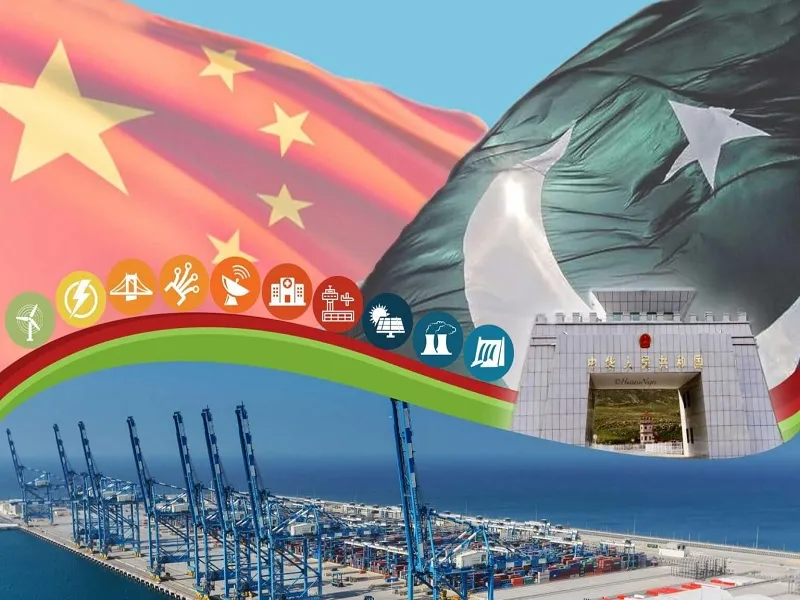
Rebranding existing logistics corridors across its territory as part of CPEC is a means to this end.
Iran’s Mehr News Agency and others reported that one of their country’s leading economic officials discussed the possibility of it facilitating Pakistan’s trade with Russia and Europe at a meeting with his counterpart during President Pezeshkian’s visit in early August. Mehr wrote that “[he] said the establishment of a joint free trade zone and linking the China-Pakistan Economic Corridor (CPEC) through Iran to Russia and Europe could be put on the agenda of Tehran-Islamabad trade relations.”
Russia and Pakistan plan to launch a delayed freight train pilot project later this month for connecting their economies via Iran, Turkmenistan, and Kazakhstan, but this route represents the eastern branch of the North-South Transport Corridor (NSTC), not CPEC. By branding it as an expansion of CPEC, Pakistan hopes to revive international interest in this somewhat stalled series of Chinese megaprojects, all while misleading India into thinking that Russia is participating in these controversial investments.
Delhi objects to CPEC since it transits through Pakistani-controlled disputed territory that India claims as its own. Seeing as how “Russia’s Neutrality During The Latest Indo-Pak Conflict Was Due To New Policymaking Dynamics”, chiefly the rise of the pro-BRI policymaking faction, some in India might fall for Pakistan’s infowar provocation that Russia is now participating in CPEC. Nevertheless, India will need to rely on Russia more than ever if ties with the US worsen, so no policy changes are expected on its part.
In any case, considering that Russia has hitherto eschewed any connection with CPEC due to India’s sensitivities, the objective reality of it not directly participating in any tangible (as in Chinese-financed) expansion of CPEC in Iran should inevitably alleviate whatever concerns some Indians might have. The same can’t be said for Iran, however, which is openly associating itself with CPEC branding even though the NSTC infrastructure is already in place for facilitating Pakistani trade with Russia via its territory.
This suggests that Iran hopes to procure Chinese investments on the pretext of its prospectively formal involvement in CPEC regardless of whether or not these actually facilitate Pakistani-Russian trade. From China’s perspective, even Iran’s symbolic involvement in CPEC (such as the branding that Chinese projects might use within the country even if they’re not connected to the actual CPEC) could raise China’s regional prestige even further, thus possibly leading to other countries following suit.
Neither China nor Pakistan will ever officially admit it, but CPEC has been a disappointment after it fizzled out in recent years and didn’t approach anywhere near the game-changing impact that was widely expected of it a decade ago, hence the importance for both of their reputations in changing this. Roping Iran into at least agreeing to allow this branding to be used for Chinese investments and Pakistani-connected trade is a means to the end of reviving international interest in CPEC.
Iran was hit very hard by Israel during their brief 12-day war so it’s unimaginable that the country would turn down any opportunity to attract more foreign investment into its economy. Accordingly, by proposing the conceptual expansion of CPEC westward en route to Russia and Europe, Pakistan got Iran to go along with this branding in pursuit of the aforesaid imperative. Iran’s newfound embrace of CPEC, in contrast to Russia’s continued distancing from it, might complicate ties with India in the future.



