

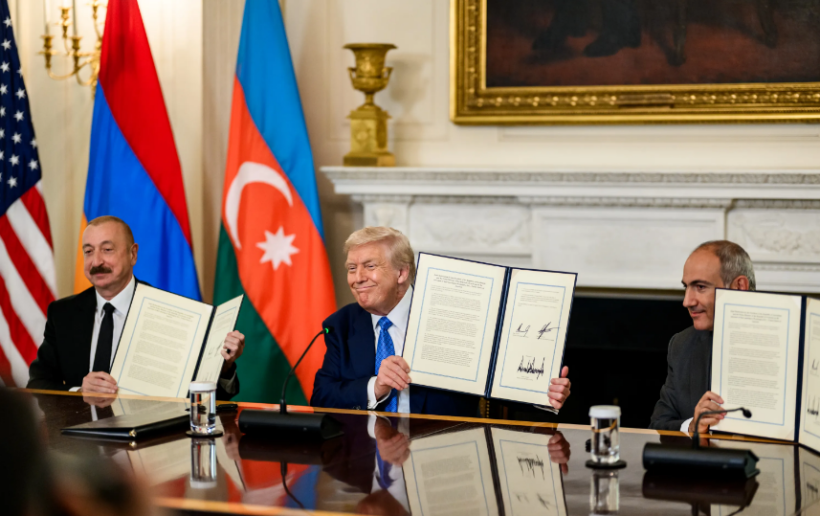
The leaders of Azerbaijan and Armenia signed an historical agreement aimed at ending decades of conflict as they were hosted by President Donald Trump at the White House on Friday.
The Armenia-Azerbaijan border conflict is an ongoing post-Soviet conflict between Armenian and Azerbaijani military forces. Azerbaijan and Armenia fought over Nagorno-Karabakh, an ethnically Armenian enclave in Azerbaijan, in the 1980s and 1990s and violence has flared up in the years since.
In recent years a major crisis began on May 12, 2021, when Azerbaijani soldiers crossed several kilometers into Armenia in the Syunik and Gegharkunik provinces.
Azerbaijan’s President Ilham Aliyev and Armenian Prime Minister Nikol Pashinyan described the event as “historic” for both countries.
It’s a day which will be remembered by the people of Azerbaijan with a feeling of pride and gratitude to President Trump… Within several months, he managed to put an end to conflicts in Asia, in Africa, and now in South Caucasus — what we could not achieve for more than 30 years… We will turn the page of standoff, confrontation, and bloodshed, and provide a bright and safe future for our children, said President Aliyev. (White House)
Today, we have reached a significant milestone in Armenian and Azerbaijani relations. We are laying a foundation to write a better story than the one we had in the past. This breakthrough would simply not have been possible without President Trump’s personal engagement and his resolute commitment to peace, said Prime Minister Pashinyan. (White House)
It’s been a long time coming, Trump said of the agreement, which will reopen some key transport routes between the countries and increase US influence in the region.
On Friday, Trump said Armenia and Azerbaijan had promised to stop all fighting “forever” as well as open up travel, business and diplomatic relations. (BBC)
Thirty-five years they fought, and now they’re friends and they’re going to be friends a long time,” Trump said at the event. (BBC)
The White House said that, as part of the deal, the US will also help build a major transit corridor that will be named the Trump Route for International Peace and Prosperity.
The route will connect Azerbaijan and its autonomous Nakhchivan exclave, which are separated by Armenian territory. In the past, Aliyev has demanded that Armenia give his country a railroad corridor to Nakhichevan.
Armenia wanted to have control of the road and the Azerbaijani leader has in the past threatened to take the corridor by force. The issue has halted and stalled previous peace negotiations.
Both leaders praised Trump and his team throughout the meeting:
President Trump, in six months, did a miracle, Aliyev said.
Trump said he had also signed a bilateral agreement with both countries to expand energy and technology trade.
Russia on Saturday welcome the peace accord between Azerbaijan and Armenia brokered by the United States, while warning that excessive involvement by outside powers could complicate stability in the South Caucasus. (Voice Asia News)
The agreement, signed on Friday during a meeting with U.S. President Donald Trump, grants Washington exclusive development rights to a transport corridor through Armenia. This route will connect Azerbaijan to its Nakhchivan exclave, which borders Turkey, a move expected to reshape regional trade links. (Voice Asia News)
In its first official response, Russia’s Foreign Ministry expressed support for initiatives aimed at fostering peace and prosperity in the region, including the Washington talks. However, Moscow emphasized that enduring solutions should emerge from cooperation among the regional states themselves, supported by immediate neighbors like Russia, Iran, and Turkey.(Voice Asia News)
In reaction to the Peace agreement Iran rejects planned border corridor backed by US President Donald Trump. Iran is saying it will distance itself from ally Russia in the context of the agreement.
According to the White House communiqué, President Trump is the President of Peace. He has brokered peace between Azerbaijan and Armenia, Cambodia and Thailand, Israel and Iran, Rwanda and the Democratic Republic of the Congo, India and Pakistan, Egypt and Ethiopia, Serbia and Kosovo, and with the Abraham Accords.
We will see next week if President Trump is a the president of peace and if he is able to find an agreement between Russia and Ukraine. President Putin will meet with President Trump next friday in Alaska.
However regarding the situation in the Middle East, President Trump was not able to find a peace agreement to put an end to the Hamas hostage-taking and Israel’s genocidal aggression on the population in Gaza.
In fact, it is virtually impossible for the US government to achieve a peace agreement since the Americans support Israel in its conquest of Palestinian territories.
_____________________________________
Source: The White House, BBC, Voice Asia News