

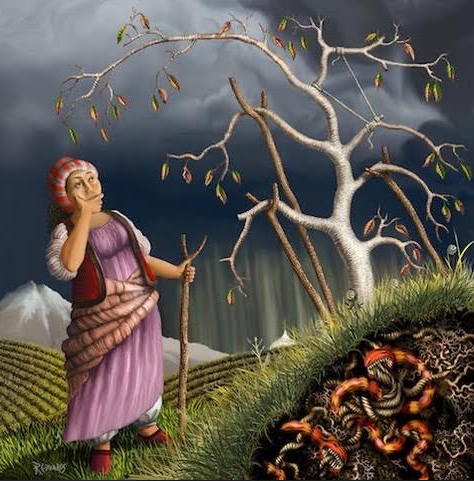
You will make your conflicts disappear when you understand them in their roots, not when you want to resolve them. (Principle of wise action, Silo Teachings)
According to the Integrated Food Security Phase Classification (IPC) report, the “worst-case famine scenario is underway in the Gaza Strip” due to the intensification of fighting, massive population displacement, and restrictions on humanitarian aid.
The unbearable suffering of the people of Gaza is already evident to the world. It is unacceptable to wait for official confirmation of famine to provide the lifesaving food assistance they desperately need, WFP Executive Director Cindy McCain said in a statement.
Today the reflection that everyone is having when trying to understand the situation in Gaza, is how the Western and Arab world allowed such a deterioration in the living conditions of Palestinians to occur?
On the one hand, Western countries have been far too slow to denounce the systematic aggression of the Israeli government against the population of Gaza and against the Israeli settlements, the civilian communities built by Israel throughout the Israeli-occupied territories over the last decades.
On the other hand, the governments of the Arab world supported and financed the struggle of Hamas and other armed groups for decades. These groups use violent means to achieve the liberation of Palestine from Israel occupation. But the Arab governments knew very well that Israel had a powerful army and access to advanced technologies thanks to the support of their allies in North America and Europe. Hamas never had such powerful allies.
All these images of starving children that we perceive on social networks are a result of the ultimate deshumanization of the human being. The struggle between a new born human being that is thrown into the world that he or she didn’t choose and death. The experience of violence and the fear living by the people in Gaza is the process of dehumanization of the human being at its peak.
The global process of deshumanization of the human being.
How much longer will it take for us to realize that it is not possible to resolve conflict in complex societies without dialogue and diplomacy? How much time it will take for us to realize that the use of violence, aggression and killing increases the problems and endangers future generations in a process of a more severe dehumanization.
Perhaps now is the time to reflect on making a change in the world and in ourselves. But it is easy to say that the people have to change – but then the problem is that the other people also think the same thing, that we should change. Maybe we should, as a species, change our conception of the human being which is acting as an engine that pulls the global process of dehumanization.
In fact, if you ask someone to define the human being, almost everyone will tell you humans are social beings, or social animals that think and have a predetermined nature. Most people have integrated and codified into their biography a common definition of human beings. This way to define the human biengs is continually disseminated by the system and the institutions through media, cultural productions, literature and education. Through this conception, life becomes this banal thing, meaning disappears and moral crisis appears.
For centuries the image of human beings has been degraded and his sacred integrity has been veiled by dogmas and beliefs.
Today in most societies, human beings and life in general is reduced to a thing. A thing that can be subjugated, that can be used, and that can be appropriated for labor power or other power.
To understand the process of dehumanization of the human being, we must go back in history and study the events and ideologies that shaped the image of the human being for centuries.
In the 18th century, Locke’s ideas were adopted by liberalism theorists. According to Locke, freedom consists of obeying natural law. Locke establishes two rights: the right to one’s freedom and the right to punish anyone who wants to harm it, thereby violating natural law. His discourse explains that work is the origin of property. Then came the era of symbiosis between liberalism and social Darwinism, which was a further step towards collective dehumanization and the beginnings of economic concentration and political power in the hands of the fittest in the struggle for survival.
While liberalism belief and practices generated pain and suffering to millions of people. The leftist (marxist tradition) opposes liberalism by denouncing its inhumanity in the name of higher values of equality and solidarity. Marx’s ideas and class dialectics were adopted by millions of workers and brought significant changes in the working conditions of several generations of workers throughout the last century.
In the twentieth century, the triumph of the proletarian revolution in Russia meant that the model of Marxism that prevailed was based on the interpretations of Plekhanov and Lenin and later Stalin. With Stalin, dialectical materialism became the official doctrine of the Marxist-Leninist in the Soviet Union (USSR) and the Communist parties around the world.
Then, the narrowly materialistic conception of the human being was integrated by most leftist currents. Later they establish that the human being was a biochemical machine that obeys mechanical laws.
Today, many environmentalists’ currents of thoughts have also established similar conceptions of the human being. They are denouncing the objectification of nature, treating nature as a thing and transforming it into a pure economic object. Many environmentalists do not hesitate to locate themselves within a purely naturalistic view of the human being.
In all these visions all freedom and intentionality in the human being remains under the rigid determinism of the laws of nature or historical determinism.
In 1989, despite the fall of the Berlin Wall and the fall of the former USSR (dialectical matérialism), the process of dehumanization of human beings continued everywhere around the world.
At the root of the ideologies of dialectical materialism and neo-liberalism we find the dehumanizing process of life and of the human being. We find this immense nihilism and destructiveness which is physically visible in the tens of thousands of nuclear bombs that have been produced since the second world war by Russia (ex USSR) and the United States (US).
Indeed, for decades, the entire world population has been living under the influence of terror. Since the Second World War, the activity of the human species’ instincts for self-preservation has been unleashed and kept the psychophysical structure of the human being under the influence of the system of vital tension which reduces the energy available for the psyche to amplified human consciousness.
Today, Russia, US, China, France, Uk, Israel, India, Pakistan and Israel maintain and produce nuclear weapons. In addition, superpowers such as Russia and the US are perfecting weapons to destroy the subjectivity and inner landscapes of human beings by using new technologies and AI.
In Canada the process of dehumanization generated the conditions for the culture of peace of the Canadian people to move toward militarization abandoning multilateralism agreements and dialogue between civilizations (China, Russia).
The deshumanizing process limits our ability to function and limits the operational freedom of consciousness. Powerless peoples are without a future. They become easy targets for manipulation, disinformation and all forms of discrimination.
Breaking with process of dehumanization is our most important task in this historical moment,
Ownership of my psychophysical structure is given by my intentionality, while external objects appear to me as beyond my immediate ownership and only indirectly subject to my control (through the action of my body). There is a particular type of object, however, that I intuit as the property of a foreign intention, and that is the body of the other. That otherness puts me in the position of being seen from outside, seen from the intention of the other. The vision I have of the other is, therefore, an interpretation, a landscape that will extend to every object that bears the mark of human intention, whether produced or used by someone in the present or the past. In that human landscape (1) I can annihilate the intention of others, considering them as prostheses of my own body, in which case I must empty their subjectivity completely—or at least within those areas of thought, feeling or action I wish to control directly. This objectification necessarily dehumanizes me, and so I justify this situation as the action of a greater force beyond my control (Passion, God, the Cause, Natural Inequality, Fate, Society, etc.). (Silo Teachings Collection, Humanize the Earth, p.63)
We need a new conception of the human being that mobilizes us toward an open future. A conception for today’s increasingly complex world marked by mondialisation, conflicts, climate changes, the lost of meaning in life and AI.
We need to move toward humanization.
To move towards humanization is to move beyond the objectification of the human being and affirm the intentionality of every human.
To move towards humanization is to change the direction of things in order to amplifying the operational freedom of consciousness and liberate the human being from mental violence and fear.
To move towards humanization is to surpass the mechanical factors and historical determinism by opening a new horizon of freedom for all human beings.
___________________________________________________________________
Source:
(1) Human landscape: it is a type of exterior landscape made up of people, and also of human facts and intentions concretized in objects. It is important to emphasize that mentioning the landscape always includes the one who looks at it; on the contrary, in other cases, when we speak of society, it appears to us as exempt from any interpretation of the gaze of oneself. (Silo, Humanize the Earth, p.56)
On being Human, Interpretations of Humanism from The Renaissance to the Present, Salvatore Puledda, New humanism Series, Latitude Press, 1997
Humanize the Earth, english translation, Silo teachings collection 2025, spanish original, Silo 1972, 1981, 1988, english translation of Spanish original by Paul Tooby, Roberto Verdecchia, and Daniel Zuckerbrot