

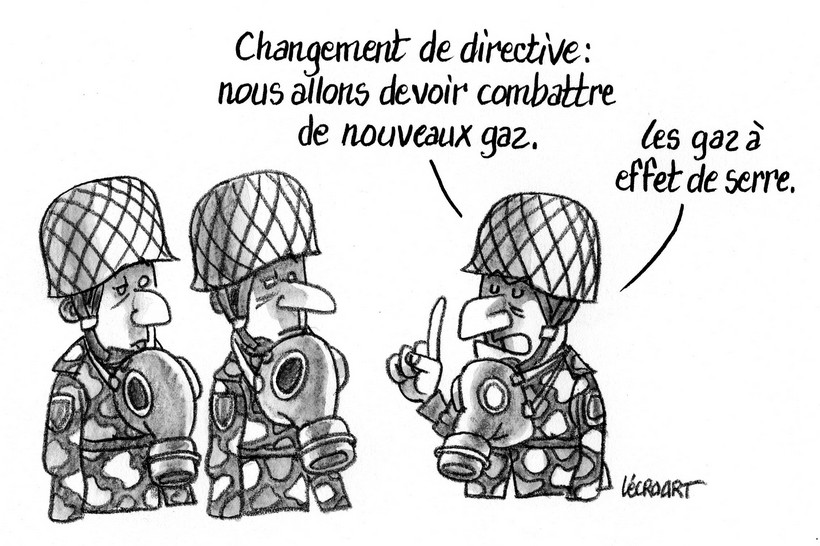
To what should we give the name “threats”? What criteria should we use to analyse threats? What process leads us to perceive a given event as threatening? How can we decipher language aimed at public opinion concerning real risks? Many questions confront anyone seeking to draw up an inventory of threats.
Threats are a social construct before being a reality. According to the dictionary, a threat is a type of behaviour, an attitude, by which one shows a person or a group of people that one intends to harm them, to hurt them, in short to force them to act against their will. Accordingly, threats would seem to come from this “other person” considered as an “enemy” who would like to take what we have by constraint or by force.
Hence the need firstly to identify who it is that is making this or that threat, and whom they are threatening, in order to avoid being drawn into and trapped by a perception and narratives defined by others. Furthermore, threats cannot be analysed solely as prefiguring their presumed consequences. They must be seen within a long-term context, and the chain of events that led to the situation must be deconstructed in order to act on ultimate causes of threats, if our objective is to defuse them. Otherwise, we risk being sucked into a logic of escalation whose outcome is well known: a surge of violence and generalised warfare.
In short, threat is one of those catch-all words that, by focusing on fear, allows us to postpone any analysis of our responsibilities and in consequence to avoid acting to prevent threats from materialising. The interaction between the complex elements of a situation is also very often ignored. Each threat is examined in its own terms, and not in its relationship with other threats. By being used excessively and in the most varied contexts, this overused word gets to be emptied of meaning.
France: the target or the source of threats?
There is a significant gap between the perception of a threat by public opinion, the reality of the risk incurred, and the response of those who govern. This is the case with regards to the military threat at the heart of the themes covered in ANV’s special issue.
This is especially the case since the invasion of Ukraine in 2022 by Russian troops, accompanied by the nuclear threat by President Putin, revived the fear of a war in Europe. A “change of era” for many commentators, such as to justify an increase in budgets and the maintenance of the logic of nuclear deterrence. Many media outlets have made this a front page theme since the invasion, and gone so far as to ask “Are we ready for war?” The only prospect held out for the future is the continued strengthening of France’s military apparatus and the militarization of society.
This resulted in the elaboration of a new National Strategic Review at the end of 2022[1]. Unlike previous similar exercises which were based on the work of a duly appointed commission, involving the holding of hearings, this review was conducted directly by staff internal to the Élysée and the Armed Forces Ministry. This document provides an overview of present threats and risks for France, and sets out the main features of military policy for the years to come. It places nuclear weapons at the heart of the system, even describing them as the “backbone of our security” and explicitly designates Russia and China as two states posing a specific threat to France. It serves as the basis for the elaboration of the Military Programming Laws (LPM). And in the spring of 2023, the government submitted to parliamentarians a new Military Programming Law covering the years 2024 to 2030, which provides for a significant increase in military spending. In doing so, it fuels the threat of war, and this strong contribution to the arms race is achieved to the detriment of the development of public services and the satisfaction of social needs. Not to mention that this militaristic vision of society comes from a minority – albeit one adorned with the democratic veneer of a parliamentary vote – and not from a genuine democratic debate.
Our military forces are always presented as serving the defence of France and peace but, like Janus, they have two faces. So it all depends on which side we are on. What is presented as defensive is generally perceived as aggressive by others… Remember also that for several years now we have witnessed a gradual disappearance of the boundaries between threats that come from within and those from without. This dematerialization of borders, against a backdrop of globalization, reinforces the unpredictability of the source and origin of threats.
Nuclear weapons provide a stand-out example with which to explain this paradox. The strategy of nuclear deterrence, the aim of which is to promote peace, to prevent any attack on “vital interests”, is specifically based on the exercise of threats against the other, the threat of disproportionate retaliation, including the use — according to French nuclear strategy — of a nuclear bomb first as a “final warning” to re-establish deterrence in the event that that “other” might have any doubt as to France’s true intentions. If nuclear weapons and the strategy of nuclear deterrence played “a fundamental role in the preservation of peace and international security” as President Macron has asserted, following in his predecessors’ footsteps[2], all it would take would be for every country to have a few nuclear weapons of its own, and there would be no more wars in the world. It is easy to measure the absurdity of such reasoning and the danger that it would pose to humanity.
Likewise, by becoming the second largest arms exporter in the world, France contributes significantly to fuelling the arms race and to participates through the use of its weapons, munitions or components in many conflicts in different countries. In recent years, the war in Yemen had already brought back into the limelight, France’s responsibility with regards to the use of the weapons it sells, highlighted in particular by several studies published by the Observatoire des Armaments, concerning the war waged by Russia against Ukraine or that of Israel against Hamas[3].
It was during the presentation of this strategic review on November 9, 2022, that President Macron explained that France must “put itself in a war economy posture”, and expressed his wish to strengthen our moral fibre, in particular with the strengthening of the SNU, the Service National Universel[4], in order “to bring together all France’s vital forces, both military and civilian, for the defence of our sovereignty.”[5].
All of which is contrary to the commitments made in favour of strengthening the values of peace regularly reaffirmed by France within the United Nations as a permanent member of the Security Council. Indeed, the UN Charter clearly states in its Article 26: ” In order to promote the establishment and maintenance of international peace and security with the least diversion for armaments of the world’s human and economic resources, the Security Council shall be responsible for formulating, with the assistance of the Military Staff Committee referred to in Article 47, plans to be submitted to the Members of the United Nations for the establishment of a system for the regulation “of armaments.” We are a far cry from that.
And what if the main threat was not military?
In fact, France favours a top-down approach to the analysis of threats, based on the security objective defined by state authorities, such as protecting the country’s territory and strengthening infrastructure to ensure it can continue to function. It does not rely on the fears and needs expressed by the population and intermediary bodies such as the various social groups and numerous civil society organizations, nor does it involve them.
This leads to a significant gap between the population’s perception of threats and the State’s response to them, whether in terms of security or in various other areas (migration, the risk of terrorism, climate threats, etc.), based on what turns out to be an illusion, the priority given to the development of technologies to respond to security risks. Indeed, this technological race – as robotization and AI, artificial intelligence, underline, is on the contrary a factor in new risks, all the more so if we do not adopt a structural point of view, that of the State, but the viewpoint of society or groups of individuals.
The most obvious example is the universalization of computing as the dominant tool for managing societies and our individual lives. The accumulation and storage of digital data – in addition to being a major consumer of energy – also represents a vulnerability in terms of the security of this data, its hacking, etc., thus creating new security threats in a kind of dialectic – already present at the military level – between the sword and the shield.
In fact, in this national narrative, widely disseminated by the dominant media, the use of threats serves as cement to unite the population around the government, more or less effectively depending on the period. Threats are given heightened coverage to mask non-consensual, minority political orientation choices favouring an economic logic based on the accumulation of ever more wealth and the reinforcement of inequalities, which inequalities themselves are the causes of wars. The rhetoric of threats serves as a kind of easy scapegoat, instead of launching and organizing a collective debate in order for us all together to question the structural causes which are at the origin of the successive crises that our societies are experiencing, and to develop perspectives to face them. Whether on an internal or external level.
France is not the imaginary country respectful of humanist values in which we would all be living in harmony and that we would have to defend against an invader. This is an illusion that underlies in particular the idea that there are, on the one hand, two distinct times in the life of a society: that of peace and that of war; and, on the other hand, also two distinct spaces: interior and exterior.
The reality is quite different. Our society lives in permanent conflict – both internally between different groups with divergent interests, as well as externally in its relations with other countries – a conflict in which we are permanently acting and reacting, in search of a balance between ourselves and others, oscillating between “hell is others” and “our worst enemy is ourselves”…
Because isn’t defending one’s territory what we already do every day through the commitments which we take on? Isn’t that the dynamic force that we need to amplify and to share as widely as possible? Because it is through actions and forms of organization elaborated collectively that we will build a “living together”. Isn’t that where the main threat lies?
L’Observatoire des armements (Armaments observatory)
Although the logic of war continues to shape our societies and relentlessly impact our lives and the planet, the Observatoire des Armements has continued, ever since 1984, to work tirelessly to disarm minds and countries. It publishes the Damoclès magazine, in paper and digital editions, as well as articles and investigative pieces that are an important and reliable source for journalists and the media.
See website https://www.obsarm.info/
[1] https://www.sgdsn.gouv.fr/publications/revue-nationale-strategique-2022
[2] See the « Discours du président Emmanuel Macron sur la stratégie de défense et de dissuasion devant les stagiaires de la 27ème promotion de l’École de guerre » – the President’s speech to military trainees on defence and deterrence strategy, 7th January 2020, https://www.elysee.fr/emmanuel-macron/2020/02/07/discours-du-president-emmanuel-macron-sur-la-strategie-de-defense-et-de-dissuasion-devant-les-stagiaires-de-la-27eme-promotion-de-lecole-de-guerre
[3] Cf. les Notes de l’Observatoire : « La guerre se fabrique près de chez nous » (n° 6, mai 2022, 28 p.) ; « Comment la France contourne l’embargo » (n° 7, juin 2023, 20 p.) disponibles par téléchargement sur https://www.obsarm.info/spip.php?rubrique46 ainsi que « La coopération militaire et sécuritaire France-Israël » (mai 2017, 100 p.) https://www.obsarm.info/spip.php?article428
[4] a scheme to re-introduce a shortened form of national service, in principle mostly civilian, but with strong militaristic overones [Translator’s note]
[5] https://www.defense.gouv.fr/actualites/nouvelle-revue-nationale-strategique-ce-quil-faut-retenir-du-discours-demmanuel-macron
The Author
 Patrice Bouveret is co-founder and director of the Observatoire des armements (Armaments observatory), an independent centre of expertise created in Lyon in 1984. He is also responsible for the publications of the Observatoire des armements, including the Damoclès review; he is the author of numerous contributions, including « Le nucléaire comme catastrophe : sortir du déni » (“Nuclear as a catastrophe: an end to denial”), in Catastrophe(s) : parlons-en ! Approche pluridisciplinaire des catastrophes de Hiroshima au Covid-19, directed by Patrick Dieuaide and Claire Garnier-Tardieu, Paris, L’Harmattan, 2022, 206 pages.
Translated by Marc Morgan
This article is part of the dossier on Civilian-Based Defence (CBD), issue 213 (special edition), December 2024, of the journal Alternatives non-violentes.
Articles from the dossier “Civilian-Based Defence (CBD)” published by Pressenza in French, German and English.



