

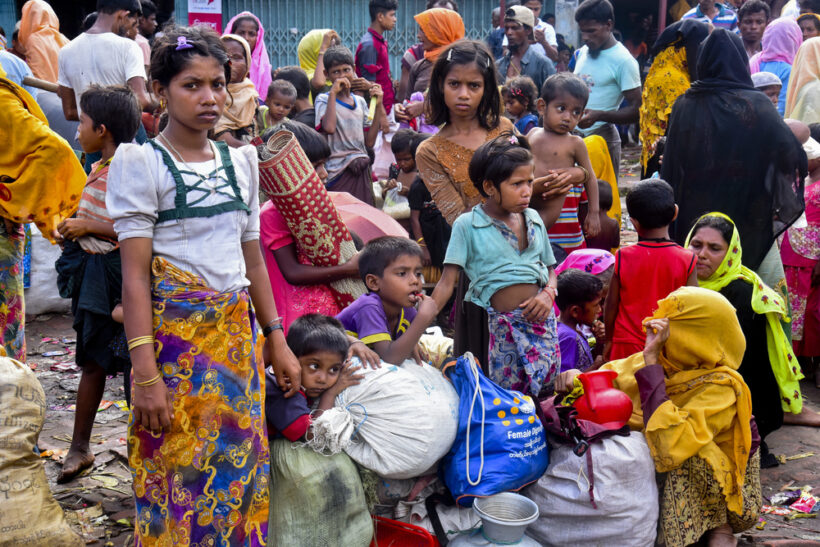
The 25th August 2017 was the witness of the tragic Rohingya refugees from their homeland. The huge influx of about 1 million Rohingya refugees into Bangladesh was talk of the town then, across the World Community. The shift in global priorities over time is evident in the World Food Programme’s aid budget cuts for the Rohingyas, reflecting how much the international community’s initial interest has now faded. Even so, many times the initiation of the Rohingya refugees’ repatriation process has been delayed, but those was not implemented at all. At the edge of a war-centric world political system, several issues have arisen day after day, which are also crucial for each of its perspectives, as the repatriation process of Rohingya refugees has failed to gain momentum to be practically implemented. Since 2017 it is about 8 years have passed, while there were a lot of hopes and aspirations for the Rohingya refugee repatriation, but nothing has been executed for the sake of this most vulnerable society of the World.
By Md. Al-Amin
As of June 30, 2025, UNHCR and Bangladeshi officials reported that roughly 1,143,096 Rohingya were staying in Cox’s Bazar, 1,106,008 of whom had registered their names with the government and UNHCR. Escalating conflict and targeted violence against the Rohingya, a mostly Muslim minority in mainly Buddhist Myanmar’s western Rakhine state, have forced about 150,000 to flee to Bangladesh in the past 18 months, the United Nations said. Joint Response Plan (JRP) 2025–26, led by UNHCR alongside IOM and 113 partners under Bangladesh’s leadership, the first-year appeal seeks US$934.5 million to assist approximately 1.48 million Rohingya refugees and host-community members. But, as of May 2025, only 140 million US dollars has been funded, which is 15-16% of that appeal. In March 2025, the World Food Program (WFP) reduced foreign aid per month from $12.50 to $6, which was a huge setback for each host country, Bangladesh and the Rohingya refugees.
Regarding the Rohingya refugee repatriation process, on 23rd of November, 2017, the first repatriation agreement was signed between Bangladesh and Myanmar, by which the first repatriation date was November 15, 2018. The 22nd of August 2019 was the second repatriation date. But neither of them got the light of the sun. Interestingly, the Bangladesh government relocated about 38000 Rohingyas to Bhasanchar, Noakhali, which was established on 4th December 2020. In the middle of 2023, China initiated a restart of the repatriation process as a medium between Bangladesh and Myanmar. In that regard, some of the Junta officials came to Bangladesh for inspection but nothing good happened to the Rohingyas. This repatriation process had not started only because of Myanmar’s internal clash among multiple militants.
The international community, particularly the United Nations, totally failed to persuade Myanmar to receive its citizens from neighboring countries. Even though there was no strong trial for this genocide. Once, in November 2019, The Gambia filed a lawsuit against Myanmar at the International Court of Justice (ICJ) in The Hague, accusing it of committing genocide against the Rohingya Muslim minority. They sued on behalf of the Organisation of Islamic Cooperation, by which the ICJ accused Myanmar, but nothing changed for Myanmar’s stance.
Recently, the interim government of Bangladesh has focused on this issue seriously. Khalilur Rahman, a career diplomat, was appointed as the ‘High Representative on Rohingya Problem and Priority Issues Affairs’ to the chief adviser Professor Muhammad Yunus. At the edge of the BIMSTEC Summit, there was a high-level meeting between Bangladesh and Myanmar, where it was decided that 180,000 Rohingya people would be relocated very soon. Chief adviser Professor Dr Muhammad Yunus proposed 3 points demand by which all stakeholders need to come under an umbrella where a durable solution should be made. Notably, the President of the United Nations, Mr. Antonio Guterres, visited Bangladesh during the last Ramadan, where he urged the World community not to overlook the most vital issue. Meanwhile, Dr Yunus visited China and urged them to make a pathway to a durable solution. Even in the ASEAN forum, Bangladesh has a significant voice on the Rohingya issue. Eventually, in Dr. Yunus’s last visit to Malaysia, which is now the chair of the ASEAN made a statement on the Rohingya refugee crisis that Malaysia and some regional partners will send a joint delegation to Myanmar to push for peace and humanitarian aid for Rohingya refugees struggling in Bangladesh, the Southeast Asian nation’s Prime Minister Anwar Ibrahim. Along with that, Malaysia’s foreign minister will coordinate the Myanmar mission, set for the coming weeks, along with counterparts from Indonesia, the Philippines, and Thailand.
In a final note, due to the massive uprising of the Arakan Army in Arakan state, it is uncertain how to make a resettlement. Simultaneously, the government has failed to minimize its counterparts over its conquering 17% of the area around the whole of Myanmar. So, it needs to think outside the box about how to resettle the Rohingyas. Third-party settlement will be an option to relocate them. For Bangladesh, it can be said to be a lifesaver; otherwise, the woes will continue for both Bangladesh and the Rohingya refugees as well.
Md. Al-Amin is an educator. He completed his post-graduation from the Department of International Relations at Rajshahi University, Bangladesh. His research interests are Diplomacy, Foreign policy, Border conflicts, and Security issues.