

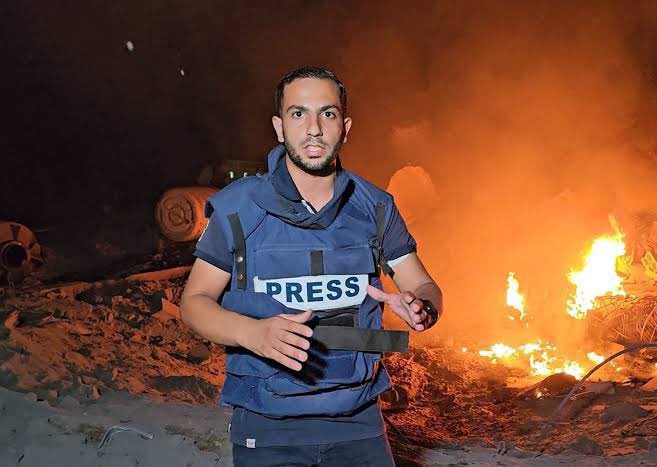
On Sunday, August 10, 2025, an Israeli airstrike hit a press tent set up next to Al-Shifa Hospital in Gaza, killing five journalists who were covering the humanitarian crisis under fire. Among them were two colleagues from Al Jazeera: correspondent Anas al-Sharif, known for his steady voice and constant presence on the bombarded streets, and cameraman Moamen Aliwa, who for years documented his colleague’s work with the precision of an unflinching gaze. The other three killed—Mohammed Qreiqeh, Ibrahim Zaher, and Mohammed Noufal—were independent journalists working for local outlets, all committed to bearing witness from one of the most dangerous places on the planet.
On Monday, August 11, Gaza City turned into a massive funeral procession. Colleagues, relatives, and citizens accompanied the coffins in a march that was both an act of mourning and a political statement: a silent crowd refusing to accept that the deaths of those who reported the war would go unpunished.
The Committee to Protect Journalists (CPJ) now counts 184 Palestinian journalists killed since the start of the war. Reporters Without Borders (RSF) raises the figure to over 220, while local authorities report 237. The United Nations describes this conflict as the deadliest for the press in modern history.
International reactions were swift. RSF denounced the strike as an “assassination acknowledged” by the Israeli army itself and filed formal complaints before the International Criminal Court. The CPJ, Amnesty International, and the UN Office of the High Commissioner for Human Rights all described it as a grave violation of international humanitarian law. UN Secretary-General António Guterres demanded an independent and impartial investigation, reminding that “journalists must be respected and protected.” UNESCO and UNRWA reiterated that targeting the press constitutes a war crime. The European Union, through Kaja Kallas, condemned the attack and demanded clear evidence before accepting any allegations of militant ties. France, via President Emmanuel Macron, proposed deploying an international force under a UN mandate to stabilize Gaza.
This attack not only took lives but also sought to erase the eyes and voices documenting the catastrophe. The deaths of Anas al-Sharif, Moamen Aliwa, Mohammed Qreiqeh, Ibrahim Zaher, and Mohammed Noufal strike directly at the truth and at humanity’s right to know. Their work, carried out in extreme conditions and at constant risk, was an act of public service that demands memory, justice, and recognition. Where their cameras and microphones fell silent, the echo of their work will endure—as testimony and as warning.



