

by George Banez
“What’s in a name? That which we call a rose, by any other name would smell as sweet.” Says Juliet to lover Romeo whose family name betrays him as nemesis to her own. She convinces him that their love transcends labels. And that meanings imputed by society can be flipped. Can this apply to food names too? Does Filipino Adobo by any other name smell as tangy?
Adobo is protein or vegetables stewed in vinegar, seasoned with soy sauce or salt, and perfumed with aromatics like garlic, peppercorn, and laurel leaves. A favorite to eat with rice, its garlicky-vinegar-soy fragrance signals dinner. This scent lingers long. So, it is the signature whiff of most Filipino homes. In the inhabited ones of the Philippines’ 7,641 islands, home tastes like adobo. Despite some 183 living languages spoken in the archipelago, variants of the stew go by the same name. So where did adobo come from?
“Adobo,” a noun in the Spanish language, refers to the marinade or pickling juice used to flavor and preserve food, particularly meat. The verb “adobar” describes the action of marinating. Since I only mastered basic vocabulary from a year of high school Spanish plus a few semesters in college, I did not encounter the word “Adobo” outside the Filipino context. That is, until I saw “Adobo” on the label of a seasoning spice mix in the U.S. Mexicans use the same word for their marinade of vinegar and chilis. Because both the Philippines and Mexico survived three centuries of Spanish rule, this is no surprise.
Globalization of Flavor
Funny how spices played a big role in colonial history and globalization. Not too long ago, in 1492, Spanish monarchs King Ferdinand and Queen Isabella sent Christopher Columbus to find a westward alternative route to the Silk Road passage to Asia. Constantinople, now Istanbul, was the major terminus of this trade route and its gateway to Europe. But the city fell to the Islamic Ottoman Turks in 1453. And that restricted the flow of goods from Asia to the mostly Christian Europe. So, kingdoms in the Iberians peninsula at the western edge of the continent needed to find a way to the precious spices growing only in Southeast Asia. In their quest for gold, territories, and valuable spices they use for medicine and flavoring or preserving food, Spanish King Charles I funded the expedition led by Portuguese Ferdinand Magellan.
An estimated 270 men set out on a fleet of five ships to find a western sea route to the Moluccas spice Islands in 1519. Part of present-day Indonesia, the group of islands south of the Philippines, was where cloves, nutmeg and mace grew. In 1521, after crossing the Atlantic and Pacific Oceans, the Europeans arrived at the cluster of islands which Spaniards later claimed as their own. They called the islands “Las Islas Filipinas” after their King, Philip II, in 1546. Around the same time period, from 1519 to 1526, they subjugated empires in the land they called “New Spain.” Spanish conquistadors overstayed their welcome there, in what’s now Mexico, and got booted out in 1810. By 1898, some 333 years of lording over The Philippine Islands, Spain sold its Asian colony to the new superpower, Mexico’s neighbor, the United States. So, the Philippines and Mexico share more than a few words in common.
The Manila Galleon Trade bridged Asia with the Americas and Europe. This global network started soon after the Spanish born Miguel Lopez de Legazpi, then living in Mexico, conquered Cebu in 1565 and Manila in 1571. Luxury goods from China and Southeast Asia loaded onto “La Nao de China,” or the Manila Galleon, sailed across the Pacific to Acapulco, Mexico. The goods transported overland to the port of Veracruz then departed on a transatlantic voyage to Spain. When the Manila Galleon Trade ended in 1815, two and a half centuries of exchange had spread to the Old-World today’s staples like tomatoes, corn, potatoes, cacao, chili peppers, and vanilla from the New World. So, which of the global culinary swaps point to the origin of Filipino Adobo?
By Any Other Name
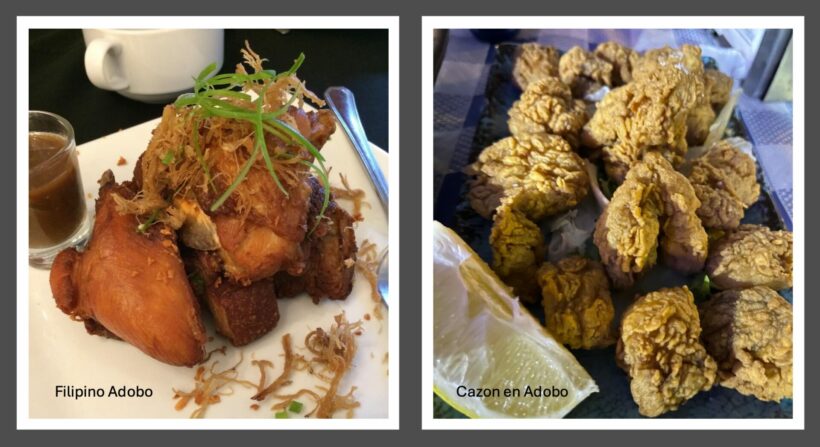
Surely, the name, “Adobo,” came from Spain. Puerto Rico, a former Spanish colony, calls their everyday spice mix Adobo. Although less common in Peru and Uruguay, some seasoning bears the same name. Two years ago, I enjoyed some delicious “Cazon en Adobo,” or Marinated fried Dogfish, in Malaga Spain. Adobo is everywhere. But I believe that Filipinos marinated and stewed pork in vinegar long before Spaniards came. That is based on what we can glean from the chronicles of Venetian writer Antonio Pigafetta, one of 18 men in Magellan’s crew who lived to tell the tale. In his account, “Report on the First Voyage Around the World” a manuscript later published as a book in Italian and French, Pigafetta mentioned a pork stew, or “coccido de puerco” in the Spanish translation.
Chronicling in Venetian dialect, Pigafetta reported meeting ashore Raja Colambu, Chief of Mazaua, the Island that was friendly to them. Calling him king, Pigafetta wrote that Colambu had a plate of pork and a large jar filled with wine served to them. They ate and drank together ceremoniously. And when it came time to eat supper, two large porcelain dishes were brought in – one was filled with rice and the other with “pork in its own gravy.” After Magellan was killed by Lapu Lapu, chief of Mactan Island, and the remaining crew prepared to leave, Pigafetta listed the words he heard natives speak. Perhaps, he did that with some help from Magellan’s slave, “Enrique,” the expedition interpreter who spoke Malay.
Pigafetta wrote down, “Tuba,” name for the naturally fermented wine that turns to vinegar with age. In an earlier entry, he described how Tuba is harvested from coconut sap. He also recorded words for vinegar (“zucha”) and hog (“babui”) that are still in use today. Even now, coconut vinegar is favored by Filipinos for cooking adobo. In his account, Pigafetta mentioned interacting with a trader from Siam, present day Thailand, before they learned of Luzon, the island in the north where Manila was located. Manila even then was the hub for trading with China. Soy sauce, the food flavoring and preservative made by fermenting soybeans, wheat, and salt, was invented in China some 1,500 years before 1521. So, based on Pigafetta’s chronicles, all the ingredients of today’s adobo were in play back then.
Perhaps, “Luñis” or “Lunis” may also lend support to a pre-colonial adobo. The pork dish traditionally prepared by the Ivatan people of Batanes, the Philippines’ northern most group of Islands south of Taiwan, looks like any soy sauce free adobo. Pork cured in salt cooked slowly until fat is rendered down. Stored in lard, it stays edible for months. Vinegar and garlic are used to enhance flavor when fried. Eating Lunis with rice tides over Ivatan families until the season of plenty returns. From early March to May, the migratory “Arayu” or Mahi-Mahi fish enter the calmer waters closer to shore making them easier to catch. But this does not happen again until the next year. So, Ivatans make their food last. Isolated by rough seas and typhoons, the descendants of Austronesians who migrated from Taiwan some 5,000 years ago preserved food this way before Spaniards called every marinated food, “Adobo.”
While “Adobo” was convenient for the Spaniards, “curry” was profitable for the British. The catch-all English word, “curry,” likely adopted from the Tamil word “Kari” for sauce, is everywhere. Seeing the successful marketing of British-invented curry powder as the flavor of India leaves me sad. Not only is India’s rich and diverse culinary heritage caricatured, but the world also remains unaware of the misappropriation. As for Adobo, Filipinos themselves should control its branding and preempt the spread of exotic interpretations by being first to present “traditional” recipes.
Non-Filipino chefs who took the time to understand the elements of adobo can accomplish the same too. Edward Lee, Korean American Chef, knew the value of vinegar beyond its flavor. He cooked Adobo fried chicken in a 2014 episode of the “Mind of the Chef” on PBS, Public Television. Also on YouTube’s PBS Food Channel, the 2023 Seattle episode of “No Passport Required” featured Chef Marcus Samuelson equating Filipino affinity to adobo with American love of barbecue. He was spot on. But nothing beats the late Filipino Chef Margarita Fores who proudly called it the “National Dish” while serving lamb and “Pitaw” (ricefield bird) adobo to guests on the 2025 Netflix series, “Somebody Feed Phil.” All three found the soul behind “Adobo,” the nourishing dish, regardless of what it is called.
About the Author:

George Banez is a writer of Filipino descent and is a retired non-profit professional living in Florida.



