

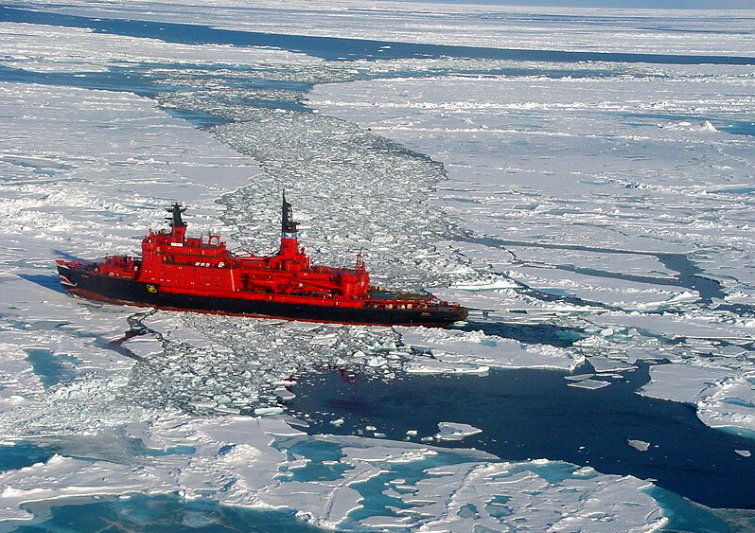
U.S. President Trump’s massive tax and spending bill planned to allocate more than US$8,6 billion to increase the U.S. Coast Guard Icebreaker fleet in the Arctic, where Washington hopes to counter the possible rising Russian and Chinese dominance.
In fact, since he was elected President Trump is pushing to revive U.S. ship building to counter China’s growing strength in maritime manufacturing and naval dominance.
As climate change shrinks polar ice packs, Arctic seas are increasingly being considered as trades routes connecting Pacific and Atlantic Oceans to major economies.
Trump has repeatedly called for the United States to acquire as many as 40 new icebreakers. This fleet could help companies with logistics and keep open supply lines for potential oil and gas and mineral development in the rugged and frigid region.
In fact, it seems that the Americans are primarily interested in getting their hands on the Arctic’s vast natural resources, especially oil and gas. It’s terrifying! Instead of massively supporting renewable energy and helping to reduce greenhouse gas emissions, the Trump administration is going the opposite way and risks triggering a catastrophe in the Arctic.
The Canadian government must act quickly under Article 234 and implement measures to avoid a disaster
Canada is one of the leading advocates country in the world for Arctic conservation. As early as the 1970s, Canada signed an agreement with Russia for the protection of the Arctic environment, with Article 234 concluded in conjunction with the Convention of the United Nations Convention on the Law of the Sea (UNCLOS).
Article 234 and Arctic preservation
Article 234 provides that “coastal States such as Canada, Russia and Greenland have the right to adopt and enforce non-discriminatory laws and regulations for the prevention, reduction and control of marine pollution from vessels in ice-covered areas within the limits of the exclusive economic zone, where particularly severe climatic conditions and the presence of ice covering such areas for most of the year create obstructions or exceptional hazards to navigation, and pollution of the marine environment could cause major harm to or irreversible disturbance of the ecological balance.
Even though this article was passed in the 1970s, when the Arctic was practically covered in ice year-round. The implementation of Article 234 cannot be changed or cancelled as a result of ice cover reduction in the Arctic Ocean or following the entry into force of the Polar Code (1), which establishes new rules of navigation in the Arctic waters.
At the time In Canada’s view, the demand for creating such a regime was driven by the necessity to protect the fragile environment of the Arctic from external adverse impacts caused by the potential expansion of resource exploitation by multinational companies and international navigation in the region. It argued that, due to the high risk of causing harm to the marine environment because of the unique characteristics of the region, stricter national rules and standards may be required in comparison with those existing on the international level. The United Nations Environment Programme also supported the basis of Article 234, emphasizing the importance and practical value of the Arctic region in the view of the United Nations.
The United States, from its side has accepted the provisions of Article 234 as a part of customary international but it argues that while exercising rights stipulated under Article 234, Canada and Russia created unwarranted restrictions for other States to exercise their right to the freedom of navigation in the Arctic Ocean, a right that is widely recognized in the contemporary international law of the sea.
The danger of pollution to the Arctic environment from oil spills and, increasingly, waste disposal, artificial lighting, and other negative consequences of intensified human activity in the region are higher every year.
The melting Arctic ice makes Article 234 more relevant. In fact, scientific evidence shows that the melting ice increases the vulnerability of the Arctic region.
But, the Trump administration shut down a federal website that had presented congressionally mandated reports and research on climate change, drawing rebukes from scientists who said it will hinder the nation’s efforts to prepare for worsening droughts, floods and heat waves and the impact of climate change in Arctic circle. (Source the Los Angelos Times)
The U.S. Global Change Research Program’s website, globalchange.gov, was taken down along with all five versions of the National Climate Assessment report and extensive information on how global warming is affecting the country.
According to Peter Gleick, a California water and climate scientist author of the first National Climate Assessment in 2000:
They’re public documents. It’s scientific censorship at its worst. This is the modern version of book burning. (Source the Los Angelos Times)
One a major problem with the Article 234 is that the provisions of the article are managed by Russia and Canada. But given that Canada no longer has diplomatic relations with Russia since the war in Ukraine, it must find other ways to initiate a dialogue with Russia to preserve the Arctic region and avoid a disaster.
________________________________________________
Source: https://globalnews.ca/news/11271924/trump-big-beautiful-bill-canada-impact-clean-energy
Polar Code source International marine organization (IMO): Under the Polar Code ships are encouraged not to use or carry heavy fuel oil in the Arctic. IMO’s Sub-Committee on Pollution Prevention and Response (PPR) 7th session in 2020 agreed draft amendments to MARPOL Annex I (addition of a new regulation 43A) to introduce a prohibition on the use and carriage for use as fuel of heavy fuel oil (HFO) by ships in Arctic waters on and after 1 July 2024. The draft amendments will be submitted to the Marine Environment Protection Committee with a view to approval and circulation for future adoption.
https://www.imo.org/en/ourwork/safety/pages/polar-code.aspx



