

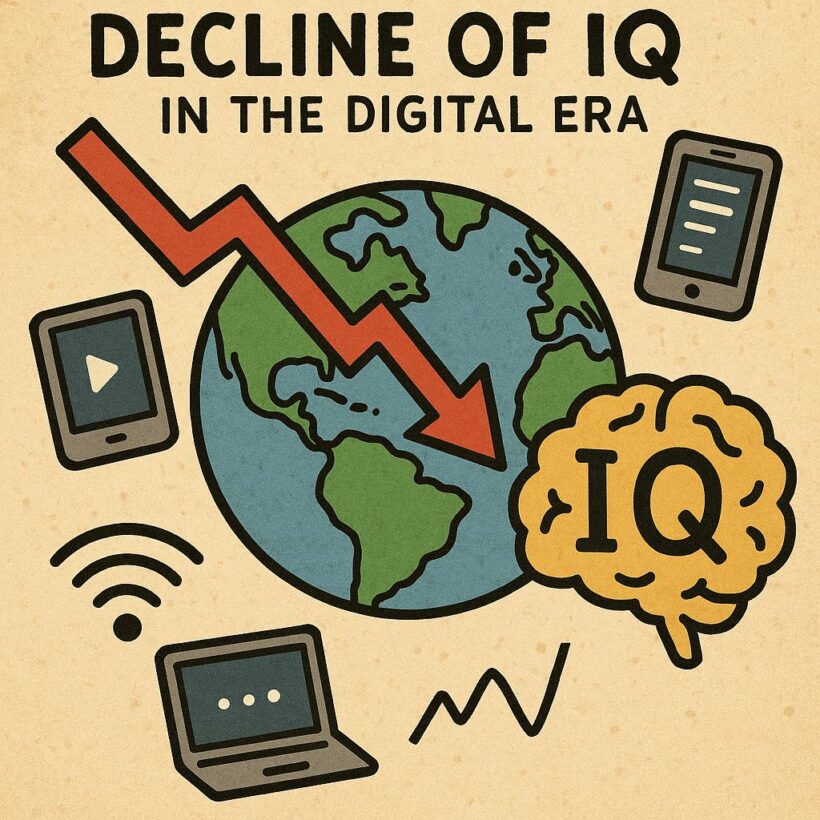
Throughout the 20th century, intelligence quotient (IQ) scores experienced a sustained increase—known as the Flynn Effect—which has been revised over the past two decades by new studies documenting a reversal in industrialized countries. This phenomenon, confirmed by longitudinal research and recent meta-analyses, is primarily attributed to environmental, social, and especially digital factors, rather than to genetic causes, as clarified by the scientific literature from 2024–2025. Today, the debate is central within neuroscience, psychology, and public policy, as both the decline of classical cognitive abilities (such as memory, attention, and abstract reasoning) and the emergence of new digital skills are being identified—requiring an updated analytical framework. The phenomenon is particularly notable in Europe and North America, while in the Global South, persistence or slight stagnation of the Flynn Effect remains dominant, with no documented decline comparable to that in highly industrialized contexts. The accumulated evidence in recent years calls for an urgent update in measurement instruments, along with a complete redesign of educational, nutritional, and public health policies.
1. Introduction: The Paradox of Intelligence in the 21st Century
The continuous rise in IQ scores throughout the 20th century fostered hopes for indefinite cognitive progress. However, new analyses reveal that since the cohorts born around the 1970s, this pattern has reversed in numerous industrialized nations. Updated studies up to 2025 show that cognitive development is no longer linear or homogeneous, but rather the product of a complex interaction between educational, environmental, and especially digital factors.
This essay aims to systematize the most recent evidence, critically assess the driving factors, and propose conceptual and methodological frameworks that align with the current state of scientific knowledge—thus offering a comprehensive map to guide researchers, policymakers, and educators.
2. Global Evidence of IQ Decline: State of the Art, 2019–2025
2.1. Industrialized Countries
The reversal of the Flynn Effect in Norway was first documented by Bratsberg and Rogeberg (2018) and has since been reaffirmed by more recent reports and meta-analyses extending through cohorts born in the early 2000s. Similar trends were identified in Finland and Denmark, confirmed by the Finnish Health and Education Authority (2024).
In the United Kingdom, longitudinal analyses from the British Cohort Study and the Centre for Longitudinal Studies (2024) reveal a cumulative decline of up to five IQ points in verbal skills and structured reasoning among post-1970 cohorts—closely correlated with shifts in education systems and pervasive digital technology use among youth.
In the United States, studies led by Northwestern University and the National Assessment of Educational Progress (NAEP, 2025) highlight pronounced deterioration in vocabulary, reading comprehension, and mathematical reasoning. These findings are backed by articles published in Psychological Science (2024) and major international academic forums.
2.2. Non-Western Contexts
In China, the Flynn Effect continues, though recent assessments—such as those from the Chinese Academy of Social Sciences (2024) and the meta-analysis by Yang et al. (2019)—report stagnation in highly urbanized, heavily digitized zones, where environmental pollutants may also play a role.
In Latin America, a slow yet uneven rise in IQ persists. However, research teams in Brazil, Mexico, and Chile have warned that unregulated digital exposure, together with disparities in reading comprehension and nutrition, are beginning to limit further cognitive progress.
Sub-Saharan Africa presents unique challenges. While datasets are still insufficient for long-term trends, nutrition and education improvements in countries like Kenya, Ghana, and Nigeria have sustained a modest Flynn Effect. Still, endemic nutritional deficiencies and test adaptation gaps remain critical constraints, as noted by the African Cognitive Monitoring Network (2025).
3. Multifactorial Causes of Decline and Cognitive Reconfiguration
3.1. Educational and Curricular Changes
Growing emphasis on standardized testing, memorization, and curriculum simplification correlates with a decline in abstract reasoning and deep thinking. The OECD (2024) and universities across Europe and Latin America have observed a marked weakening of cognitive environments both inside and outside the classroom—particularly in digitally saturated urban populations.
3.2. Environmental and Nutritional Drivers
Neurotoxic agents such as lead and organophosphate pesticides have been definitively linked to cognitive deterioration. Chronically exposed children in the U.S. and China experienced IQ reductions of 5–7 points, according to research by Chen et al. (2024) and the National Institute of Environmental Health Sciences.
Nutritionally, the 2024 joint report from UNICEF and FAO shows that urban populations—especially children and adolescents—often face deficits in iron, iodine, zinc, and omega-3 fatty acids. Combined with ultra-processed diets, these deficiencies contribute significantly to cognitive stagnation.
3.3. Digitalization and Attentional Fragmentation
Recent publications by Mara Dierssen (2024) and Umberto León Domínguez (2024) confirm that prolonged exposure to shallow digital media, multitasking, and increasing reliance on generative AI has contributed to impaired executive functioning, shorter attention spans, and decreased working memory—particularly in younger populations.
Conversely, structured and therapeutic use of AI in older populations (as studied by the University of Vigo, 2025) may help delay cognitive deterioration if implemented responsibly. Still, the phenomenon of cognitive offloading—intensively debated at international symposia in 2024–2025—has highlighted the urgent need to regulate digital interactions and reimagine pedagogical strategies.
4. Counterpoints, Limitations, and Methodological Debates
Though some scholars promote the idea of a newly emerging “digital intelligence”—strong in information screening, collaborative adaptation, and multitasking—the empirical evidence to date suggests that such gains do not sufficiently compensate for the measurable decline in foundational cognitive abilities.
Researchers stress the need to improve testing instruments to reflect diverse cognitive realities and to include neurobiological markers (e.g., brain imaging, executive function mapping) that can differentiate between superficial and deep cognitive processing. Current test batteries often fail to capture these nuances.
5. Implications, Policies, and Open Research Agendas
Recent major institutions—including the OECD, WHO, and the European Brain Council—recommend:
- The urgent development of updated and culturally sensitive IQ and cognitive assessment tools that reflect both traditional abilities and new digital skills.
- Wholesale curricular reform emphasizing critical thinking, sustained attention, analogical reasoning, and information synthesis.
- National limits on screen exposure time and age-appropriate digital literacy programs.
- Public health policies focused on neuroprotective diets and elimination of environmental hazards affecting brain development.
- Longitudinal, cross-cultural studies integrating environmental exposure, nutritional intake, digital behaviors, and cognitive performance.
- The identification of cognitive biomarkers capable of predicting functional vulnerability to digital overstimulation or sociocultural disadvantage.
6. Conclusions
The accumulated evidence from 2019 to 2025 demonstrates the emergence of a global cognitive reconfiguration—one that reflects both a decline in classical capabilities and the rise of new, technologically mediated abilities. The phenomenon is not linear, nor is it homogeneous. The pressing question for global education, health, and governance systems is whether this reconfiguration leads to a more adaptive cognitive ecosystem—or instead exposes millions to functional impairment in an increasingly complex world. Either way, urgent, interdisciplinary action is required to protect the depth, independence, and resilience of human cognition in the digital age.
References
Bratsberg, B., & Rogeberg, O. (2018). Flynn effect and its reversal are both environmentally caused. Proceedings of the National Academy of Sciences, 115(26), 6674–6678.
(Norwegian longitudinal study; documents reversal of the Flynn Effect attributable to environmental and cultural factors, massive sample with high statistical robustness.)
Chen, L., et al. (2024). Environmental pollution, neurotoxicity, and their impact on IQ: Studies in China and the USA. National Institute of Environmental Health Sciences.
(Review of cumulative effects of lead and pesticides on child and adolescent IQ.)
Costa, A., et al. (2025). Cognitive trends in Latin America. National Autonomous University of Mexico (UNAM).
(Regional studies on IQ evolution, digitalization, nutrition, and education policy.)
Dierssen, M. (2024). Research on cognitive reconfiguration and brain aging in the digital era. Royal National Academy of Medicine, Spain (RANM).
(Current analysis of the impact of digital exposure and AI on deep cognitive functions.)
Finnish Health and Education Authority. (2024). Cognitive trends in Finland.
(Official national report linking cognitive changes to digital exposure and educational transformation.)
García, M., et al. (2025). Impact of AI on executive functions and memory: Multicenter analysis. University of Vigo.
(Explores AI’s dual role as both cognitive enhancer in older adults and potential threat to critical capacity development.)
León Domínguez, U. (2024). Cognitive offloading and outsourcing induced by AI. University of Monterrey (UDEM).
(Study examining digital delegation and its neurological and behavioral consequences.)
Mekonnen, D., et al. (2025). Cognition and development in Sub-Saharan Africa: Challenges in measurement and nutrition. African Cognitive Monitoring Network.
(Report addressing food security and educational access as central variables in cognitive development.)
NAEP – National Assessment of Educational Progress. (2025). Longitudinal study on U.S. cognitive trends.
(Longitudinal data confirming IQ and academic performance decline across multiple domains, 1970–2025.)
OECD. (2023–2025). Reports on global cognitive and educational trends. Organisation for Economic Co-operation and Development.
(Evaluations of the evolving state of education, cognitive scores, and policy recommendations worldwide.)
Possin, K. L. (2024). New digital skills vs. decline in classical abilities: Neuropsychological perspectives. University of California, San Francisco (UCSF), Memory and Aging Center.
(Discussion of cognitive reconfiguration grounded in neuropsychological tracking of digital-era brains.)
Simonsen, L., et al. (2024). Effects of educational standardization on cognition in children. Autonomous University of Madrid / University of Helsinki.
(Explores how curricular simplification and test-based systems impact individual and collective reasoning.)
UNICEF & FAO. (2024). Reports on nutrition and cognitive development in the Global South.
(Shows strong association between micronutrient deficiency and cognitive delay in lower-income populations.)
World Cognitive Forum. (2025). International symposium on neuroscience and cognitive health in the digital age. Lisbon, Portugal.
(Summary of expert panels on digital cognition and public responsibility in emerging cognitive landscapes.)
Yang, X. J., Li, Y. Y., & Zhang, J. (2019). The Flynn Effect in China: A meta-analysis. Intelligence, 74, 1–10.
(Meta-analysis of IQ gains in China; updates suggest stagnation in urban areas by 2024.)