

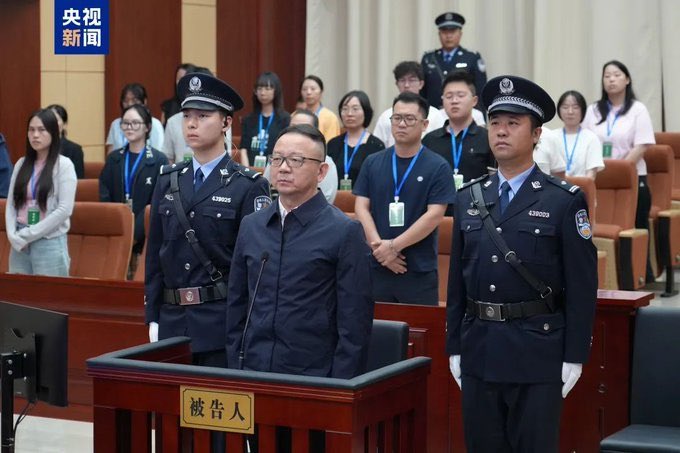
The financial system of the People’s Republic of China operates under an intrinsic logic of collective interest, economic sovereignty, and structural stability, markedly distinct from Western models. This article argues that its design and regulation are not merely aimed at efficiency, but are deeply rooted in a millenary philosophical tradition—Confucianism, Legalism, and Taoism—that prioritizes the national common good over economic individualism. This heritage has been strategically synthesized with Marxism-Leninism, giving rise to “Socialism with Chinese Characteristics,” a framework that legitimizes active state intervention to ensure stability, direct capital toward strategic goals, and combat corruption. Recent high-profile cases, such as today’s sentencing of former Tibetan Vice Premier Wang Yong, illustrate the rigorous application of these principles, demonstrating how public morality and economic discipline are essential to the cohesion and legitimacy of China’s political system.
1. Introduction: The Uniqueness of China’s Financial Model
The study of the financial system of the People’s Republic of China is often biased by Western analytical lenses, which tend to evaluate it based on its deviation from liberal market models. However, to truly understand its functioning and resilience, it is imperative to examine it through its own endogenous logic: a deep interweaving of collective interest, economic sovereignty, and structural stability. Far from being a mere referee of market forces, the Chinese state—and the Communist Party of China (CPC) as its vanguard—stands as the active guarantor of an economic order that prioritizes the national common good over individualism, especially that exercised by economic and political elites.
This approach is not a contemporary pragmatic aberration, but the reflection of a millenary philosophical tradition that conceives social order and prosperity as the fruits of centralized and morally guided governance. This document will explore that thesis, outlining the founding principles of the Chinese financial system, contrasting them with Western approaches, and tracing their profound connections to Confucian, Legalist, and Taoist schools of thought. Finally, it will demonstrate how this amalgam has culminated in “Socialism with Chinese Characteristics,” a framework that has enabled the country to sustain continuous growth and exceptional control over its economic destiny, as illustrated by recent examples of the anti-corruption campaign.
2. Founding Principle: Stability as a Political and Social Imperative
In Chinese political cosmology, the state is not a passive agent that intervenes post-facto in market failures; it is, in essence, the custodian of the “Mandate of Heaven,” understood in the contemporary era as the ability to ensure the prosperity and stability of the nation and its people. Financial policy, therefore, is not organized around the axiom of the “individual freedom of capital,” a concept with little resonance in Chinese political tradition, but rather around national stability and sustained collective development.
This translates into concrete policies that define the scope of capital:
Restriction of rampant speculation
Unlike markets where speculation is seen as a source of liquidity, in China it is viewed as a potentially destabilizing force that diverts resources from the real economy and creates harmful bubbles. The government actively intervenes in key markets such as real estate, promoting the maxim “housing is for living, not for speculation” (房子是用来住的,不是用来炒的), imposing restrictions on multiple property ownership and limiting leverage.
Prevention of capital flight in critical moments
Capital controls are not an anomaly but a fundamental tool to preserve national financial integrity and prevent hemorrhaging that could compromise autonomous development capacity. For instance, a general annual limit of USD 50,000 applies to Chinese citizens purchasing foreign currency—designed to stabilize the yuan and preserve foreign exchange reserves.
Strategic direction of credit
Credit flows are preferentially directed to sectors the state deems strategic for long-term development, even if their immediate profitability is not the highest. Major state-owned banks, such as the Industrial and Commercial Bank of China (ICBC) and the China Construction Bank (CCB), provide massive financing to high technology, infrastructure (such as Belt and Road Initiative projects), and renewable energy, in alignment with five-year plans and national development guidelines.
Prevention of systemic banking crises
Historical memory of instability and external humiliation reinforces the priority of avoiding banking collapses that could devastate the social and economic fabric. Unlike many Western economies that suffered deep recessions after the 2008 global financial crisis, China avoided a major systemic banking crisis largely due to strict state control and the capacity to quickly recapitalize or restructure troubled financial institutions.
Severe penalties for corruption and tax evasion
The use of the financial system for corrupt enrichment or tax evasion is not merely an economic crime; it is a direct affront to the legitimacy of the system and to social cohesion, justifying exemplary punishment.
3. Wealth Flight: An Ethical and National Cohesion Issue
The Western conception—particularly Anglo-Saxon—often posits the individual’s ability to “save themselves” and move capital freely across borders as an inalienable right. In contrast, in China, personal wealth is intrinsically tied to social and national responsibility. Wealth is ultimately a resource of society that, while it can be individually managed, must serve the greater purpose of collective flourishing.
Thus:
Unjustified capital export as potential “economic betrayal”
Removing money from the country without a clear strategic justification is not seen as a mere exercise of economic freedom but as a potential betrayal of the social contract and the collective nation-building effort.
Excessive accumulation and use of tax havens as a threat to cohesion
Opulence without contribution and shielding wealth in opaque jurisdictions are perceived as corrosive to internal cohesion and governance legitimacy. Anti-corruption campaigns led by Xi Jinping since 2012 reflect this principle. High-ranking officials and businesspeople, like Wang Yong—former Vice Premier of the Tibetan Autonomous Region—are judged not only by the sums received in bribes (271 million yuan, approximately 37.9 million USD), but by their betrayal of public trust. The restitution of funds and confiscation of assets, as in Wang’s case, seek not only to punish but to repair patrimonial damage to the state.
Rigorous control mechanisms
Strict limits on capital movements, detailed inspections, currency controls, audits, and severe regulations are essential tools to prevent capital flight that provides no tangible benefit to the People’s Republic of China.
4. Moral Economy vs. Deregulated Market Economy
The core distinction underlying the Chinese model is that of a moral economy versus a deregulated market economy. In Chinese tradition, shaped by millennia of Confucian and Legalist thought:
Money as a means, not an end
Capital and wealth accumulation are not goals in themselves but tools for achieving harmonious development (social harmony, stability, and prosperity). This idea deeply resonates with Confucian principles of the “Great Government” (大同, dàtóng), where individual prosperity is subordinated to collective well-being.
Individual well-being conditioned by collective balance
The legitimacy of individual prosperity is inherently tied to its non-compromise—or ideally, its positive contribution—to social balance and collective prosperity. A wealthy individual who undermines social order or evades responsibility is frowned upon. The case of Wang Yong and other Tibetan officials like Wu Yingjie (accused of receiving 343 million yuan) or Jiang Jie (225 million yuan) shows that the system does not tolerate illicit personal enrichment—even at the highest levels—when it compromises public trust and internal cohesion.
Conditional financial openness
Integration into global markets is desirable insofar as it contributes to China’s development and modernization, but only when it does not jeopardize economic sovereignty or internal justice. Strategic autonomy is non-negotiable
In contrast, the Western—especially Anglo-Saxon—financial system operates on radically different premises: the unrestricted right of individuals to move capital, individual responsibility in times of crisis (while the state rescues banks), and the consideration of capital flight as a “rational strategy” of optimization. This approach has led to structural instability, with cycles of bubbles and crises; explosive inequality, with elites often enriching themselves at the system’s expense; and crises of legitimacy, where citizens lose trust in the social contract.
5. Philosophical Roots: The Common Good in the Chinese Worldview
The articulation of the Chinese financial system, as described, is not merely a modern construct but deeply echoes the philosophical notion of the “common good” (天下為公, tiānxià wéi gōng, “all under heaven is for the public”) that has infused Chinese thought for millennia.
5.1. Confucianism (孔子, Kǒngzǐ): Harmonious order and the Mandate of Heaven
Confucian philosophy lays the foundation for a vision of the state as the guarantor of moral and social order. For Confucius, virtuous government (仁政, rénzhèng) aims at the people’s stability and prosperity. The concept of the “Great Unity” (大同, dàtóng) envisions a society where wealth and resources are shared for everyone’s benefit, and leaders act altruistically for the collective. In this framework, reckless speculation or elite capital flight are seen as violations of social harmony (和諧, héxié) and the principle of rectification of names (正名, zhèngmíng), where everyone fulfills their role for the greater good.
5.2. Legalism (法家): Strong state and pragmatic control (Han Feizi 韓非子)
While Confucius emphasized rulers’ morality, Legalist thinkers like Han Feizi argued for a strong, centralized state with strict laws and harsh penalties to contain selfish impulses. From this view, restrictions on capital movement, fiscal penalties, and economic direction are not policy preferences—they are imperatives for preserving state power and avoiding chaos (乱, luàn). The conviction of officials like Wang Yong for abusing public office to enrich themselves is a clear application of this logic, where betrayal of public trust is harshly punished to protect the state’s power and wealth (富国强兵, fùguó qiángbīng).
5.3. Taoism (道教): Flexibility, adaptability, and balance (Wu Wei 无为)
Often perceived as more individualist, Taoism offers a crucial lens to understand the adaptability and fluidity of Chinese thought. The concept of Wu Wei (无为, “non-action” or “effortless action”) implies action in harmony with the natural flow, avoiding rigid dogma. This philosophy enabled the CPC to shift from a planned economy to a “socialist market economy” without losing its legitimacy. Taoism emphasizes the interconnection and complementarity of opposites (阴阳, yin-yang), reflected in the coexistence of state planning and market mechanisms, seeking dynamic balance for the greater good.
6. Synthesizing Traditions: Marxism, Chinese Thought, and Socialism with Chinese Characteristics
6.1. The Sinicization of Marxism
This concept, promoted by Mao Zedong and his successors, entails adapting the universal principles of Marxism to China’s specific conditions and culture, rejecting dogmatism.
6.2. Convergence and mutual influence
– The state as engine and guarantor: The CPC adopted the Leninist model of party vanguardism and state control but framed it within the Chinese tradition of the “virtuous and ordered state.” The socialist state is not just a tool for revolution; it is heir to the Mandate of Heaven, responsible for harmony and prosperity.
– Social harmony over class struggle: While Marxism emphasizes class struggle, post-Deng Xiaoping China prioritized “developing productive forces” and building a “harmonious society.” Social tensions are viewed as contradictions the Party must manage to maintain stability. Xi Jinping’s “common prosperity” (共同富裕, gòngtóng fùyù) initiative reflects this effort to balance growth with equitable wealth distribution.
– Pragmatism and adaptability: Deng’s phrase “crossing the river by feeling the stones” (摸着石头过河, mōzhe shítou guò hé) captures Chinese pragmatism. This Taoist-inspired flexibility allowed the CPC to incorporate market elements and global capitalism—not as betrayal, but as necessary development stages.
– Nationalism and the “Chinese Dream”: The CPC has fused Marxism-Leninism with revolutionary nationalism. Communism aims not only at class emancipation but at the “great rejuvenation of the Chinese nation” (中华民族伟大复兴, Zhōnghuá Mínzú Wěidà Fùxīng), restoring global leadership and overcoming the “century of humiliation.” Economic growth and military strength are framed as means to fulfill this national destiny.
7. Conclusion: The Global Projection of the Chinese Model
The Chinese financial system is a deliberate construction, designed to prevent individual interests—especially those of the wealthiest—from undermining national stability and collective well-being. This is not merely a matter of technical efficiency or economic pragmatism; it is the manifestation of a state-guided development ethic, rooted in philosophical tradition and synthesized with Marxism-Leninism.
The public and exemplary sentencing of high officials like Wang Yong, Wu Yingjie, and Jiang Jie, with asset confiscation and restitution orders, does not aim to merely punish—it reaffirms the implicit contract between the state and its internal structure: those who betray public mandate and exploit political office for personal gain betray both the people and the Party.
In this consistency—and not in the spectacle of punishment—lies the system’s legitimacy and its disciplinary control. The absence of “fake news” in China’s official press on such cases reinforces a narrative of a system that, within its own parameters, seeks verifiability and uncontested judicial and media authority.
This logic, often criticized through the lens of classical liberalism, has been fundamental to China’s unprecedented economic growth, its avoidance of major banking crises, and its exceptional control over its economic destiny in a globalized world—lifting its people out of extreme poverty.
The Chinese model represents a form of comprehensive sovereignty—not only territorial and political, but also economic and financial. Understanding this architecture is essential for analyzing the emerging world order and viable alternatives to the hegemonic economic paradigm.
Bibliography
– State Council of the People’s Republic of China. Five-Year Plans.
– Mao Zedong. Selected Works.
– Academic sources on Chinese philosophical traditions (Confucianism, Legalism, Taoism).
– Publications of the Central Commission for Discipline Inspection of the CPC.
– Xi Jinping. The Governance of China.
– Academic studies on Socialism with Chinese Characteristics and China’s political economy.



