


Green groups call for sustainable, people-centered solutions ahead of the State of the Nation Address (SONA)
Manila, Philippines — Environmentalists warn that the massive flooding and the sanitation issues should not be used to legitimize the implementation of the Waste-to-Energy (WtE) incinerator in Manila. Doing so would be short-sighted, harmful, and would further inundate Manila with multiple woes.
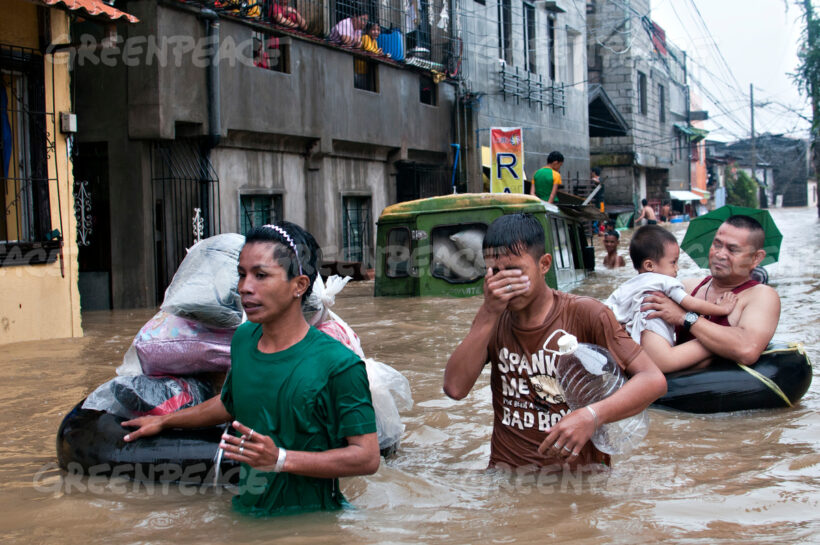
Flooding in Metro Manila. Residents near Tumana River and the nearby district in Marikina battle strong currents from floodwaters as they evacuate their houses following torrential rains. Weeks of heavy rainfall leave thousands of people stranded, homeless, and without power. Credit: Greenpeace.
The clogging from plastic waste in pumping stations, which help waters subside, is said to be one of the culprits in Manila’s flooding. In 2017, the Philippine government borrowed US$207.6 million each from the World Bank (WB) and the Asia Infrastructure Investment Bank (AIIB) for the Metro Manila Flood Management Project. The rest of the total project cost, worth USD 500 million, will be shouldered by the Philippines.
The project includes several components, including upgrading pumping stations, improving drainage systems, and a WtE plant to burn Manila’s waste located in the 5.8-hectare Brgy 128, located in the Smokey Mountains, Tondo. Both banks have categorized the project as having high risks of potential environmental and social harms. Reboot PH, a youth network with members affected by the project, said it could subject the barangay’s 23,000 poor settlers to displacement, job losses, and health issues.
However, the WtE plant was dropped from the project after a feasibility study for the proposed facility concluded that it was not viable due to insufficient environmental and social assessments, along with high capital and operational expenditures. According to the World Bank document, it was replaced with a centralized Materials Recovery Facility with the allocated funding to facilitate improved waste management and divert waste at scale.
Despite this, President Bongbong Marcos continued to pursue the project, even locking investors in his recent trip abroad. Three weeks ago, Manila Mayor Isko Moreno declared a public health emergency as contracted waste collectors PhilEco and MetroWaste refused collection after the past government failed to settle P950 million of payments for the garbage collection services. GAIA said the declaration must not be exploited to fast-track or realign allocations for the establishment of the proposed WTE project, and bypass public consultation and procurement processes.
Reboot PH, present during one of the public scoping sessions, reported that only around 40-50 project-affected people were able to participate in the public scoping held in March by DENR. Further, it did not have an open dialogue on community concerns, nor were project-affected people informed of the potential health, economic losses, and involuntary displacement from the WtE project.
Environmentalists also raise health issues from waste-burning facilities. “Waste-to-energy incinerators don’t eliminate waste. They transform it into a new set of toxic problems,” said Dr. Jorge Emmanuel in a press conference held last July 2nd on the global air quality monitoring report by GAIA. In Dumaguete City, citizens led by WoW Negros monitored the area near a waste burning facility at a Central Materials Recovery Facility. The PM 2.5 concentration level was unhealthy for a portion of the population 24 out of 27 days (88%), and was up to 7 times higher than WHO guidelines, as a result of the facility’s emissions.
The international expert on environmental health who has worked with the United Nations and other global institutions said that, “even the most advanced WtE facilities in Europe have been found to emit harmful levels of dioxins, especially near schools and farms. Periodic stack testing underestimates dioxin emissions as much as 1,290 times compared to continuous monitoring. In the Philippines, we don’t have the capacity to do continuous dioxin monitoring. So why push for a technology we cannot even regulate to protect our own citizens?”
Mayang Azurin, lead of the divest campaign in GAIA Asia Pacific, “Public finance is better allocated for much-needed services, including disaster relief, recovery, and long-term climate resiliency planning, which includes reducing the amount of plastics in our system by banning single-use plastics, providing more appropriate alternatives such as reuse systems, and enforcing the Ecological Solid Waste Management Act”. Azurin said loans for WTE projects have only added to dirty debts and environmental injustice in Asia.
The EcoWaste Coalition also stated that the flooding in the Philippines is primarily a result of poor land use policies, inadequate urban planning, deficient drainage systems, and clogged waterways exacerbated by climate change — not waste buildup alone. They also reminded policymakers of the standing legal bans on incinerators under the ESWM Act and the Clean Air Act.
Kalikasan People’s Network for the Environment said the country’s flooding woes are rooted in systemic failures—particularly poor land use planning, deforestation, destructive reclamation and mining projects, and weak environmental governance—problems that waste-to-energy (WtE) incineration cannot solve. The group warned that such projects endanger poor communities, which already suffer the most from environmental degradation, toxic emissions, and the constant threat of displacement. They urged the Marcos Jr. administration to prioritize inclusive, community-based, and ecologically sound waste management and climate adaptation strategies.
GAIA advised policymakers, the WB, and AIIB to take heed of Baguio City’s abandonment of its plan to operate a WtE plant and the recent order for closure in Dumaguete City. “More cities in Asia are recognizing that there are alternatives and WtE incineration is a problem rather than a solution”, they said.
###
GAIA (www.no-burn.org) is a worldwide alliance of more than 1,000 grassroots groups, non-governmental organizations, and individuals in over 90 countries. We envision a just, zero waste world built on respect for ecological limits and community rights.
Press contact: GAIA Asia Pacific: Robi Kate Miranda, Communications Officer for Campaigns, robi@no-burn.org



