

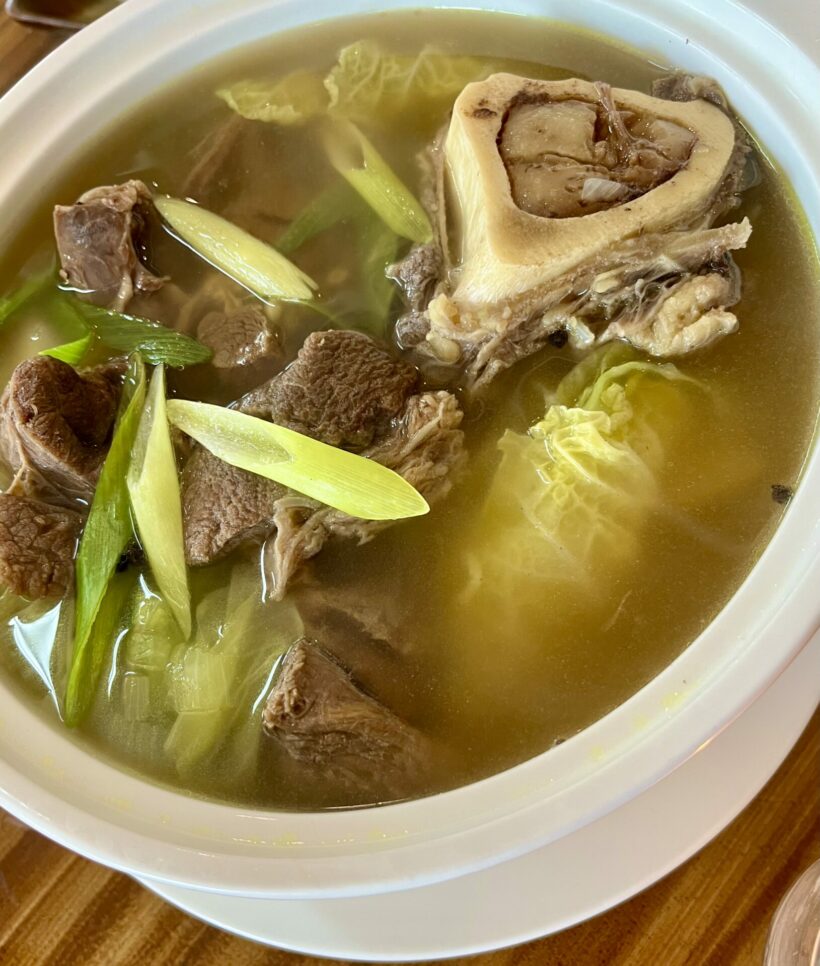
by George Banez
“We need to first know our own food so intimately before we can fully present its diversity internationally,” declared Filipino French digital content creator Erwan Heussaff. The James Beard Foundation Media Award recipient for promoting Filipino cuisine added: “But we are quite shy in nature, so, our food has never really penetrated internationally.” Across the table from him, American television writer and producer, Philip Rosenthal, listened intently. The endearing host and creator of the “Somebody Feed Phil” Netflix series asked the rhetorical, “Why?” And said, “There is a lot to be proud of.”
This segment of the “Manila” episode featured Phil sampling “pulutan,” or small plates like tapas, that go well with beer or spirits – gin and rum in the Philippines. Heussaff fed Phil “Pitichan”, a version of chicharon pork rind topped with “atchara” pickled vegetables and chunks of crispy fried “Pla-Pla,” a large Tilapia, wrapped in mustard leaf with a small dallop of fermented rice and shrimp. Then Chef Claude Tayag
brought him the pièce de resistance, “Sisig.”Described by Phil as “tangy pork mix” in the narration, “sisig,” is a sizzling hot plate of chopped pork face meat. These “pulutan” bites failed to make Phil break into his happy dance. Still, his comments to Heussaff were earnest.
The congenial and funny Phil introduced Episode 7 of Season 8 with, “I love Filipino food, (it has) so many different great influences yet so unique.” He assured viewers that they would “want” the Filipino food they find where they live. Then he quipped, “It helps if you like pork, like I do.” For a TV personality like Phil, who happens to be Jewish, that is the joke. Referenced by his comedian guest, Ike Barinholtz, observant jews do not eat pork because pig meat is not kosher or allowed. So, Phil was more than gracious to Heussaff.
Food-Travel Show’s “Affinity” to the Philippines
Hugely successful because of Phil’s endearing banter with the Netflix series director, his brother Richard, the show milks the lighthearted family comedy with snide remarks Phil makes of his lovely wife Monica and their two children who join him from time to time. From Season 1, released in 2018, to Season 6 in 2022, each episode concluded with a video call to his elderly parents, Helen and Max, in New York City. Phil
would show them delicacies from where he was filming to get a reaction and crack jokes. The subject of Phil’s Jewish jokes, his dad Max himself told a joke or two. So beloved were they that Episode 6 of Season 6 was the “Tribute to Helen and Max” show after they passed. In the episode, Phil and Monica asked Isabelita, their Filipino caregiver, to share stories.
Isabelita must have inspired the show’s visit to the Philippines. After 8 seasons and 48 episodes, they came. Phil acknowledged that his introduction to Filipino people was Isabelita. He said: “She’s one of the kindest, sweetest people I ever met. She used to give our dad his favorite fried chicken, which came from a place called Jollibee, a global fast-food franchise that was born here in the Philippines.”
Phil’s words felt vaguely familiar. In 2016, the late Anthony Bourdain opened Season 7 of his CNN series, “Parts Unknown,” with an episode on the Overseas Filipino Workers (OFW). After highlighting Filipino cover bands and eating home-cooked “Adobo” with them, Bourdain devoted a quarter of the episode to Aurora, a nanny who recently returned to Manila after 30 years of working in America. In the scene, she
gleefully improvised lyrics of a holiday song while she cooked “Kare-Kare”, the Filipino oxtail peanut stew. Aurora was preparing dinner for her extended family and special guest Anthony Bourdain.
Voicing over the segment, Bourdain narrated: “I am at this Christmas gathering today because of one of our directors, Erik Osterholm. It was Aurora who raised him. For over 20 years, she cared for and loved Erik and his sister…looked after the whole family.” He proceeded to read Erik’s letter: “Aurora is such an incredible woman. She has an infectious and loving energy, so powerful. I am 100% the man I am today
because this woman literally raised me from when I was six months old – singing to me, dancing with me, wiping away my tears, cooking for me, and making me laugh every turn.”
In a related essay, “Unfinished Business,” Bourdain on the “Medium” website wrote: “My daughter is no stranger to sisig and sinigang and adobo and holds me in disregard for being unable to procure her the delicious Filipino pastries and breads she finds at her other family’s (her caregiver’s) home.” Bourdain wrote that Tagalog words were commonly heard at his house because his daughter was cared for by Filipino
nanny, Vangie, from the beginning of her life.
Bourdain had no illusions that Episode 1 of Season 7 covered Filipino food or the culture of over 7,000 islands in the Philippines. He implied that this show was not going to be last about the country. But it was only the second he filmed in the Philippines. The other, Episode 5, Season 5 of “No Reservations,” mostly featured, “Lechon,” the Filipino whole roasted pig. Out of around 293 episodes of Bourdain’s four series, “A Cook’s Tour” (2002-2003), “No Reservations” (2005-2012), “The Layover” (2011 – 2013), and“Parts Unknown” (2013-2018), he released only two on the Philippines.
Filipino Food and American Media
Why did it take Philip Rosenthal and the late Anthony Bourdain that long to come? Both Netflix’s “Somebody Feed Phil” and Food Network’s “A Cooks Tour” series premiered with Saigon. Bourdain released 8 episodes in Vietnam and 10 episodes in Japan from 2002 to 2018. Moreover, CNN’s apparent replacement to Bourdain’s show “Stanley Tucci: Searching for Italy” that aired in 2021 devoted 6 episodes on the Hollywood actor’s nostalgic food trips all over Italy. A-lister actress Eva Longoria followed that with her own heritage travel: 6 episodes of “Searching for Mexico” in 2023, and 8 episodes of “Searching for Spain” in 2025. Will the Philippines be the next culinary show destination?
So, despite the Filipino caregivers’ introduction of Filipino fare to their ward and employer’s home, is interest not there yet? Favorites mentioned by Bourdain, like “Sinigang” sour soup and “Adobo” or meat stewed in vinegar, soy sauce, and garlic, are easy on anyone’s palate. And although not well covered in the media, families of five U.S. presidents and visitors to the White House have likely sampled Filipino food. The first Filipino American White House chef, Cristeta Comerford, incorporated Filipino dishes and flavors in the menu. President Obama, familiar with Filipino food from living in Hawaii, is said to have enjoyed Filipino-style barbecue skewers. Retired in 2024 as White House Executive Chef, Comerford worked there for nearly 30 years.
But what comes to mind by the mere mention of Filipino food to those uninitiated or unfamiliar? Perhaps the image remains of the 2003 “Balut” stunt eating challenge of Season 3, Episode 15 of NBC’s “Fear Factor.” Beloved in the Philippines and other Asian countries as a pick-me-up snack, “Balut” is a boiled duck egg that has partially developed. Perhaps also lingering like after-taste are scenes from the Travel Channel’s “Bizarre Foods with Andrew Zimmern.” It premiered in 2007 showing regional ingredients special to Filipinos like crickets, frogs, and “Tamilok” or “shipworm” the mollusk (shellfish) that thrives on dead mangrove trees.
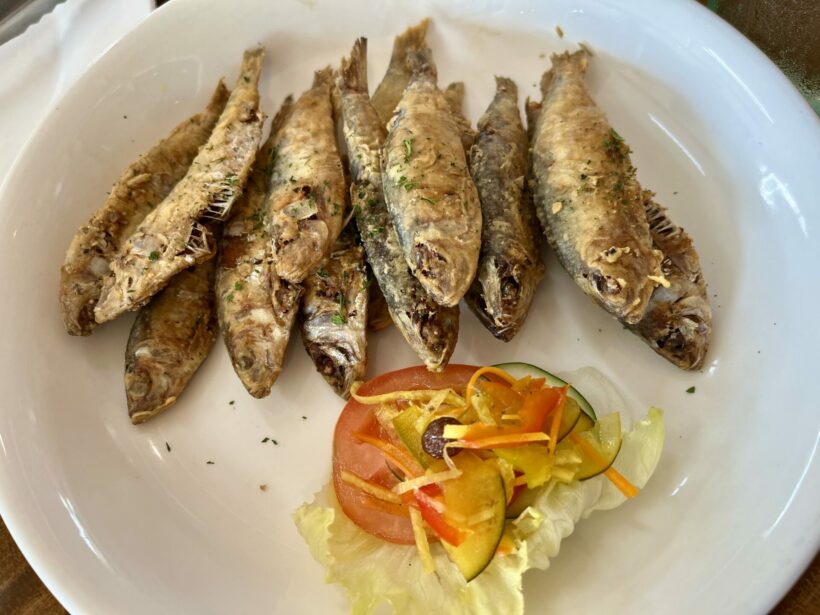
Tawilis fish of Taal Lake.
Is Filipino Shyness an Outcome or the Cause?
Perception matters. But is the self-proclaimed Filipino shyness making it worse? Be it caused by ignorance or modesty, however, this reticence in promoting the unique qualities of the cuisine holds back mainstreaming Filipino food and products. Purveyors pay the price. Globally marketing Filipino culture through travel shows, vlogs, and reviews matters only because of the bottom line.
In 2022, to promote her HBO-MAX series, “Take Out with Lisa Ling”, the American Journalist and TV personality told ABS-CBN Network: “Filipinos are in every sector of the American economy and so it always surprised me why Filipino food is not as pervasive as other Asian food like Chinese, Japanese, even Korean food now. I think that that is starting to change. I have been hearing about increasingly more and more
Filipino restaurants all throughout the country….And (referring to Filipino food) it’s delicious.”
So, “shyness” needs to go. Having “intimate knowledge” of one’s own cuisine can facilitate that. But simply relying on self-produced, even AI- generated digital content for insights is not enough. Amending pre-existing perceptions requires concerted effort.
About the Author:

George Banez is a writer of Filipino descent and is a retired non-profit professional living in Florida.



