

On Tuesday, 15 July at 12:30 p.m., demonstrators from across Europe gathered in front of the European External Action Service (EEAS) at 234 Petite Rue de la Loi, demanding the immediate suspension of the EU–Israel Association Agreement. On the eve of a major summit of the Foreign Ministers of the EU’s 27 Member States, civic pressure is intensifying in Belgium, across the continent, and globally: hunger strikes, vigils, legal actions, and political appeals are taking place hour by hour, denouncing the complicity of the EU governments in the ongoing carnage in Gaza and calling for concrete measures, starting with the suspension of trade relations.
Signed in Brussels on 20 November 1995 and in force since 2000, the EU–Israel Association Agreement is the legal foundation of the bilateral relations and political dialogue between the EU and Israel. It goes far beyond a simple free trade agreement, encompassing political, economic, agricultural, industrial, scientific (including pharmaceutical and defence sectors), and academic cooperation.
Replacing the 1975 agreement between the State of Israel and the European Economic Community (the EU’s predecessor), the 2000 Association Agreement is not merely a commercial text with strictly economic aims as it is founded on a key clause requiring respect for human rights. The Article 2 of the Association Agreement states that the ‘relations between the Parties, as well as all the provisions of the Agreement itself, shall be based on respect for human rights and democratic principles, which guides their internal and international policy and constitutes an essential element’ of the Agreement as enshrined in Article 2 of the Treaty on the Functioning of the European Union (TFEU).
Not only civil society organisations but also several EU member states and Members of the European Parliament highlight that Israel is gravely violating this clause in its ongoing assault on Gaza. As of today, seventeen countries have called for the activation of Article 2, stressing that successive Israeli governments since the signing of the agreement – from Sharon to Netanyahu – have intensified settlement expansion, aerial bombardments, and blocked aid delivery to the Gaza Strip, in blatant contradiction of the agreement’s commitments.
Despite these violations, the partnership has only deepened. Israel is integrated into the European Neighbourhood Policy, the Euro-Mediterranean Partnership, and participates in several EU programmes, including Erasmus+ and Horizon Europe. Economically, the ties between the parties remain particularly strong: according to a recent report presented to the French National Assembly by the MPs Mathilde Panot and Clémence Guetté, the « EU is Israel’s largest trading partner, ahead of the United States and China. Israel, by contrast, is the EU’s 31st trading partner. »
In light of the worsening humanitarian crisis in Gaza, the EU’s new High Representative for Foreign Affairs, Kaja Kallas, announced on 20 May a review of the agreement. However, a decision has already been postponed once, as suspending the agreement would require unanimous consent from all 27 member states, due to the EU’s decision-making constraints. Protesters are once again demanding urgent, concrete measures, beginning with the suspension of the agreement in line with international law and EU core values, reminding that Article 17 of the Treaty on European Union (TEU) obliges the European Commission, as guardian of the treaties, to ensure “the application of the Treaties and of measures adopted by the institutions pursuant to them.”
Strong Voices in the European Parliament
Speaking at a vigil held at the House of Compassion on Place du Béguinage in Brussels on Monday 14th July, the Irish MEP Lynn Boylan, Chair of the European Parliament’s Delegation for relations with Palestine (DPAL), expressed her position based on the principle of peoples’ right to self-determination: « It is not for us to decide what kind of state or government the Palestinians should have. But we must, with all our strength, ensure that they survive, so they may exercise their right to self-determination in the face of the ongoing genocidal process. »
Lynn Boylan also accused the EU of betraying its own core principles:
«The EU, as represented by its member states, continues to prioritise trade and financial interests over human rights. Its governments bow to the American pressure and prefer to censor artists rather than stop the massacres. »
She concluded with a direct and urgent appeal: «On 15 July, it is time to do what is right: suspend the EU–Israel Association Agreement and show the world that there can be no trade with genocidal regimes and warmongers. »
A Transnational, Intergenerational Mobilisation
Tuesday’s protest forms part of an ongoing mobilisation that began in Brussels with the arrival of the Global March to Gaza and has continued through a series of hunger strikes. Among the key organisers are House of Compassion and the Palestinian Refugees for Dignity collective, whose action highlights Article 2 of the TEU, which states that the EU is “founded on the values of respect for human dignity, freedom, democracy, equality, the rule of law, and respect for human rights.”
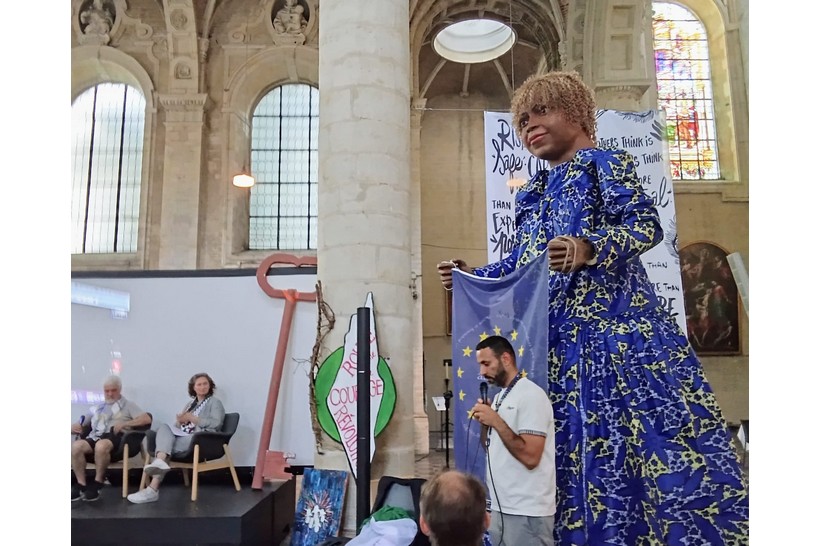
At the heart of the demonstration stood the “Giantess of Dignity” named Sabine after Sabine Amiyeme, a hairdresser from Liège who spent 13 years living undocumented in Belgium before being detained and threatened with deportation. Now a symbolic figure already present at previous actions, she is surrounded by banners calling for an end to EU complicity in Israeli crimes.
Hunger Strikes to Awaken Consciences
In Ghent, from 7 to 12 July, a new phase began with the launch of the campaign Hunger Strike 4 Justice in Palestine. A few weeks earlier, a first hunger strike had taken place in Brussels, from 16 to 21 June 2025, in the Church of Béguinage, where around thirty volunteers transformed the space into a living memorial: children’s dolls, bloodstained cloths, and a 15-metre banner listing hundreds of victims’ names.
These hunger strikes are part of a larger movement. Since January 2024, more than 750 people in at least ten countries (France, Switzerland, the Netherlands, Germany, Spain, the UK, Turkey, Lebanon, the US, Canada) have joined fasting campaigns to denounce global inaction in the face of horror.
A Legal Offensive Without Precedent
As attention turns to Kaja Kallas, expected to announce potential sanctions on 15 July, European jurists are preparing a landmark legal action. The association JURDI – Juristes pour le respect du droit international will file a complaint on Thursday with the Court of Justice of the European Union in Luxembourg. The target: the Commission and Council for “failing in their duties” to uphold international law in the face of crimes committed in Gaza. The complaint, based on Article 265 of the TFEU, accuses the EU institutions of prolonged inaction since October 2023.
«While 18 sanction packages have been imposed on Russia, no concrete measures have been taken against Israel, despite massive violations of humanitarian law » said criminal lawyer Alfonso Dorado, advisor to the ICC and co-author of the complaint.
A formal notice had already been sent on 12 May. Two months later, the legal procedure is moving forward, notably relying on the EEAS report requested by the 17 member states calling for a review of the EU–Israel agreement, which lists hundreds of violations of international humanitarian law by Israel in Gaza and the West Bank.
Former Diplomats Speak Out as Europe Reaches a Moral Crossroads
Another strong signal has come from 27 former EU ambassadors to the Middle East and North Africa. In a letter to EU leaders, they denounce the Union’s inaction in the face of the humanitarian crisis in Gaza and call, like the protesters, for the immediate suspension of the EU–Israel Association Agreement.
In this context, the 15 July mobilisation continues the collective civic effort to restore meaning to the EU’s founding principles. A new generation of activists, refugees, intellectuals, and elected officials are trying to force the EU out of its paralysis, echoing Lynn Boylan:
“Their reputation is in tatters. It is time to act.”
As one protest sign read: “The Union is founded on respect for human dignity.”
On 15 July, protesters are calling on EU leaders to live up to that promise.



