

by George Banez
“NO.” I politely told one of the participating housewives. She suggested adding sugar to the Filipino “Chicken Adobo” recipe I prepared for them to cook. Back in Fukuoka, Japan, in the 90s, I said “YES” to every opportunity to make extra Yen. As a newly arrived international student, I barely spoke Japanese. But I cared more for the appearance fee than my reputation. So, I once agreed to go around the city with a big celebrity and give my one-word opinion on the local food on national TV. After that food-travel show aired, I somehow ended in a local news segment making “Adobo.” At that time, Fukuoka was gearing up for a big international event, hence their interest in other cultures.
Before I even got this unsolicited advice to improve on “Adobo,” I had already shown other women groups how to cook Filipino favorites like veggie “Lumpia” spring rolls and “Sotanghon” stir-fried noodles. Despite not having cooked professionally in my life, nor any culinary training under my belt, I felt confident saying, “No.” I knew what adobo was not. I grew up eating it in the Philippines.
Filipinos love adobo. It is a stew of meat, seafood, or vegetable simmered in vinegar, cloves of garlic, whole peppercorns, and a few dried laurel leaves. Mention “adobo” to them, especially those from the region around the capital, Manila, and they imagine chicken and pork stewing in that vinegar marinade, some water, and soy sauce. Typically saucy or soupy, this adobo, when paired with “Sinigang” sour soup and white rice, is the everyday fare that homesick Filipinos crave. When properly cooked, this classic chicken-pork adobo tastes tangy but not sour. It is aromatic but not spicy. Unlike the soy-marinated Japanese Terriyaki, Filipino adobo is not sweet. It is not meant to be sweet. And for me, chicken adobo is more similar in taste and texture to “cCq au vin,” if this French dish had a little more of the braising red wine liquid left.
Whenever asked to share Filipino food, I cook this soy sauce adobo prototype to introduce the uninitiated to the cuisine. But this is not the adobo I remember from childhood. The adobo I enjoyed eating at home had no soy sauce. Filipinos aptly call this variant, “Adobong Puti,” or White Adobo. Home cooks in the Bicol region, where my mother was born, make adobo with pork belly cut into big cubes, with the skin on. They marinate it in sea salt, vinegar, and the same trio of aromatics: garlic, peppercorns, and laurel leaves. Then they simmer it uncovered in a “Kawali,” a wok-like vessel, until all stewing liquid dries out and pork fat is rendered down. Slow cooking over low heat allows vinegar to tenderize the meat and the acidity to evaporate. The pork bits absorb the tangy flavors throughout. Cooks then let the meat fry some more in its own fat before serving with rice.
This “dry” pork adobo can be stored in its lard and eaten for the rest of the week without refrigeration. A diner simply taps the meat over rice to hit it with fat. In the tropical Pacific weather, heating adobo may not even be necessary. In our house, we drizzled soy sauce on the rice greased with lard from adobo. In my mother’s hometown, it is the taste and quality of the pork that matters. In other places, I heard that cooks have hog meat gender preference too. Small towns in the Philippines used to designate a market day every week. That is when meat of freshly slaughtered animals is available for sale. So, this method of thoroughly cooking pork in vinegar preserves it until the next market day without having to rely on spices to enhance or cover up flavors. The cooking process also likely extracts the antimicrobial essential oils in laurel leaves (Laurus nobilis) to keep spoilage bacteria away.
No Right or Wrong Adobo
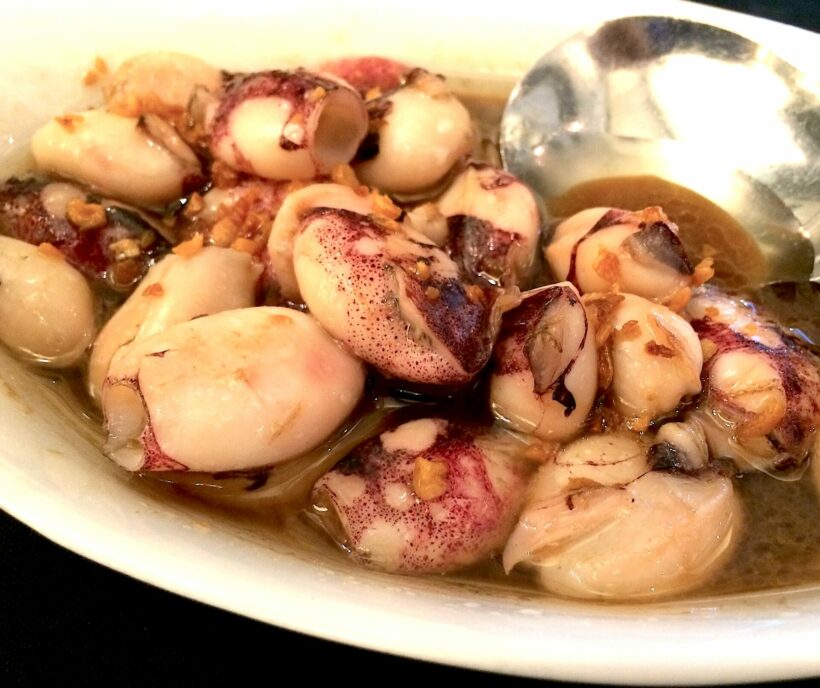
Cooks from Bicol, a coconut-growing region South of Manila, add coconut milk or substitute it for vinegar as the stewing marinade in their White Adobo. They slow-cook the adobo until the meat is tender, and coconut milk becomes oily. They stop just before the coconut milk residue turns brown. They may add “Siling Labuyo,” or Birds’ eye chili to the stew or substitute it for garlic. “Labuyo” chili gives this adobo some heat, a regional taste preference. I was told that this flavor profile works well for game meat, like “Bayawak” or monitor lizard. Coconut milk and chilis tone down the gaminess. Another favorite, “Adobong Pusit,” or Squid Adobo, also develops deeper umami with the addition of one whole, unsliced “Siling Haba,” or Finger Chili. But squid adobo in our house was never spicy-hot. Nor were the squiddy attributes ever missing. With or without coconut milk, the squid is stewed in its ink with vinegar, aromatics, and sometimes soy sauce or pork. To coastal Filipinos, it is squid freshness and size – smaller is better – that cannot be compromised.
Vegetables like “Kangkong” or water spinach and “Sitaw” or Long Beans, when simmered in vinegar, garlic, and soy sauce, with or without pork bits, also fall under the “adobo” label. Regardless of the protein or greens used, however, adobo is not that to Filipinos unless “Sukang Puti,” or white vinegar, is used. They prefer vinegar derived from sugar cane, coconut, or nipa palm sap. Depending on the age, white vinegar retains some sweetness. But Filipinos look for vinegars with rounded sourness. Sharp and ideal as dipping sauce when uncooked, naturally fermented vinegars when thoroughly cooked, release the fruitiness from the wine they come from. As such, cooks simmer adobo uncovered or add the vinegar only after the stew boils to let it evaporate slowly.
Now, imagine using balsamic vinegar. A relative who had lived longer in New York City than the Philippines once cooked that version of adobo for family in Manila. She rightfully claimed that hers was a big hit among friends in Manhattan. But the homeboys were not impressed. Nancy Reyes Lumen, self-proclaimed “Adobo Queen” and third-generation heir to The Aristocrat Restaurant chain, said that “there is no wrong or right adobo.” Food hospitality executive and culinary instructor, Rosario Gerundo, also said that all versions are welcome for as long as they are named accordingly. Sweetening the adobo marinade with brown sugar and pineapple juice turns it another dish, “Humba.” While adding muscovado sugar and star anise in braising pork hock makes it “Pata Tim.”
What’s the Fuss about Rachel Ray’s Adobo?
Popular American TV cook, Rachel Ray, made money for YouTube vloggers, like Uncle Roger, whose videos reacting to her techniques became viral. Five years ago, Ray released an episode on cooking Filipino Chicken Adobo. Perhaps through vitriol masquerading as humor, Uncle Roger “spoke” for some of his 6.7 million viewers who disapproved of Ray’s “interpretation.” Putting Uncle Roger’s bias aside, I am one of the 64K YouTube viewers of Rachel Ray’s Show who could not get past her saying, “…now it’s going to get spicy and good.”
After this edification, Ray, proceeding to fry coarse black pepper in olive oil, adds sliced chilis to the pot. She directly pours three quarters cup of vinegar into the “spicy” mix where she also dropped fresh laurel leaves and scallions. She jokes that the steam could, “clear your sinuses out.” Then she pours an equal amount of Tamari, “aged soy sauce,” according to her. She proceeds to “…sweeten it up with about two tablespoons of light brown sugar.” Fast forward, she instructs viewers to put the lid on, simmer, and reduce the braising liquid to thicken it up like sauce to “glaze” the chicken.
Obviously, Ray had in mind some spicy Filipino version of the Chinese American General Tsao Chicken Take Out or the food court Terriyaki Chicken. So, why sell it as Filipino Adobo? Surely, diners care more about taste than labels, right? But in this case, the intended flavor of adobo happens to be the exact opposite. By analogy, dressing up coq au vin with hot sauce to “spice it up,” for me, is not about right or wrong. It is a missed opportunity to taste something out of the ordinary and to enjoy a dish the way its originators would. In appropriating cultures for profit, when does innovation become misrepresentation?
So, in hindsight, should I have conceded to the well-meaning Japanese housewife who wanted to “elevate” my Chicken Adobo recipe with a dash of sugar? NO.
About the Author:

George Banez is a writer of Filipino descent and is a retired non-profit professional living in Florida.



