

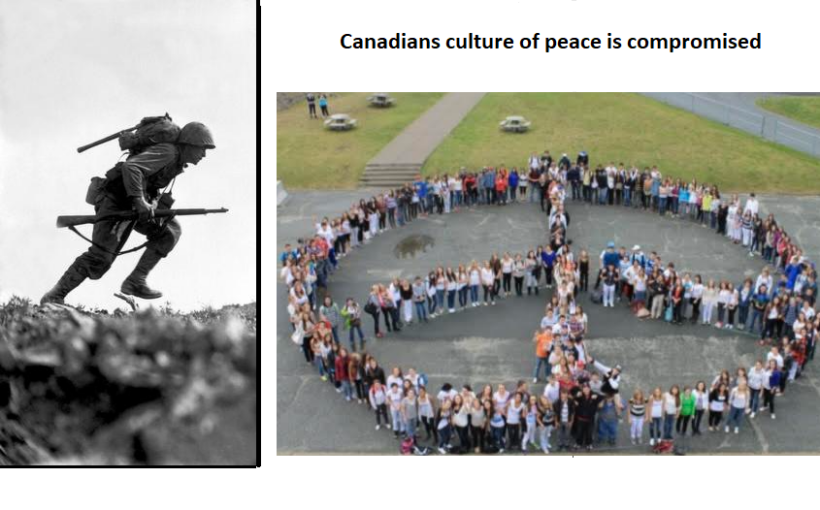
During the last decades and during the cold war, all the Canadian government choose not to increase the expenses in defenses has NATO demanded. The existential threat posed by the possibility of a nuclear war between the Soviet Union and the United States had, preoccupied Canadians since the late 1940s, and especially following the election of American President Ronald Reagan in 1980 with the American Star Wars space defense research program.
During the cold war, many Canadians were involved in the peace and anti-war movement. The possibility of a nuclear war over Canada motivated anti-nuclear activists and led to the creation of Canadian Voice of Women for Peace.
In fact, if a nuclear war had broken out between the United States and the Soviet Union during the Cold War. The Canadian government knew it would probably have taken place over Canadian territory. This is why despite the pressures of the Americans and NATO in 1969, the Prime Minister Pierre Trudeau signed the international Nuclear Non-Proliferation Treaty and nuclear missiles were progressively banned from Canadian territory.
Prime minister Trudeau chose, in the 1970’ and 1980’ diplomacy over arms race and wars and dialogue over confrontation.
Unlike its predecessors, Prime Minister Mark Carney, elected last April, failed to defend Canada’s pacifist and peace culture facing Trump administration pressure. In June at the NATO leaders’ summit his government decided to pay billions of dollars annually on defense within the next decade. The Prime minister’s decision was made without consulting the Canadian population.
Earlier this week, a directive was sent to the federal ministers, asking them to find ways to reduce program spending by 7.5 per cent in the fiscal year that is on April 1, 2026, followed by 10 per cent in savings the next year and 15 per cent in the 2028-2029 fiscal year.
These programs spending are related to direct services to the population such as federal transfers to provinces and territories for health and social services, debt payments and direct transfers to individuals such as seniors benefits.
The amount of money that will be allocated for defense is equivalent to 5 per cent of the country’s gross domestic product. Carney never talked about increasing the defense budget to $150 billion during the election campaign. The Canadian people didn’t give the Liberal Party such power to abandon the Canadian culture of peace and to override the national budget and surely did not give them the mandate to proceed with cuts in health services and in senior benefits.
Throughout the spring election period, Carney had clearly expressed that Canadian sovereignty was one of his priorities. Once elected, facing the Trump politics on tariff his team of ministers worked hard to guarantee Canada’s economic sovereignty by supporting the Canadian industry and workers. However, Carney gave in to the demands of the Trump American administration and NATO by dramatically increasing the budget allocated to military spending.
Canada is breaking with the peace and diplomatic tradition
Carney’s government is breaking with the tradition of Canadian governments to stand up to the American military-industrial complex. It is breaking with the Canadian values and this idea of a people of peace generate peacemakers leaders.
The Carney government trend is completely opposite, and his action is preparing the Canadians for future confrontations and wars. Unlike its predecessors, Carney seems not to recognize that an arms race against Russia and China would be futile. Furthermore it would increase the likelihood of a direct confrontation on Canadian territory.
But the most worrying thing is that the government seems to prioritize mainly the military industry. This decision will hit hard the direct services to the population, such as health services and benefits for the elderly.
Peaceful culture and peacemakers leaders – Canadians values and tradition
Over the last century, Canadians embraced the culture of peace and have chosen leaders that promote diplomacy and dialogue to resolve conflicts.
Moreover, several Canadian leaders since the last decades did not let themselves be intimidated by the Americans and have publicly declared their opposition the offensive wars operated by the US.
In fact, since World War II, Canadians leaders have increasingly turned to dialogue and diplomatic means to resolve conflicts. Given their geographical location, side by side with major military powers including Russia in the North, the United States in the South and for the last few decades, China in the West (pacific region) Canada chose diplomacy and dialogue instead of direct confrontation and isolationist policy which was a wise choice.
Canadians peaceful leaders
After the second world war, Lester B. Pearson had played an important role in the founding of the UN. During the conflict between Israel and its Arab neighbors, the United Nations responded to the Suez Crisis of 1956, a war between the alliance of the United Kingdom, France, and Israel, versus Egypt, which was supported by other Arab nations. When a ceasefire was declared in 1957, Pearson suggested that the United Nations station a peacekeeping force in the Suez in order to ensure that the ceasefire was honored by both sides.
He was awarded the Nobel Peace Prize in recognition of his diplomatic role in resolving the Suez Canal Crisis (1956). The selection committee declared that Pearson had saved the world.
From 1963 to 1968, Pearson served as Prime Minister and signed the Canada-U.S. Automotive Products Agreement (the Auto Pact) in January 1965, and the unemployment rate reached its lowest levels in over a decade.
During the Vietnam War, Canada remained officially neutral, although mutual assistance was periodically provided. In fact, Canada and Vietnam share a common history, as both nations were part of the French colonial empire.
During his term, Pearson resisted American pressure for Canada to participate in the Vietnam War. Visiting the United States, Pearson gave a speech at the University in Philadelphia on April 2, 1965, advocating a negotiated settlement of the Vietnam War. Then when he visited President Lyndon Baines Johnson a few hours later, Johnson strongly admonished Pearson. According to legend in Canada, Johnson grabbed Pearson by the lapel, shook him, and shouted, “Dammit, you pissed on my rug!”
In 1968, Prime Minister Pierre Elliott Trudeau announced that he wanted to normalize Canada’s relations with the People’s Republic of China. The administration of U.S. President Lyndon B. Johnson opposed any diplomatic recognition of Communist China by its allies.
The Trudeau government therefore waited for the arrival of a new president, Richard Nixon, to begin serious discussions for official recognition of the People’s Republic of China.
Moreover at the time Trudeau had the twin goals of improving East-West relations and reviving arms control negotiations between the Soviets and the West.
In 1976, despite American opposition, Pierre Elliott Trudeau was the first NATO head of state to visit Cuba and Fidel Castro. The two men quickly became friends. Upon Castro’s death in 2016, Justin Trudeau, then Prime Minister of Canada, expressed his sadness and declared that Fidel Castro was a friend of Canada, his words deeply shocked the American administration.
In 1985, Prime Minister Brian Mulroney turned down President Reagan’s invitation to take part in his “Star Wars” space defense research program, deciding that it is not in the Canadian national interest. Nicknamed the Star Wars program, the program proposed a missile defense system intended to protect the United States from attack by ballistic nuclear missiles.
Mulroney’s action followed a recommendation made by a special parliamentary committee that Canada should maintain some distance from the U.S. program.
A few years later, the fall of the Berlin Wall vindicated Canadians’ decision not to invest colossal amounts of public money and research into the Star Wars defense system.
On September 18, 1997, at a conference in Oslo, Canadians achieved the unprecedented feat of abolishing antipersonnel mines with the agreement signed by 100 countries. Some countries simply left the conference. This was particularly the case with the United States, which had wanted to see certain exceptions included in the text. Several other major manufacturers or users of antipersonnel mines—Russia and the People’s Republic of China in particular—also refused to sign the text of the future treaty.
In February 2003, more than 150,000 people took to the streets in Montreal to express their opposition to the war in Irak.The Prime minister Jean Chrétien, having received pressure from the US government to join the war, refused to engage in a new offensive war with Iraq on March 17, 2003.
Today Canadian culture of peace is compromised by the government’s Carney support for militarization and confrontation.
Why this sudden change? Why this massive investment of Canadian public funds in weapons and instruments of massive destruction?
Why suddenly prioritizing violent means over diplomacy and dialogue?
Why did the Carney government abandon Canada’s peaceful culture when facing the American military-industrial complex at the NATO Summit in June?
In this world grappling with more and more uncertainties and conflicts. Canadians need leaders who will put Trump and NATO arrogance in their place. Canadians need leaders who are not afraid to speak out against injustice, immoral acts and offensive war that generate suffering and poverty to tens of millions of people around the world.
Canadians need leaders who respect their peaceful cultural traditions.
Leaders such as Brian Mulroney:
In 1980′ Prime minister Mulroney’s opposition to apartheid was not driven by simple domestic politics and he had some hostility from various groups and leaders around the world.
In an interview given to the Conservation, Mulroney explained the issue was to him one of simple justice and morality. Like his early political mentor, John Diefenbaker, he thought the system of apartheid was indefensible and immoral.
Mulroney thought it was contrary to Canadian values, which have their roots in the founding of the country as a place dedicated to bringing different groups closer together, rather than farther apart in division and in conflict.
People who say that nations only have interests, no friendships, are nonsense. … Everybody has interests but also friendships. And you can’t deal at the international level with any hostility. You gotta try and bring people (together). Canada is a middle power. We’re not a superpower. So we have to leverage our assets as best we can and bring people together. (Source: The Conversation)
____________________________________________
Source : The Conversation , Wikipedia and The Globe and Mail, Federal ministers told to find ambitious’ saving before fall, Ottawa, eyes rising cuts to program spending over coming years after promising defence boost at NATO Leaders Summit meeting, Tuesday July 8, 2025.