
Building together a path for our cities
On February 7 and 8, 2026, Cecina, in the province of Livorno, will host the National Coordination of organizations involved in the construction of the Fourth World March for Peace and Nonviolence, an event conceived not as a simple organizational meeting, but as a space for convergence, listening, and shared planning.
The goal of the meeting is clear: to create together a common path for our cities, inspired by the principles of the World March for Peace and Nonviolence, capable of transforming a global vision into concrete, widespread, and recognizable local practices.
In a world marked by wars, rearmament, growing inequalities, environmental crises, and loss of meaning, the National Coordination was born from the need to connect territories, experiences, and people, overcoming the isolation of individual initiatives and building a shared language and horizon.
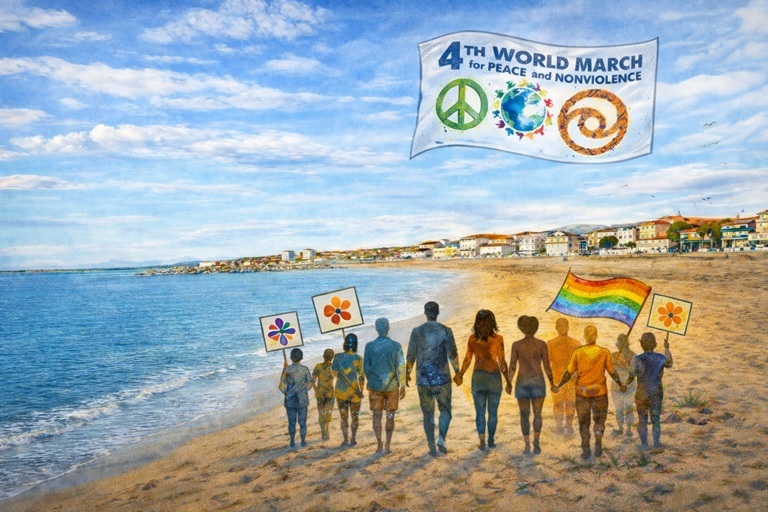
The Fourth World March for Peace and Nonviolence, which will take place from September 21 to October 4, 2026, proposes a profound change of perspective: no longer a march that physically crosses the planet, but the March “in my city,” a week of simultaneous actions in cities on all continents, linked together by the same intention and a global scope.
The Cecina Coordination fully embraces this vision: strengthening the bonds between territories, supporting the autonomy of local initiatives and, at the same time, making them part of a common, visible, and recognizable process.
Coordination Program
On Saturday, February 7, at the Municipal Library of Cecina, the Coordination will open with a public welcome and greeting ceremony, which will see the participation of institutions and connected cities.
During the afternoon, the purpose of the meeting and the objectives of the Coordination will be presented, together with an overview of the Fourth World March, exploring shared tools and paths: from the manifesto to communication, from the website and social media to the press office, to the Schools on the March and Universities on the March projects.
Ample space will be dedicated to sharing experiences and proposals from cities, because the Coordination is born from the grassroots and is nourished by the plurality of territories. The afternoon will also be enriched by an international connection and a moment of dialogue with the experience of Peace Walk to Jerusalem, to underline the global and interconnected dimension of the journey.
On Sunday, February 8, at the headquarters of “Fuori dal Comune,” the work will continue in a more operational form. After a summary of the discussion that emerged, the Coordination will be dedicated to defining the next steps for the realization of the March and the construction of the National Coordination program, with the aim of giving continuity to the process and making it effective in the territories.
The morning will conclude with a symbolic and public gesture: the creation of a mural dedicated to the Fourth World March for Peace and Nonviolence – “In my city,” as a reflection of the work done and as a visible sign in the urban space of Cecina.
Art, peace, and public space
The National Coordination is taking place at a particularly significant moment for the city. Until March 1, 2026, the Municipal Exhibition Center in Cecina is hosting the exhibition “Pablo Picasso – His Posters,” an internationally renowned exhibition that presents, for the first time in Italy, 58 original posters from the Röthlisberger Collection.
One of the most intense sections of the exhibition is the Peace Posters section, dedicated to the deep connection between Picasso and the theme of peace. In the posters created after World War II, the artist chose an essential and accessible language, bringing art out of museums and into public spaces. The famous dove of peace, created in 1949, thus became a universal symbol: fragile, simple, but capable of crossing geographical and ideological boundaries.
This coincidence between the National Coordination and the exhibition opens up a natural dialogue: art as civil responsibility, the manifesto as a democratic tool of communication, the city as a place where peace is not only declared, but made visible and shared.
From Cecina, from our cities, a path can begin that is capable of influencing the present and opening up the future: peace can once again become a daily and shared practice.