

Not all decisions of power are explained by the logic of security, nor even by strategic interest. Some obey a more primitive impulse: punishment. The migration offensive deployed in Minneapolis at the beginning of January does not respond to a demographic emergency, an exceptional criminal threat, or a verifiable operational necessity. It responds to something else. It responds to the use of the State as an instrument of political, racial, and symbolic revenge by Donald Trump.
The city chosen is not accidental. Minneapolis does not concentrate the largest flows of irregular migration in the country. It is not a border city. It is not a corridor for drug trafficking. It is not an enclave of transnational criminal networks. Minnesota hosts around one hundred thousand undocumented people, a modest figure when compared to Texas or Florida. And yet Minneapolis and Saint Paul register a disproportionate density of immigration agents, even higher than that of local police forces. That anomaly reveals the key: this is not about controlling a phenomenon, but about disciplining a territory.
The federal deployment was officially presented as an operation against fraudsters, rapists, murderers, and gang members. That language is not new. It is the habitual vocabulary of mass criminalization, designed to dehumanize and justify the expansive use of force. The observed reality, however, shows something else: indiscriminate detentions, violent raids, incursions into civilian spaces, protests repressed, and deaths that fit no standard of proportionality. The message was not surgical. It was exemplary.
Why Minneapolis? Because Minneapolis embodies everything that Trumpism despises.
It is a city governed by Democrats. A progressive stronghold in a state that Trump systematically lost in every presidential election in which he competed. It is home to the largest Somali community in the country: Black, Muslim, organized, and visible. It is the political district of one of his most openly declared enemies, Ilhan Omar, a figure who condenses in her very existence what white nationalism perceives as a threat: woman, refugee, Muslim, left-wing, and democratically elected.
But Minneapolis is also something else: it is memory. It was there that the police killing of George Floyd detonated a global uprising against structural racism and state violence. It was there that the Black Lives Matter movement took form, crossed borders, and reached the gates of the White House. For Trump, Minneapolis is not merely an adversarial city. It is an open wound in his imaginary of authority. And wounds, in his logic, must be punished.
The punishment takes the form of the federal migration apparatus. ICE, conceived originally as an administrative agency, is transformed into an internal occupation force. Not to protect, but to intimidate. Not to apply the law neutrally, but to send a political signal: disobedience has a cost. Difference has a cost. Resistance has a cost.
That use of power is not only morally questionable. It is legally problematic.
At the constitutional level, massive and selective raids directly strain the Fourth Amendment, which protects against arbitrary detention and requires individualized probable cause. Immigration status does not suspend the Constitution. Nor does it authorize collective detentions based on racial or territorial profiling. The Fifth Amendment, which guarantees due process, is eroded when deprivation of liberty is executed as a punitive spectacle rather than as an individualized administrative procedure. The Fourteenth Amendment, for its part, prohibits discrimination and guarantees equal protection under the law. When federal force is systematically concentrated in Black, Muslim, and politically oppositional communities, discriminatory intent ceases to be a suspicion and becomes a legally defensible hypothesis.
Federal immigration legislation, particularly the Immigration and Nationality Act, does not authorize raids designed as political punishment nor deployments aimed at undermining adversarial local governments. Administrative discretion has limits. Disproportion, selectivity, and deviation of purpose constitute abuse of power.
At the international level, the obligations are even clearer. The United States is a party to the International Covenant on Civil and Political Rights, which prohibits arbitrary detention, guarantees due process, and requires equality before the law without discrimination. It is also a party to the International Convention on the Elimination of All Forms of Racial Discrimination, which obliges States to eradicate practices that, by their purpose or effect, produce racial discrimination. International human rights law does not distinguish between citizens and non-citizens in what is essential: dignity is not conditional.
From that framework, the raids in Minneapolis cannot be analyzed as a harsh but legitimate migration policy. They are, rather, a form of structural violence exercised by the State against a symbolically hostile territory. A use of fear as a technology of governance. An authoritarian pedagogy directed both at migrants and at society as a whole.
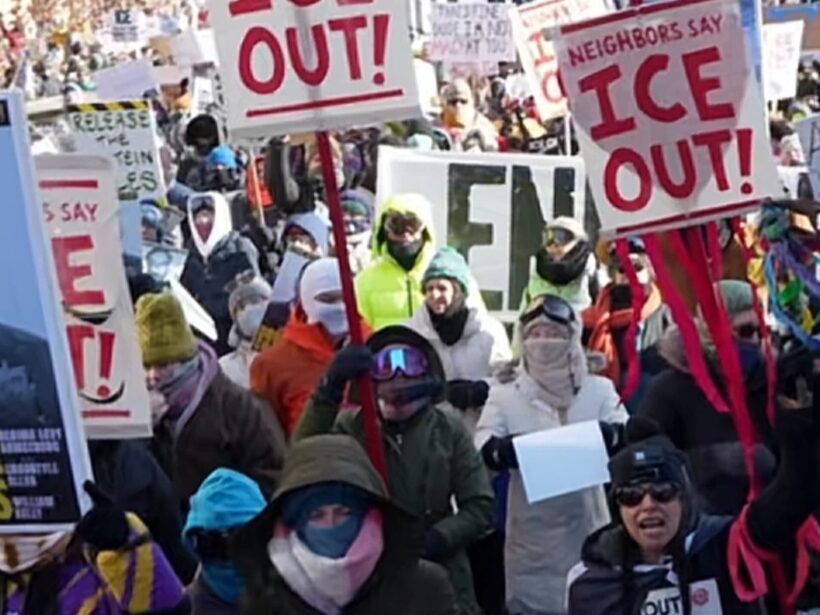
Against this, the social response of Minneapolis acquires particular value. Neighbors who warn with whistles, who distribute food, who record operations, who intervene, who organize. That reaction explains, paradoxically, the choice of punishment. One does not punish those who submit. One punishes those who respond.
The thesis, then, is clear: Minneapolis is not the scene of a migration policy. It is the scene of retaliation. The punishment of a president who does not govern from the law, but from resentment; not from institutional responsibility, but from animosity; not from security, but from hatred.
When the State is used to avenge political defeats, discipline identities, and erase uncomfortable memories, the problem ceases to be local. It becomes a symptom of democratic regression. And when the law is transformed into a weapon against those who embody diversity, what is at stake is not only the fate of migrants, but the moral and legal health of the entire society.
Minneapolis, today, is not an exception. It is a warning.



