

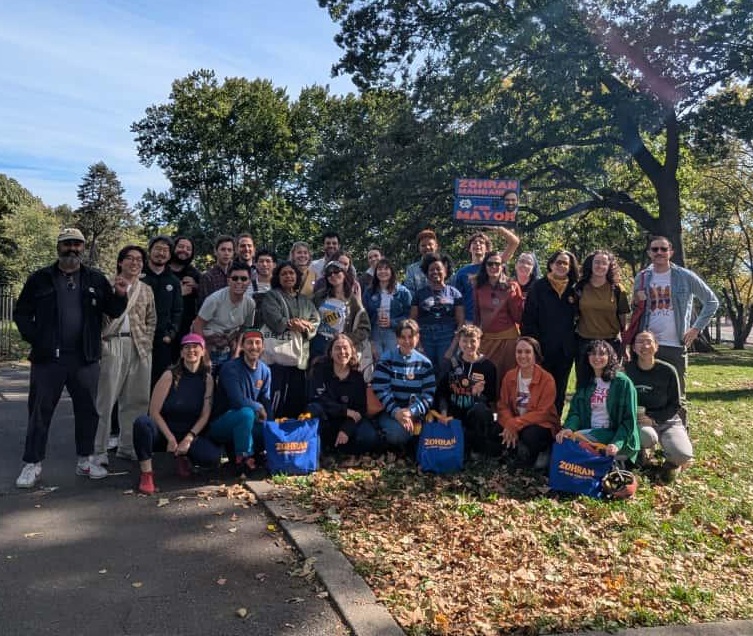
At the top of the hill in Arthur S. Somers Park, in the shade of centuries-old trees, local pro-Zohran Mamdani activists have gathered. We’re in a neighborhood a quarter of an hour’s drive from Bed-Stuy, where I live, across Pacific Avenue, the artery that forms the backbone of Brooklyn. There are fewer people than in the first group I worked with in late September, but that’s not a bad sign; on the contrary, as soon as they grow larger, the groups split up to “colonize” new areas. The interactive map for online registering now displays a web of intersections; these are the points from which the canvas (the door-to-door canvassing with potential voters) begins each day. The fractal figure that reproduces itself over and over again is most reminiscent of the Zohran For New York City campaign. And that’s not all: each group is branching out into WhatsApp groups and subgroups to coordinate more quickly and better distribute resources throughout the week.
As is customary, we applaud the new activists, and one by one, they introduce themselves briefly. A young man and a young woman are in charge of the day, so they begin to outline the work we will be doing. I note a sense of confidence; I would dare say self-assurance, but not boldness. Indeed, the campaign, despite a thousand barbs, snares, and provocations, is proceeding at full speed, and Zohran continues to rise in the polls; all of this is spurring the young people who today speak openly of “winning the mandate” (victory achieved with more than 50% of the vote) as if it were a goal within reach.
A few nights ago, the eagerly awaited debate took place between the three candidates (independent Cuomo, Republican Sliwa, and Democrat Mamdani) vying for the prestigious post of mayor of one of the largest and most powerful cities on the planet. I followed almost the entire debate, and I can say that, regardless of my personal political sympathies for Zohran’s ideas, I truly don’t feel biased in saying he appears to have no competition. His strength lies not in his political finesse, but in the simplicity with which he speaks about things we’ve grown accustomed to believing impossible for years, like dreams we could joke about with friends over dinner (Popular supermarkets because everyone has the right to eat! Free buses! Tax multimillionaires! Put a stop to the arrogance of real estate developers!), which today, thanks to Zohran, seem closer.
And he’s not just talking about it in theory: several teams of economists, engineers, lawyers, and educators are working to provide creative and workable structural plans. Zohran’s great promise is that the system of privilege that we’ve been led to believe was untouchable, under penalty of bankruptcy and poverty (the latter, meanwhile, we can actually see creeping up on us), will be challenged. The economic structure of neoliberalism that dominates the city will likely not be radically altered, but simply the possibility of a different perspective, one bearing other values, excites young people and all those who have maintained a sufficiently pure heart, while panicking those who have sacrificed every other ideal for self-interest.
In particular, the young people who threw themselves headlong into the campaign seem to have formed a special bond with the aspiring mayor, a sort of friendship that I see shine in their eyes every time they talk about him; they rejoice and suffer with him, they feel like friends. They say that Zohran loved walking in parks, but now, poor thing, he has to go to cemeteries to enjoy a moment of solitude. They firmly assert that Zohran doesn’t need to lie to earn love, that Zohran, unlike Cuomo, has never had anything to do with Trump and can say it with his head held high. Zohran has earned their trust.
These days in India, the country of Zhoran’s mother, the famous filmmaker Mira Nair, Diwali, the festival of lanterns, is being celebrated; outside every home, a lantern is lit, symbolizing the return of light after years of darkness and chaos. They celebrate the return of Rama and Sita to Ayodhya, the great capital of ancient India. Rama represents the greatest good for mankind, dharma in its highest and most perfect form, the order of the cosmos; “He Ram (Oh Rama)” were Gandhi’s last words as he was dying.
I honestly don’t believe Zohran will embody all this, and I hope he at least won’t disappoint us. But in the eyes of the kids I meet at the canvas, so alight with life and political passion, I see many small lanterns, and each fire seems eager to light another.
I must leave my ramblings; it’s time to pose for the group photo, to which we’ll add a video to send Zohran a happy birthday (he’s turning thirty-four).
I’ll be working in tandem with Amanda, who grew up in a small community in Ohio and came to Brooklyn after a work experience in Africa. We’ll knock on the imposing doors of brownstones and enter rather dilapidated vintage apartment buildings; along our journey, we’ll meet other young people enthusiastic about Zohran, suspicious older women with tiger-like dogs, a Mexican woman who will decide to open the door only after hearing Zohran’s name, (as if it were a password) and a Jewish woman who will want to share her fears with us so that we reassure her. Amanda will be so good at putting her at ease that she almost never will want to let us leave.
I’ve written the verbs in the future tense because there’s still one thought in my head I want to share, but I’d like to do so quietly, for good luck, because for now it’s just a hope: His name is Graham Platner, he’s a veteran and an oyster farmer; in 2026 he’ll run for governor of Maine. Like Zohran, Graham is supported by Senator Bernie Sanders, and his campaign shares its political and advertising apparatus with the New York campaign. Graham’s ideas are more or less the same as our darling’s; they are socialist (he even proposes public healthcare for all) and anti-oligarchic, and his sudden entry into the race has caused quite a stir.
I have to move on, Amanda’s calling me to start canvassing.



