

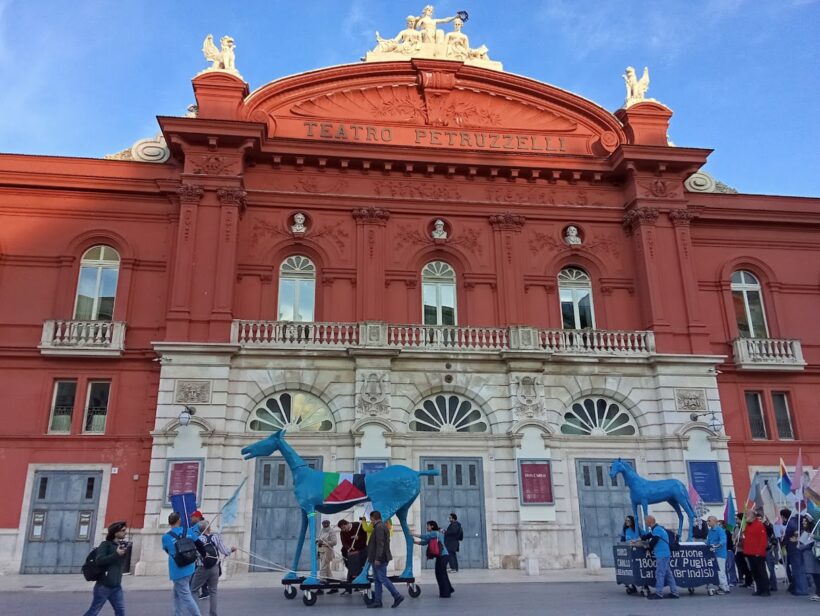
The final stages of Marco Cavallo’s journey have brought the blue horse to Brindisi and Bari, two strategic ports in southern Italy facing the Adriatic and looking towards Albania. From these shores, Italy is experimenting with the externalisation of borders on behalf of a European Union that is becoming less supranational and increasingly, and dangerously, bent to the will and costly whims of ethno-nationalist and far-right factions. In this instance, that takes the form of exporting a model of administrative detention which, over recent decades, has already proven a failure on economic, human, environmental, social, and cultural levels.
In Gjadër and Shëngjin, Albania, new detention centres have been built, modelled on the already disastrous Italian CPRs (Centres for Repatriation). They stand as outposts of a European Union that imprisons and expels before it welcomes, outsourcing its conscience along with identity promises founded on exclusion and confinement, and in doing so evading the very principles of the rule of law.
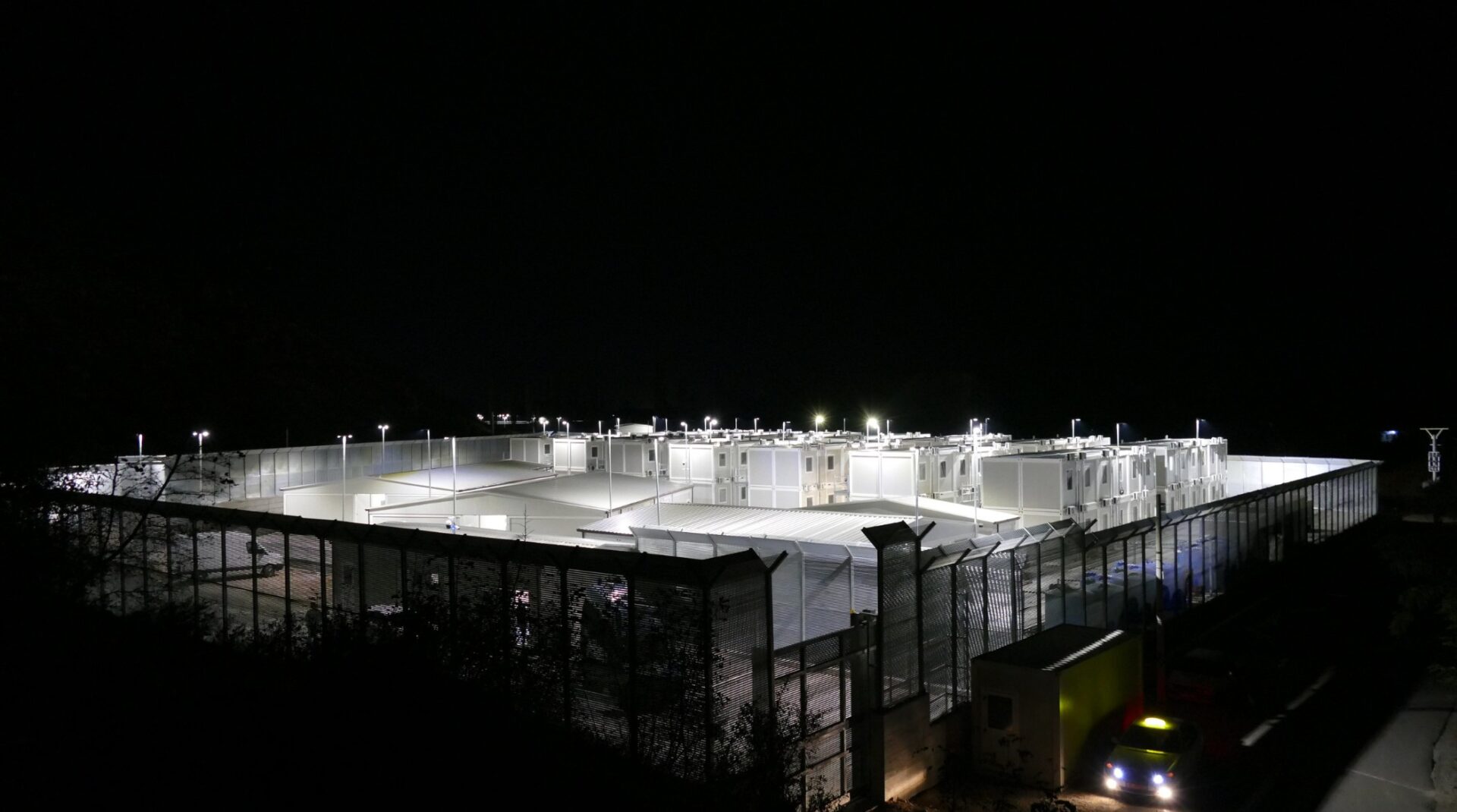
Viewed from above, the migrant detention centre in Gjadër, in the province of Lezhë, northern Albania. Photo: Nicolas Lesenfants Ramos.
Stopping in Bari, on the very same day globally dedicated to mental health, takes on a profoundly symbolic and political significance: it becomes a meeting at the edges of exclusion, where the promise of freedom clashes with the machinery of confinement and the ever‑present shadow of expulsion. As the blue horse arrives and gazes out over the sea along the Apulian coast, it carries within its fragile wooden frame the voices collected along the journey, the dreams of those on the move, of those imprisoned, and of those who gather in its wake. Above all, it carries the hope that imagination can still tear down the walls that politics relentlessly builds and sustains.
A Galloping March That Breaks the Silence
In Bari, Marco Cavallo’s procession begins in silence, yet even in its quietest moments, its mere presence bursts forth with a startling force. It is a ‘spring of the mind that enters without knocking’ and as it steps into the open, it erupts, shattering the seals of repression, hollow rhetoric, and the deeply ingrained fears that continue to carve out pockets of marginality and social isolation.
It is no coincidence that the march sets off from the square in front of the university’s main campus, itself another “total institution,” now marked by widespread social malaise, where pressure, isolation, and relentless competition create alarming levels of distress, particularly among young people and staff alike—academic, administrative, and managerial. According to data from ISTAT (the Italian National Institute of Statistics) and reports from the ANSA news agency, one-third of Italian university students suffer from anxiety, and over a quarter exhibit depressive symptoms. A recent international study (“Exploring mental health of Italian college students: a systematic review and meta-analysis”, June 2025) further estimates that the risk of suicidal ideation among Italian students is around 7%.
Mental health should occupy a central place in youth policies, as emphasised by the student representative Valerio Fresa, who spoke during the concluding event marking World Mental Health Day, which coincided with Marco Cavallo’s march in Bari. Other speakers also stressed how those labelled as “mad” or “insane” have been and continue to be rendered so different that they appear alien, excluded even from the role of “enemy” which would at least confer a more defined identity and a place within society. In the same way, a young person striving to form their identity in a fiercely competitive society risks being perceived as an outsider, and may even be rejected through the continual idealisation of migration as the only possible path, as if it were necessary to purge society of the potential diversity of young people growing up in contexts that refuse to accommodate the processes and outcomes of such change.
Youth emigration is, in fact, steadily increasing, particularly in southern Italy: between 2013 and 2022, Puglia recorded one of the highest rates of emigration among young graduates (ages 25–34), reaching the alarming figure of one person leaving per thousand inhabitants (counting only statistically measurable data and excluding young people in more temporary forms of mobility).
The “mad” person, like the young individual, is thus the other, the one who must remain elsewhere, invisible, in order to allow the dominant classes to defend the fragile illusion of a so-called “normal” society. The same mechanism of exclusion and erasure is repeated today in the CPRs, administrative detention centres where undocumented people, instead of being able to share their stories and potential, are locked away in the name of security, places that, in new forms, reproduce the logic of the asylums.
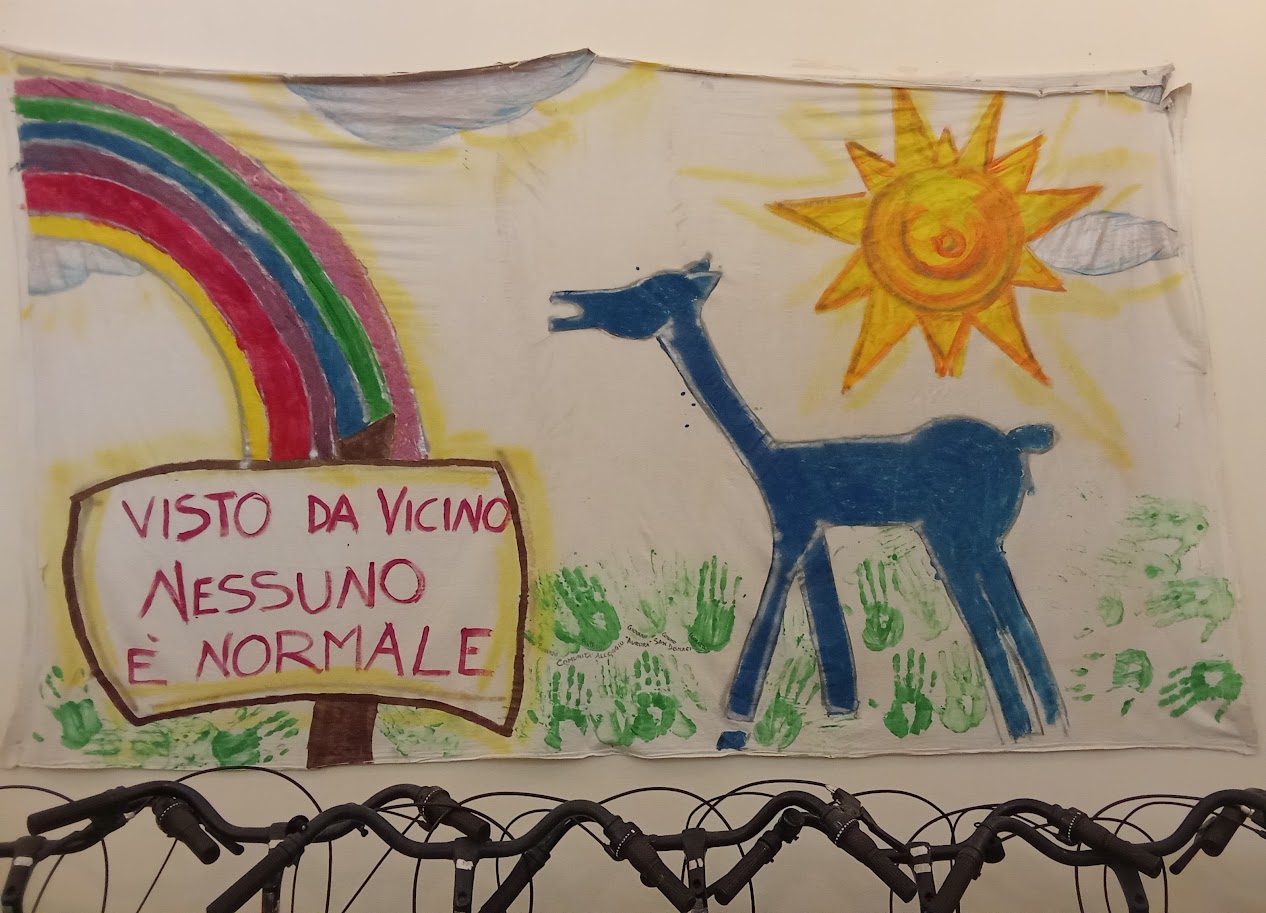
Poster displayed on the walls of the “Marco Cavallo” centre in Latiano (BR), featuring the famous phrase attributed to Franco Basaglia: “Up close, no one is normal.” Photo: Anna Lodeserto.
Encountering the City Between Disbelief and Hope
Marco Cavallo’s passage through the streets of Bari arouses curiosity, amazement, and sometimes even derision. Suddenly, around a corner, only a fragment can be glimpsed, but when the blue horse is fully revealed, its turquoise wooden body glows with a light impossible to ignore, even for the most distracted or hurried passerby.
«Who’s that? Will it set us free too?» — a young woman jokes aloud as she exits a shop. Her teasing remark draws other glances, other passers-by, more or less curious. It is in that very moment that the power of public art is revealed: irony becomes participation, mockery turns into a question. «From what do we need to be freed?», asks a man as he steps out of his shop to watch Marco Cavallo pass by, alongside the ‘Cavallina Terrona’ created in Latiano (BR) in 2008.
The Legacy of Law 180 as a Common Good and Transformative Path
The #180benecomune (180 Common Good) campaign, aimed at defending “the law that makes us human in order to remain human,” promoted by the Forum Salute Mentale with the participation of hundreds of organisations from across the country, embodies precisely this transformative spirit. Law 180 of 1978, the so-called “Basaglia Law,” though remembered in history in this way, is not simply the “law that closed the asylums,” as is repeatedly recalled on every appearance of Marco Cavallo. Rather, it is a true bastion of civilisation that initiated a process far from complete, one that calls for a profound transformation in approaches to both mental health and public healthcare.
It is instead a cultural journey, not merely a legislative outcome, addressing in unprecedented depth the dimensions of human rights, the recognition of the other, and the possibilities of coexistence with diversity, both within and around us.
Today, as attempts are made to diminish its legacy and the CPRs (administrative detention centres) exemplify the hardening of public policies in the form of institutions of segregation and social violence, reaffirming that spirit is more urgent than ever: human dignity knows no borders.
In this perspective, each stage of Marco Cavallo’s journey, which has traversed the peninsula over the past month, has been shaped through dialogue with local communities, weaving together music, art, imagery, meetings with local institutions, journalistic documentation, debates, and theatrical performances.
The Voices of Bari and Testimonies from the Field
During the final gathering on 10 October, psychiatrist Claudio Minervini of the Centro Sperimentale Pubblico per lo Studio e la Ricerca sulla Salute Mentale Comunitaria “Marco Cavallo” (Public Experimental Centre for the Study and Research of Community Mental Health) based in Latiano (BR) recalled the origins of Marco Cavallo, born in 1973 within the San Giovanni asylum in Trieste, under the direction of Franco Basaglia. «The blue horse – Minervini recounts – was born from the dream of a patient who drew it with a belly full of wishes. Some placed a flask of wine inside it, others a lost watch, others the desire to see their child again, since at the time one could be institutionalised simply for being a young, single mother. In a very short time, Marco Cavallo became the symbol of collective liberation: when he managed to break through the asylum gates, it was dreams, not only people, that stepped into the open air and saw the sky again, until they lost themselves in it.»
Today, that gesture is repeated symbolically in front of other gates: those of the Centres for the Repatriation of Migrants (CPRs), where men and women are confined for the supposed “offence” of lacking proper documents, with no access to legal proceedings or knowledge of their own fate.
The psychiatrist Filippo Cantalice, a member of the national board of the association Psichiatria Democratica, reports being denied access to the Bari Palese CPR: «Only members of parliament and regional councillors are allowed in. Despite having a signed authorisation, we were turned away. But what is invisible must become visible: the CPRs are structured along endless corridors, halfway between asylum and prison, places where suffering is made systemic and neglect reaches extreme levels of unlivability».
Cantalice recalls how Basaglia, in Gorizia, understood clearly that, despite the best efforts of experts and professionals, an asylum could in no way be “humanised” and could only be closed. «The same applies to these modern camps. It is not a question of reforming them, but of abolishing them.»
Between Mental Health and Migration Policies: The Same Logic of Segregation
The connection between the asylums of yesterday and today’s detention centres is not merely symbolic. Both stem from the same impulse: to isolate what the conformist part of society deems deviant and refuses to see. Whether it is mental distress, poverty, or migratory paths, the mechanism is the same: move the problem elsewhere, confining it behind physical and bureaucratic walls, at the margins of cities, and often in alien locations, as made evident by the structures crossed during Marco Cavallo’s journey through Brindisi and Bari, as well as in its previous stops.
Whereas in the past asylums served to protect society from its own fears, today administrative detention reproduces the same logic under different names and with different bodies, generating terror where none need exist, and where, on the contrary, people are necessary to rebuild a living social fabric, such as in southern Italy, exemplified by the widespread reception projects carried out along the Ionian corridor in Calabria, which for many years earned the region the nickname “Dorsale dell’Ospitalità” (Corridor of Hospitality) and which have been studied worldwide.
Law 180 opened a breach in the culture of segregation, just as the activation of the SPRAR projects, later SAI, did for the reception of migrants and refugees almost twenty years ago, but today, those breaches risk being closed once again.
What Will Marco Cavallo Do Now?
On the walls of the “Marco Cavallo” Experimental Centre in Latiano (Brindisi), a caption on a historic photograph reads: «What will Marco Cavallo do when it is finished?»
Today, the question resonates more than ever, and also opens a horizon of others:
- Will he retrace his steps across Italy, moving backward through streets and towns, to stitch together the social wounds he has encountered along the way?
- Will he carry with him the voices, the hopes, the unspoken desires gathered from every encounter, every glance, every story he has met?
- Or perhaps, will he find a way to pass through new gates – beginning with the extraterritorial ones in Gjadër and Shëngjin – and cross the Adriatic, symbolically leaping over not only borders, but the walls of the mind and the politics of confinement?
The Final Ride of the Blue Horse
Until the very end, Marco Cavallo remained faithful to his destiny: to unite what power seeks to divide, to reveal what is hidden.
On World Mental Health Day, his arrival in Bari closed a journey that began in Trieste on 6 September, in the very places where Basaglia taught the world that “up close, no one is normal”, and that what we call “normality” is little more than an illusion, from which we must distance ourselves if we truly wish to be – and, above all, remain – human.
From Gradisca d’Isonzo to Milan, from Ponte Galeria to Palazzo San Gervasio, for over a month the blue horse traversed an Italy defined by borders and fears, calling for the closure of the CPRs and a return to a culture of care rather than confinement.
Marco Cavallo carries with him closeness, curiosity, and courage. He reminds us that illness – if it can even be called that – cannot be healed through exclusion, just as human mobility cannot be controlled through detention. For, as Basaglia still teaches, freedom is no longer a privilege: it is itself a form of therapy, a horizon, and a pathway toward collective growth.



