

In Brindisi, Basaglia’s Twin “Blue Horses” Challenge the Adriatic Border
A powerful symbol of the liberation of psychiatric asylums in the 1970s, Marco Cavallo, the celebrated “blue horse” born in Trieste, at the far north-eastern edge of the Italian peninsula, set off once again on 6 September this year, half a century after its creation and first journey. Its present-day voyage took it to the south-eastern tip of Italy, to Brindisi, facing the Adriatic and looking ideally towards the Albanian coast, where deported people are now being transferred to new facilities built by the Italian government in Gjadër. Between memory and resistance, its passage through Apulia and other Italian peripheral regions revived Basaglia’s enduring lesson: “As long as there is a concentration camp, there can be no care”.
It was in precisely these terms that Franco Basaglia described the psychiatric asylums, beginning with the one in Gorizia, where he took up his post as director on 16 November 1961, declaring: “This is a concentration camp — and as long as a camp exists, no therapy is possible.”
From that moment onwards, his work marked a decisive turning point, contrasting with all those who believed such institutions could be ‘reformed’ or even ‘humanised’, an idea and hope he himself had once embraced and even attempted early in his career. He later realised, however, that any effort to make these places more ‘tolerable’ or even ‘liveable’, thereby normalising their existence, only served to perpetuate their repressive function. As he explained in his book “L’istituzione negata (The Negated Institution)” – published in Italy in 1968 and never officially translated into English until the forthcoming international edition in 2026, translated by Professor John Foot – these institutions represented a denial of life itself, extinguishing any possibility of peace or healing for those subjected to confinement.
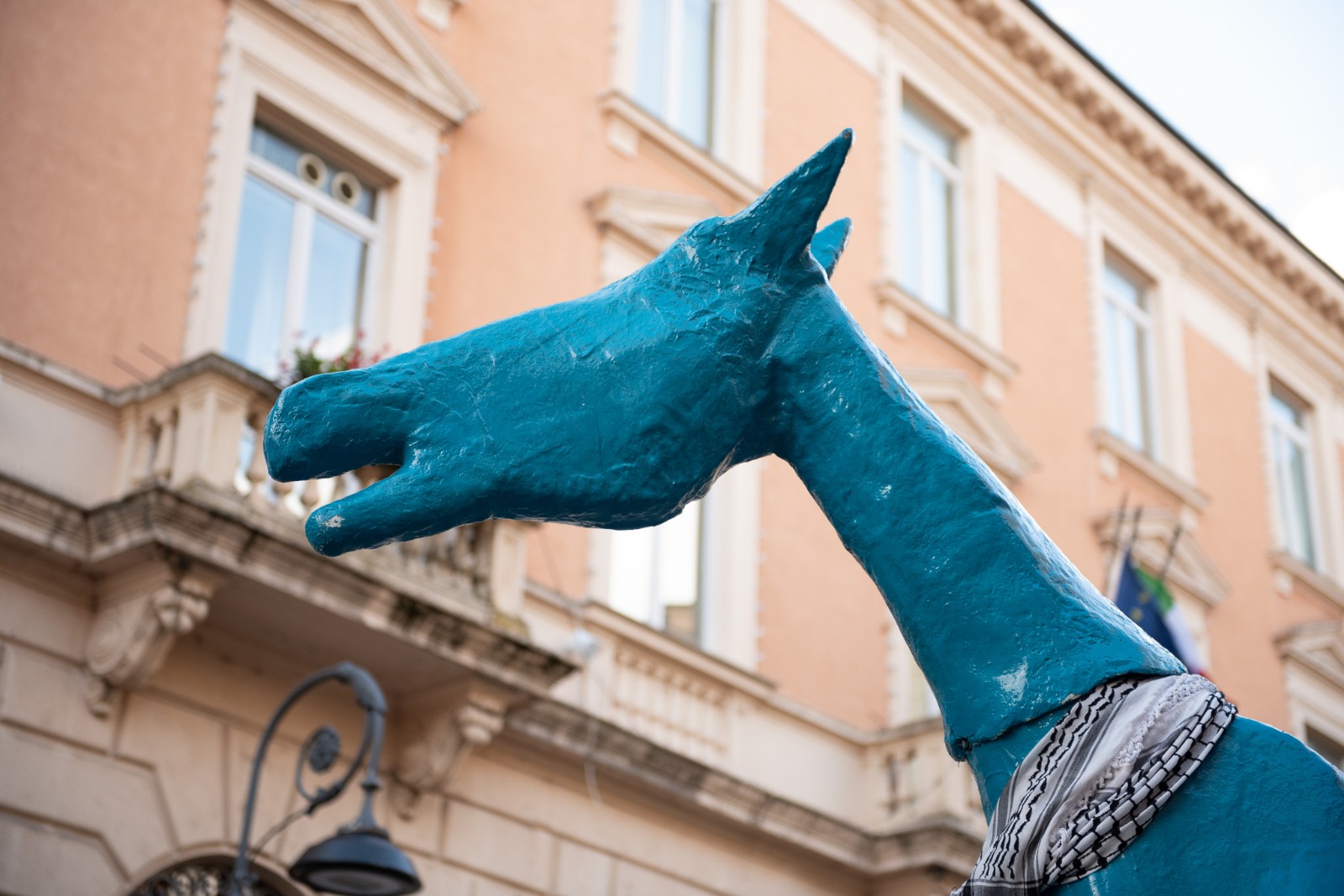
A view of Marco Cavallo in the city centre of Potenza, during events organised by the local committee “Assemblea Lucana No CPR”. Photo: Salvatore Lucente.
Based on these initial theoretical insights, grounded in direct experience in the north-eastern border region of Italy, Friuli Venezia Giulia, Franco Basaglia and his equally committed wife, Franca Ongaro, dedicated their lives to combating what they termed the ‘total institution’ a concept drawn from the Canadian-American sociologist Erving Goffman, particularly in his 1961 work “Asylums: Essays on the Social Situation of Mental Patients and Other Inmates”, first translated into Italian by Ongaro in 1968, with an introduction by Basaglia himself. Together, they left a visionary legacy that now travels once more across Italy for over 1,200 kilometres, embodied in the wooden frame and steadfast hooves of Marco Cavallo.
This journey has been long and arduous, tracing the country’s principal sites of confinement, from Gorizia to Milan, from Ponte Galeria on the outskirts of Rome to Palazzo San Gervasio (PZ) in Basilicata, then on to Brindisi, and concluding in Bari, where it culminated on World Mental Health Day, celebrated worldwide on 10 October.
From Brindisi to Bari: The Adriatic Frontier of Confinement
The final stages of Marco Cavallo’s journey brought him to Brindisi and Bari, on the western shore of the Adriatic. On the opposite coast, the current Italian government is pushing the logic of border externalisation to its most extreme limit — both geographically and politically — in what the Albanian anthropologist Fabio Bego has described as a neo-colonial projection of power.
By constructing detention sites initially intended to process non-vulnerable asylum seekers rescued in international waters, and subsequently repurposing them into Centres of Permanence and Repatriation (CPRs), such as those in Gjadër and Shëngjin modelled on Italy’s Centri di Permanenza per il Rimpatrio (CPR, Repatriation Detention Centres), exemplify to what extent the Italian government is further extending a broader European policy increasingly characterised by incarceration and pushbacks in cooperation with third countries. This approach not only exports control mechanisms and forced returns mechanisms but also Europe’s moral conscience, while laying the groundwork for the ongoing revision of the Return Directive (Directive 2008/115).
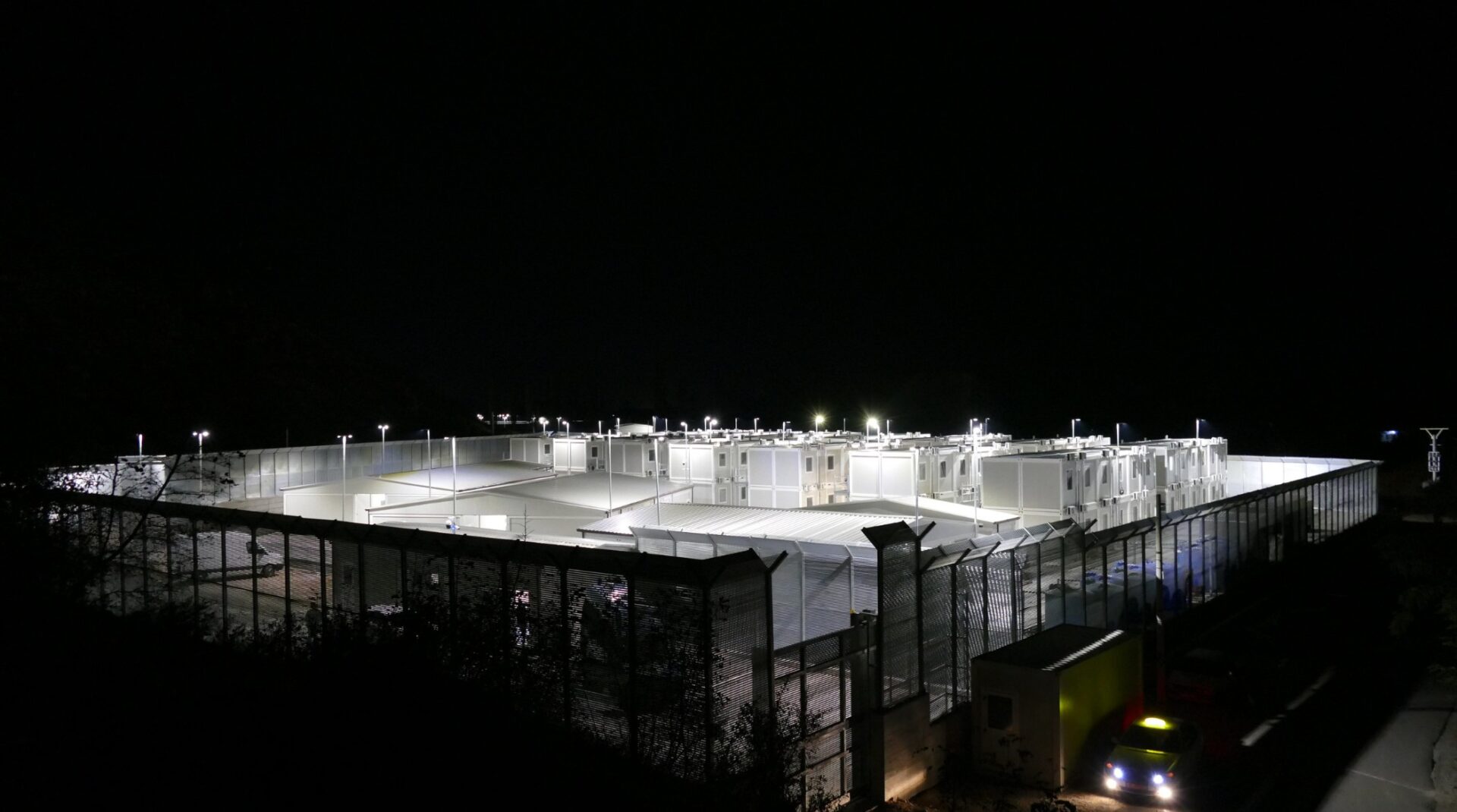
Aerial view showing the cell blocks of the Gjadër detention centre in Lezhë District, northern Albania. Photo: Nicolas Lesenfants Ramos.
The Albanian centres in Gjadër and Shëngjin, now approaching the first anniversary of the initial forced transfers of people — most of them originating precisely from the port of Brindisi — stand indeed as outposts of a Union in which detention has replaced hospitality, despite its high cost and evident failure.
For Marco Cavallo, and for all those following or preparing his journey, arriving here is never a coincidence, nor merely a stop along the way: it is an encounter – or rather, a clash – between the promise of freedom and the machinery of internment, at the very heart of Europe’s geography of exclusion. Reaching the narrowest point of the Adriatic, Marco Cavallo carries within its blue frame all the voices gathered along the journey: those detained in the centres, those on the move, the artists, the artisans, the citizens, and all who continue to believe that imagination can tear down the walls that governmental politics seeks to erect.
A Symbol Born in an Asylum but Ready to Close It
Marco Cavallo was born not as a living creature, but as an act of collective imagination within the psychiatric hospital of Trieste. Patients and artists created it under the guidance of Franco Basaglia, the central figure of Italian psychiatric reform, who devoted his life to challenging the very foundations of institutional psychiatry. Its name derives from a real horse that, in the early 1970s, carried laundry and supplies inside the asylum, seen by the patients as the only living creature free to move continually between inside and outside. When that horse was threatened with slaughter, patients and staff united to save it and secure its peaceful retirement nearby. That successful act would later be recognised as a profound gesture of resistance within a place designed to negate humanity.
From that act of defiance emerged a giant papier-mâché horse, large enough – as the patients later explained – “to contain all our dreams.” On 25 February 1973, when the horse first passed through the asylum gates and into the streets of Trieste, over five hundred people accompanied it in a jubilant march towards freedom. That very single moment vividly represented ‘the beginning of the end’ for asylums, at least in Italy, a historic and joyful outburst, through a collective cry of liberty and dignity under the open sky. Five years later, ‘Law 180’, universally known as the ‘Basaglia Law’, was approved by the Italian parliament on 13 May 1978, initiating the long process of gradually dismantling psychiatric hospitals in Italy. More than a health reform, the ‘Basaglia Law’ was and still is considered a manifesto of humanity and progress, as well as a concrete collective commitment to freedom and social responsibility.
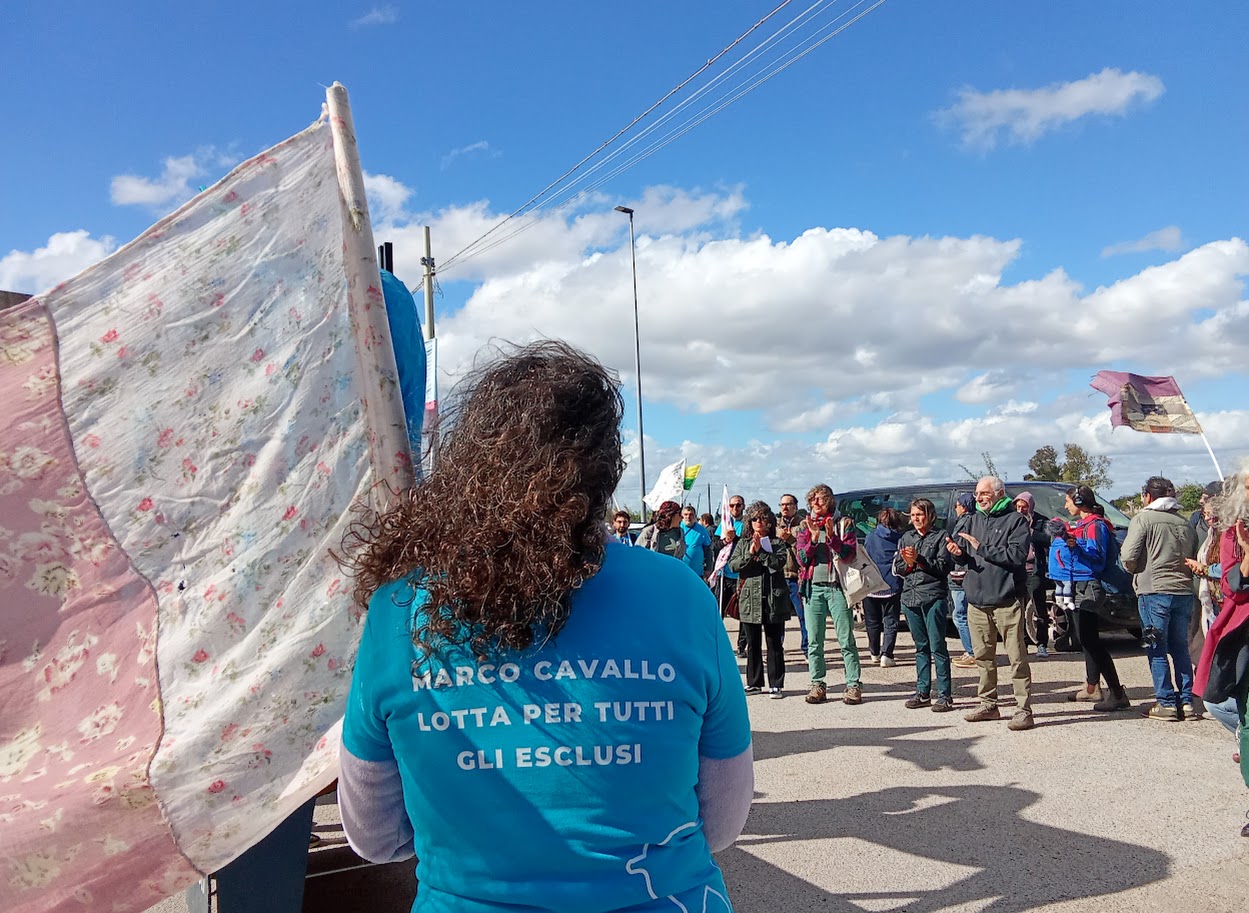
Demonstration with Marco Cavallo outside the Restinco detention centre near Brindisi, on 8 October 2025. Photo: Anna Lodeserto.
The Importance of Basaglia’s Legacy Today
Throughout his life – and even beyond it – Franco Basaglia (1924 – 1980) revolutionised the dominant view of madness and medical treatments. For him, what is still called ‘mental illness’ was not to be considered an individual deviation, but the symptom of a deeply suffering society marked by exclusion, poverty, discrimination, and social injustice. By introducing a form of radical democracy within the walls of the asylum, Basaglia enabled all those diagnosed as psychiatric patients to speak for themselves in the heart of one of the most antidemocratic institutions imaginable. This comprehensive cultural revolution would later stand as a precursor to the spirit of 1968 and the profound upheaval of established orders.
Building on Erving Goffman’s theoretical framework and his own first-hand experience in north-eastern Italy – later shared across the world, notably in Brazil, where he contributed to the development of community-based mental health system now embodied by the Centros de Atenção Psicossocial (CAPS) – Basaglia exposed a system in which asylums, prisons, and now detention centres all obey the same logic: to lock away those who are considered a disturb society and marginalise them even architecnonelly at the margins of habited spaces.
Decades later, his intuition and global vision continue to inspire psychologists, activists, and civil society organisations supporting Marco Cavallo’s journey through the CPRs by highlighting the conditions of centres designed to detain migrants solely for lacking a document or other similarly harmless administrative pretexts. These places today embody the same culture of instrumental fear, repression, and punishment inherited from the pre-Basaglia era, a system of control and violence that was never entirely dismantled and is now being exported abroad, as seen in the Lezhë province of northern Albania.
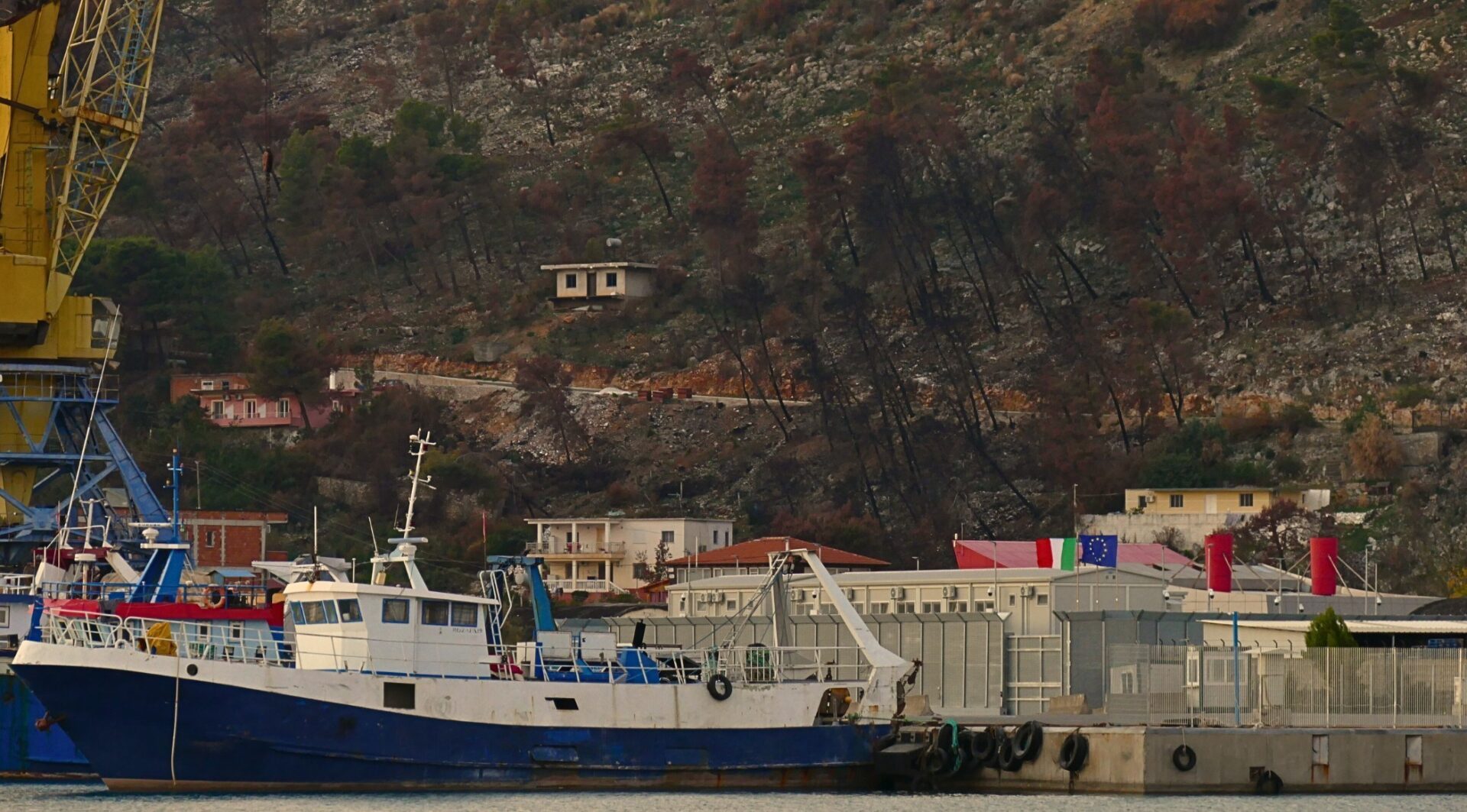
Side view of Shëngjin port (Albania), where the first centre was built based on the model of the “hotspots” operating in Italy. Photo: Nicolas Lesenfants Ramos.
From the Psychiatric Revolution to the End of Administrative Detention
Fifty years on, Marco Cavallo is once again on the move, faster and more determined than ever. As an integral part of a broad awareness-raising campaign promoted by Forum Salute Mentale, the network Mai più lager – No ai CPR, the SIMM – Società Italiana di Medicina delle Migrazioni (Italian Society of Migration Medicine), the Brigata Basaglia and the Association 180amici Puglia, the initiative “Il viaggio di Marco Cavallo nei CPR” (“The Journey of Marco Cavallo to the CPRs”) represents a collective effort to denounce the dangerous practice of internment and demand the closure of all administrative detention centres.
Having once opened the way and exposed the denial of humanity within psychiatric hospitals and forensic institutions, the blue horse now traverses a new generation of invisible institutions, steeped in structural violence and institutional racism. From Trieste to Brindisi, passing through Milan, Rome, Cori (LT), Cisterna di Latina (LT), Palazzo San Gervasio (PZ) and Potenza, each stage of the journey has given rise to public assemblies, artistic performances, and multilingual readings of letters addressed to those held in detention.
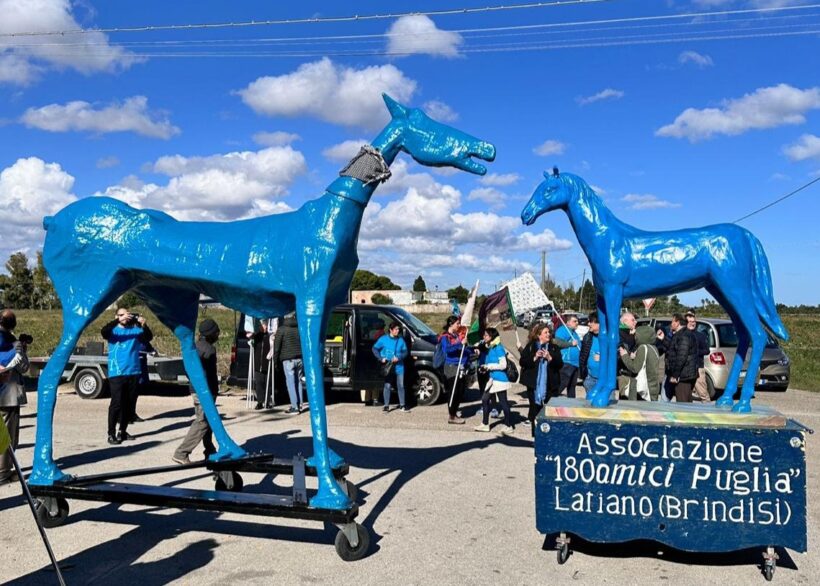
In Brindisi, two blue horses – one reproduced in fiberglass and arriving from Trieste and the other, smaller, affectionately named ‘Cavallina Terron’ (‘Southern Little Mare’, a term that boldly reclaims a slur long used to exclude and stigmatise southern migrants within Italy) – led a demonstration uniting artists and civil society organisations, including Association 180amici Puglia, the Comunità Africana di Brindisi e Provincia, and the NO CPR Brindisi network. As part of the national campaign “180 Bene Comune” (Law 180 as a Common Good) for mental health and social justice, the initiative denounced the alarming conditions inside the centres: prolonged isolation, severe psychological suffering, the systematic use of psychotropic drugs to suppress distress and the increasing recurrence of suicides.
For all these reasons, and drawing on hundreds of studies and monitoring reports, artists, medical professionals, and concerned citizens following Marco Cavallo from one region to another have raised a powerful collective call for the definitive closure of all CPRs and the unconditional defence of migrants’ rights.

Detail of the cells at the Gjadër detention centre in Lezhë County, northern Albania, seen from above. Photo: Nicolas Lesenfants Ramos.
Brindisi: A Symbolic Crossroads
The Brindisi stop carries particular weight within the broader campaign. The local CPR, located in Restinco – a hamlet barely five kilometres from Brindisi – is the closest to the Gjadër centre in Albania, less than two hundred kilometres away. Numerous migrants expelled from Brindisi have been transferred by sea under military escort, exposing the transnational reach of Italy’s detention system.
It was indeed from Brindisi’s port, in April 2025, that the first forced transfers to Albania departed, in execution of Decree-Law 37/2025. Those held in such centres remain detained indefinitely – often merely for having lost or expired documents – revealing the true face of a ferocious European policy of border externalisation and institutionalised administrative detention.
This system reproduces, under new forms and reinforced means, the logic of the old psychiatric asylums: claiming to protect society from its own fabricated fears, in the name of a supposed legality, the very same controversial approach that writer Luca Rastello denounced in his still profoundly relevant works, even a decade after his death, such as “La frontiera addosso. Così si deportano i diritti umani” and “I feticci della legalità e della memoria”.
A Journey of Resistance and Memory, Accompanied by Art and Theatre
In the small space before the entrance to the Restinco Detention Centre, participants recited and embodied the names of the fifty people who have died in Italy’s CPRs since 1998, observing five minutes of silence in their memory. A patchwork “flags of rags”, sewn from reclaimed fabrics, fluttered in the wind as in previous stages, reproducing once again a poetic metaphor for re-stitched dignity that endures even in the harshest conditions. The participants awaited the return of Claudio Stefanazzi, Vice-President of the Italian Parliament’s Bicameral Commission for Regional Affairs and the only person permitted to enter the centre as an elected parliamentarian, who had just led a monitoring visit inside, who declared: «I had the honour once again of being in charge of inspecting the detention centre of Restinco. Originally conceived as transit structures, these centres have become places of detention where people remain at the mercy of senseless bureaucracy, victims of a system that criminalises migration as a tool of power, now even exporting it to Albania.»
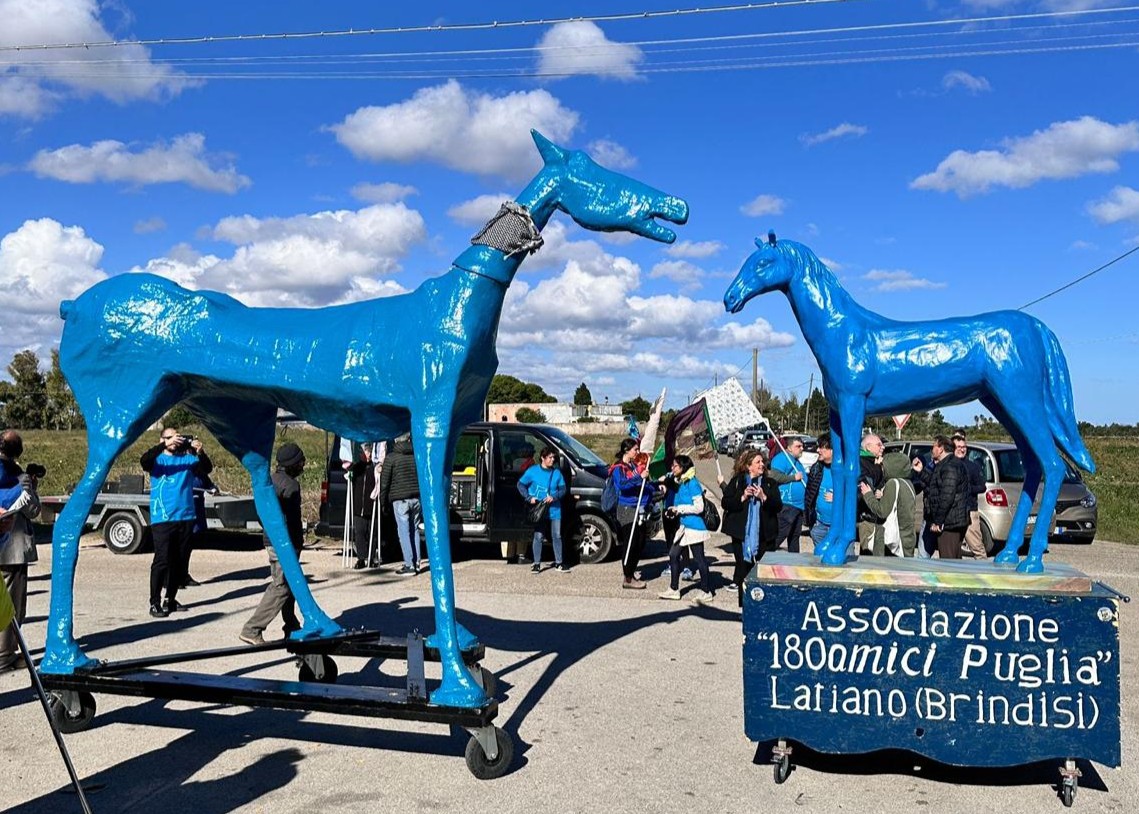
The two blue horses outside the Restinco detention centre during the 8 October 2025 demonstration. Photo: Stefano Penta.
Meanwhile, the two blue horses stood outside, embodying the collective outcry against places of dehumanisation and the criminalisation of migrants. They later returned first to Latiano, and then to Brindisi, where a colourful and diverse procession wound through the city’s streets, blending civic engagement, historical memory, and artistic expression. Around Marco Cavallo, other cultural initiatives continued to animate the city, ranging from photographic exhibitions, theatre performances, and public debates interweaving the themes of mental health, migration, and human rights, all echoing a single, powerful message: internment is Europe’s moral defeat, yet it is still possible to change course.
Artistic Voices: Reclaiming Dignity Through Culture
At the Yeahjasi Cultural Space in Brindisi, the theatre play “Reietti. Come creammo i CPR” (“Outcasts: How We Created the CPRs”), written and interpreted by Oscar Agostoni in collaboration with Disturbi Teatro, offered a gripping and meticulously researched monologue guiding the audience through the inner reality of Italy’s detention centres and recalling every recorded death since 1998 and echoed the demands of numerous civil society organisations for their immediate abolition.
In the same venue, on via Santa Chiara in Brindisi’s historic centre, the photographic exhibition “The Adriatic Guantánamo ~ La Guantánamo Adriatica” featured the work of the Belgian-Venezuelan photojournalist Nicolas Lesenfants Ramos, presenting stark images from the detention centres of Gjadër and Shëngjin, built by the Italian government in Albania. First shown at the House of Compassion in Brussels, where it was inaugurated on World Refugee Day and concluding the Week of Hunger Strike for Justice in Palestine on 20 June, the exhibition and accompanying journalistic work connect Italian mobilisation with the demonstrations and activities of the transnational “Network Against Migrant Detention”. Together, they expose the alarming proximity between the Restinco CPR on the outskirts of Brindisi and the new facility in Gjadër, just a few kilometres away on the opposite shore of the Adriatic.
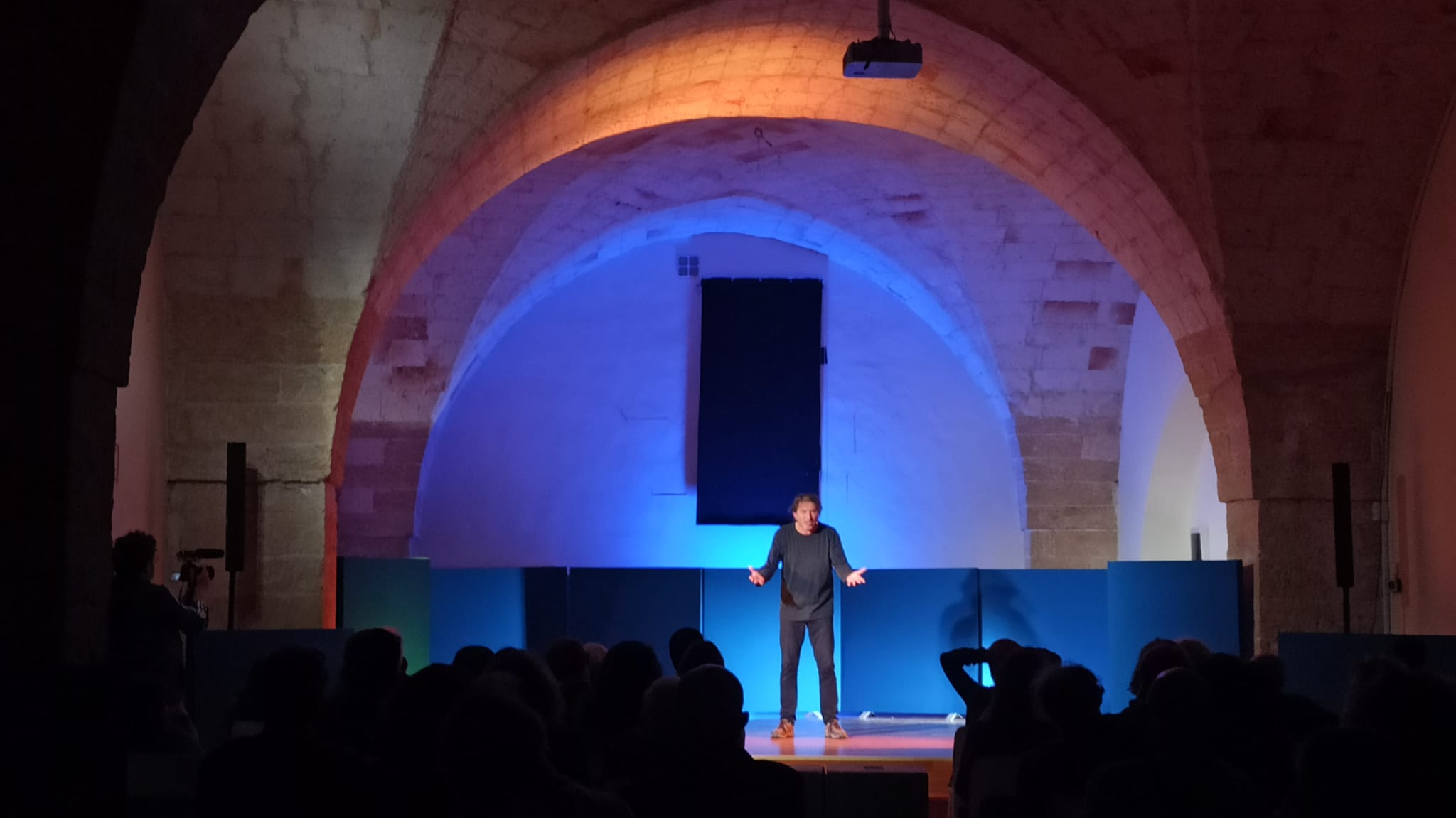
Scene from the performance of the play “Reietti. Come creammo i CPR” (“Outcasts: How We Created the CPRs”). Photo: Helga Bernardini.
Reclaiming Basaglia’s Legacy: Defending Dignity Without Borders
To defend and carry forward Basaglia’s legacy today is to affirm that dignity knows no borders, and that no one should ever be hidden, silenced, or confined for their uniqueness, their vulnerability, or the place they come from. As Basaglia taught the world, freedom is itself a form of healing.
In its resolute gallop, the blue horse is there to renew this lesson: freedom is not only an objective or a destination to reach, but a way of inhabiting the world through a living, breathing act, renewed with every encounter, every act of courage, every fragile alliance. So continues the journey of Marco Cavallo, a creature of popular strength and imagination, seemingly delicate yet, in its own way, invincible in carrying hope, memory, and resistance across the long, unyielding road of individual and collective dignity.