
On-the-ground a live report:
Saturday, October 4th. A truly warm autumn, in every sense; a scorching sun is beating down on New York City today, making the keffiyeh useful as a head covering. I’m in one of my favorite squares: Washington Square Garden, in the Village; we used to come here during the pandemic spring, when the venues were closed and kids would gather to play music. I even remember a small group that would show up pushing a piano on wheels.
The pro-Palestine march will set off from here; meanwhile, under the great marble arch, a rally is taking place. An imam is speaking, encouraging people not to yield to evil, because God periodically throws it into the world so that humanity may react to it and find the truth, the treasure. He tells a story, similar to today’s reality, which happened a thousand years ago in Arabia; back then too, evil was about to overwhelm good, but in the end, everything turned around.
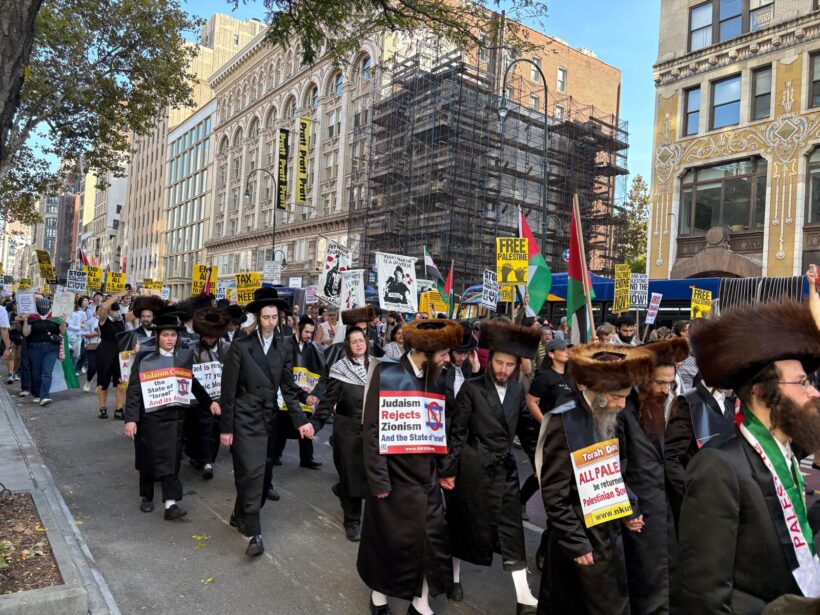
It seems a bit like something straight out of a Hollywood movie, but my heart protests and wants to believe it! Speaking alongside the imam are rabbis who agree with him. They are Orthodox Jews, dressed in black frock coats, with typical sidelocks, and many of them wear a fur hat, the shtreimel. For now, I can barely see them, but I will be able to observe them properly during the march, when they walk in a group, in several rows, holding hands—there are children among them too. Their signs are among the most radical against Israel: flags with the Star of David banned, rejection of the State of Israel, sovereignty for a Palestinian state, and shocking images of children killed by hunger. They will proceed silently and calmly, dressed as if it were January, without showing any sign of suffering—not even the children.
But let’s return to the square. I’m hot and dripping with sweat. I spot a free spot on a modern bench—a long, snaking concrete slab with no backrest—and it’s in the shade. I make a beeline for it; I’m almost there when I see a young man bend over and reach for something; he picks up a fallen Palestinian flag and with a delicate gesture, brushes the dirt off. Perhaps someone had inadvertently stepped on it. I sit down next to him and notice a tremor in his hands. He’s wearing a kippah, but then he compliments my earrings (they’re crocheted ones shaped like watermelon slices) and he relaxes. I thank him and ask if he knows the schedule for the day. He doesn’t; it’s his first time participating in one of these demonstrations.
All around us, activists are swarming—I’ve already bought four fanzines, the fantastic New York Crimes, and I’m running out of space for all the flyers for the many initiatives. Another young man arrives; he’s also Jewish but not religious—on his head, he’s not wearing a kippah, but a black-and-white checkered bandana, and he’s handing out informational leaflets from a Jewish group active in defending the Palestinian people. He reminds me of my friends from Milan in “Mai Indifferenti” (“Never Indifferent”), among the first in their community to have the courage to speak up and say “NO! We won’t stand for this!”
The two young men start talking. I notice the activist is quite taken aback to learn that the other is at his first protest, so much so that he decides to sit down on the bench. The two of them are talking a mile a minute, and I’m desperately straining to listen. They’re talking about Zionism; the activist recounts the birth of Zionism starting in the 1800s and says clearly that they are the real antisemites, because they put the Jewish people in constant danger. I can’t hear if or how the other one responds; his voice is much softer. Meanwhile, the drums and chants have started; it’s time to get up and march.
In a flash, I’m alone again in the river of people walking. In all honesty, it’s not quite a river, more of a stream. The turnout at American demonstrations is decidedly smaller than at ours, but there’s no doubt the spirit is the same. The last march I participated in was a year ago, and I’m pleased to note that not only has the number of participants grown, but above all, last time it seemed like bystanders were looking at us as if we were aliens, whereas today, from the sidewalks and windows, they are applauding us.
I ask others if they know the route, but no one does. Everyone just follows the flow, belting out the many slogans the kids have invented over these two years of struggle. There are new ones like “Liberation is near” and “Gazans you have made us proud.” I move here and there to take a few photos, and just a few meters ahead of me, the pair reappears. They are still chatting, gesticulating like old friends.
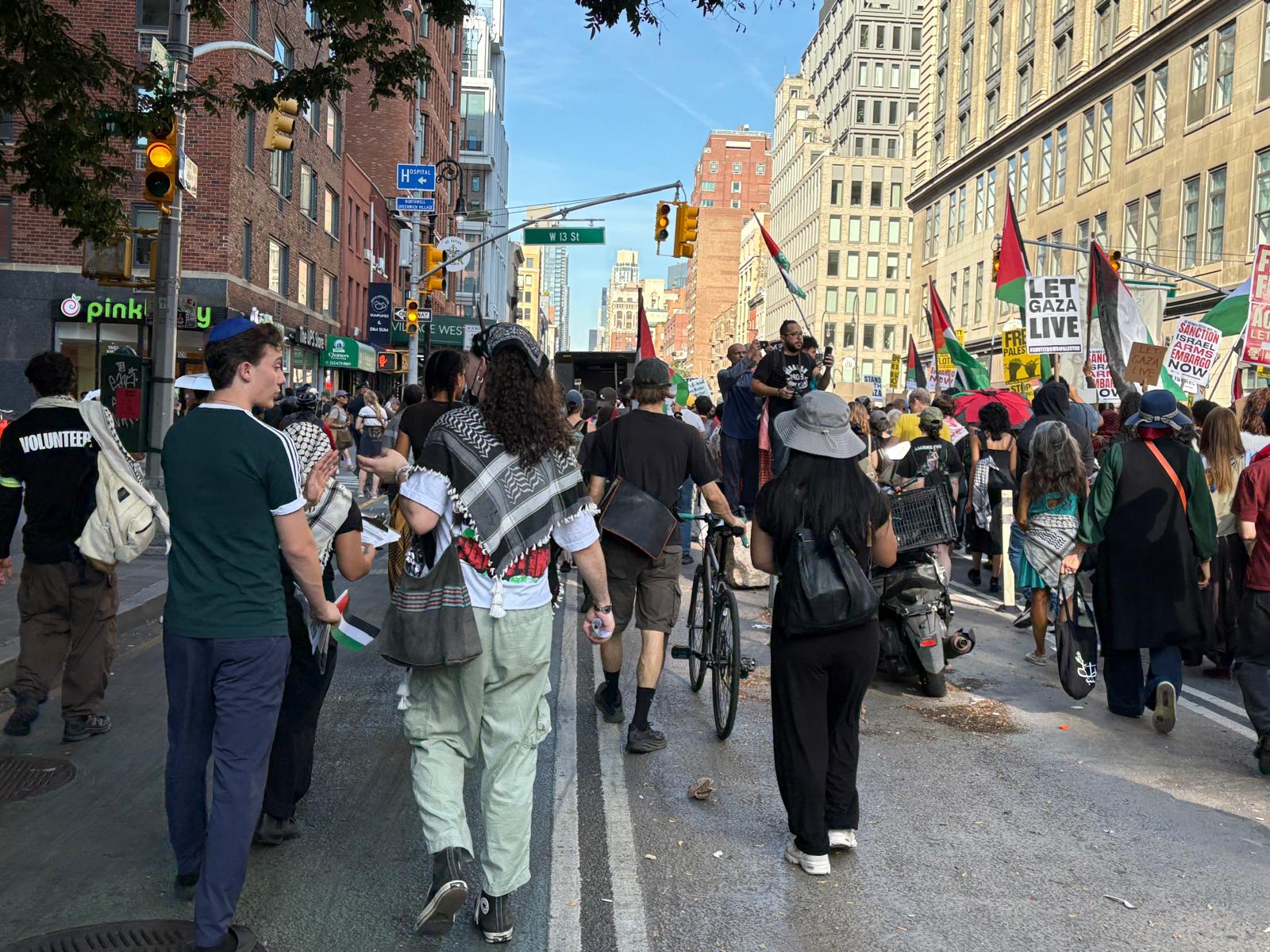
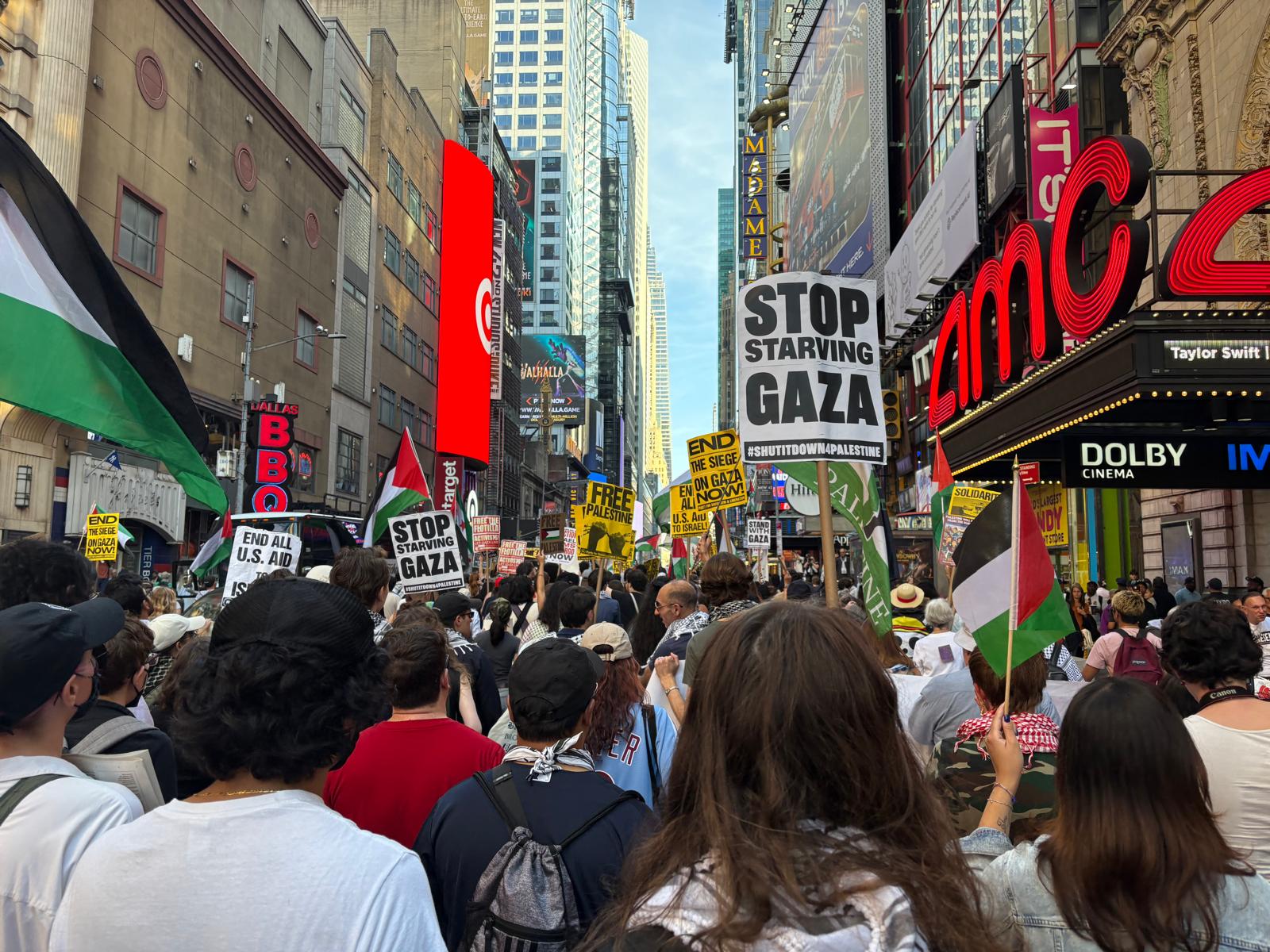
I reflect on how in every society there is a gray zone where people live who perhaps just want to get on with their own lives without getting too involved with the world, but you can’t always do that. That grayness can become so heavy it takes your breath away, a bit like the leaden sky over the Po Valley sometimes does. I imagine how hard it must be for an “ordinary” Jewish person today to pretend nothing is wrong, I imagine the sense of confusion, of loneliness they might feel. Yet, there is no other way out than a “coming out” to be able to breathe again. I wonder if that young man, so clean-cut and devoid of any typical protest paraphernalia, had come to the square against the wishes of his family, his mother, his father… because he could no longer bear the pricks of conscience, because these are the days of Kippur, of forgiveness and understanding.