

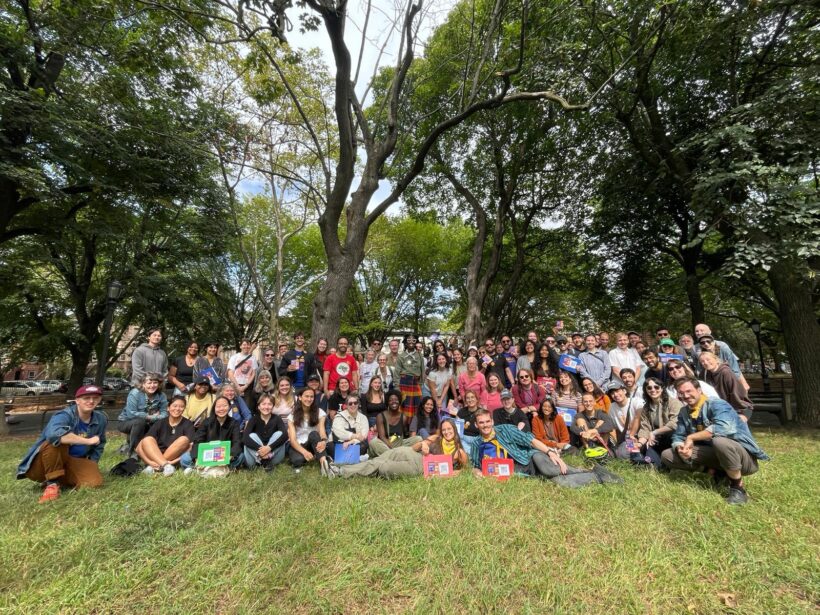
Sunday, September 21, 2025: the meeting is at noon in Fulton Park, one of those small parks in Bedford-Stuyvesant in Brooklyn, the neighborhood where my husband and I have decided to live this year. In reality, almost no one calls this area by its full name; to everyone, it’s Bed-Stuy. During the great civil rights struggles of the last century, this suburb distinguished itself as one of the fiery hearts of the Black Panthers. Walking through its streets, if you’re not too distracted, you can still sense that presence, as the sign I photographed suggests.

This is where I will be baptized into the “Zohran for New York City” campaign, participating in my first “Canvas for Zohran,” the term used here to refer to door-to-door canvassing during election campaigns.
It’s not yet noon, but there are already many of us, and from every corner I see young people joining us. A guy invites us to form a circle. With a quick glance, I try to count how many of us there are; I’d say at least a hundred. That same guy starts talking, or rather shouting, because otherwise we wouldn’t hear him. I am among those who raise their hands when he asks if this is our first “canvas,” and the others applaud us. There are about thirty of us newbies. The young man speaks calmly, explaining why it is important for us all to be here today, committed to writing a new chapter in the city’s history. He talks about the rivals, those in his own party, Cuomo and the big donors, without rancor or anger, but as something that has become tiresome, and which has fed up young people in particular, who have little tolerance for the hypocrisy and arrogance of power that they represent.
Zohran Mamdani speaks a new language, one that young New Yorkers recognize as sincere and have decided to trust. The great wonder of this New York autumn is that a whole generation of young people has thrown itself into politics. An overwhelming surge that is leaving movements and parties around the world pale and even jealous. I sense a hint of pride in the words with which the young man closes his speech: “The world is watching us and we must rise to the occasion; we can inspire others.” One last ritual: the souvenir photo of the day, and then we are ready to begin.
I will be working in tandem with Isaac; our folder, number 25, corresponds to a stretch of brownstones (those characteristic sandstone-fronted houses) on Macon Street, about seventy addresses in total. Isaac, who is twenty-nine, like probably the average age of the participants, works entering data and managing telematic systems for schools and institutions, so he is perfectly proficient with the MiniVanApp application. He explains everything to me in detail because he hopes that in the future I will be able to manage on my own, or even train new activists. The app gives us information about who is registered to vote, including their name, address, and, when possible, whether they are a Democrat, Independent, or Republican. Normally, we don’t visit those who have not shown interest; in other words, we don’t proselytize.
Our main target is Democratic and independent voters: we want them to learn about Zohran’s platform and elect him mayor in the November election. Bed-Stuy has one of the most important architectural heritages in the United States, which is why its splendid brownstones are under siege from real estate developers.
But approaching one of them is no easy task, and Isaac and I treat it as a joke. Often there are several unmarked doorbells; sometimes they all answer, sometimes none do; many buildings look abandoned, some really are, others are not, but give the impression that their inhabitants want you to believe they are. Isaac tells me that when we see signs of children—tricycles, small bicycles, toys—we will probably be welcome in that house. He adds that Zohran is adored by children, so much so that some of them have taken it upon themselves to convince their parents to vote for him. Mysteries of Generation Z, to which the candidate himself may also belong? At each door, whether it opens or not, we leave a flyer with the four key points of the campaign: 1. Freeze rent increases 2. Free and faster buses 3. Free childcare 4. A safer city.
In a city where rents have reached unprecedented levels, where gentrification is devastating entire neighborhoods, and where sending a child to daycare costs $20,000 a year—if you can’t afford it, you stay home, don’t work, and your family becomes even poorer— these four points are real needs, visible to all, to which Mamdani’s socialist and progressive campaign is offering a response. Considering mobility, the connective tissue of the metropolis, as a resource in which to introduce changes that alleviate and provide opportunities for the weaker classes is also highly innovative.
Isaac explains to me that pilot tests have shown that free buses would above all benefit the internal life of neighborhoods; moreover, by eliminating the time the driver spends checking or collecting tickets, the journey is reduced by 40%, which leaves everyone more satisfied. The issue of “safer cities,” the mantra of all Western bourgeoisies and right-thinking people, is also addressed with creativity and a spirit that I would describe as humanistic. My mentor talks to me about the idea of “recruiting” an unarmed police force, trained in social services by psychologists and educators, capable of intervening in the thousands of everyday situations that disrupt life in the city, so that uniformed officers can concentrate on fighting serious crime.
Between chats, a broken doorbell, and a little dog that welcomes us, it’s already 3:30 p.m. It’s time to go to the Frog, the brewery where Zohran’s activists have gathered.
Marina Serina, I was born in Milan, but my family is from Crema. I have moved around a lot and have been living between Italy and the United States for the past eight years. But Milan and Crema remain my roots. I studied philosophy in the 1990s at the University of Milan; it was also in Milan during those years that I discovered yoga, which I have been practicing and teaching ever since. My life and my thinking have embraced these two passions; I let them guide me confidently toward the future. In 2007, I started the Tartaloto Yoga Center in Crema, which continues to spread teachings under the guidance of other talented and dear teacher friends. There have been many projects; one deserves mention, “yoga for Parkinson’s,” from which a book was drawn, Non Siamo Frankenstein, Siamo Dèi (We Are Not Frankenstein, We Are Gods) (Verona: Gingko, 2024).



