

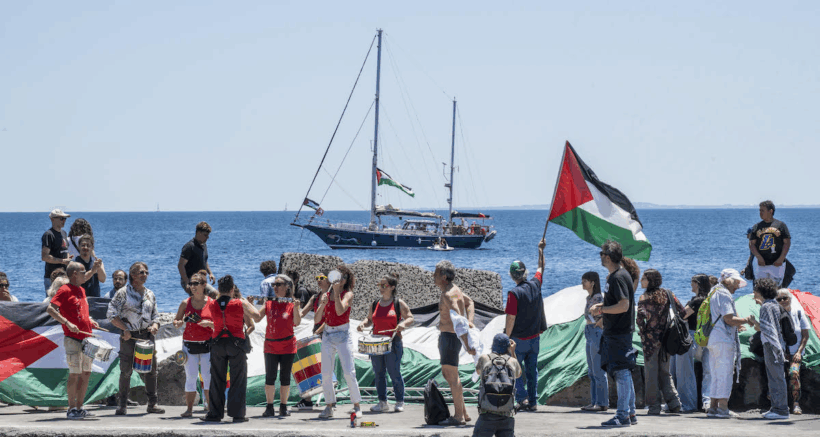
Lucio, Manfredo and Stefano are on the boats of the Global Sumud Flotilla and will recount their adventure for Pressenza. This is their first logbook. Fair winds from the entire editorial team.
A tsunami of humanity is about to unleash itself to try to free Gaza from the aid blockade. We will try to break Israel’s illegal siege with the power of nonviolent solidarity, a force of humanity and for humanity. Thousands of people are involved in this magnificent international movement that wants to help all the innocent people of Gaza.
While part of the flotilla has departed from Genoa for Barcelona, here in Sicily we are working to rig the boats, verify safety conditions, provide the galley and sails, and check the engines along with all the international crew members.
Among the many people wandering among the various boats being prepared, many lend a hand with specific tasks that often go beyond the nautical realm: engines, electrical systems, cleaning, and emptying of previous owners’ materials, which in some cases will not be needed for the mission. Therefore, the sailors engaged in various inspection and testing tasks are often seen as tightrope walkers hanging from a rope twenty meters in the air, intent on checking the sails, nautical blocks, and lines; particularly meticulous owners schedule such inspections regularly.
So terms like “banzhigo” (a seat with a harness used to hoist a person to the masthead) and running shrouds (additional steel cables when the mast is at 90 degrees to the boat and therefore requires additional support in certain sailing conditions) require explanations typically provided by a sailing instructor for the more curious. In reality, these explanations will be useful on a mission for crew members who aren’t sailing experts but come aboard as journalists, political or social media influencers, doctors, or mechanics. The port is therefore a hive of people coming and going in search of tools, or support for very complex and demanding tasks, such as lowering a sail, or opening a shackle particularly stuck by years of saltiness.
It’s an atmosphere of great collaboration, but also of tension and hope; we’ve discussed among ourselves the threats from Israeli National Security Minister Itamar Ben Gvir, who raised the possibility of a prolonged detention in very harsh conditions. Certainly, having the support and backing of large segments of the population in Europe and around the world represents both security and hope. At the same time, we’re preparing for training on how to behave in tense and emergencies. Meanwhile, we’ve learned that all the boats departing from Spain have reversed course due to 30-knot winds and rough seas. Obviously, unexpected events are a daily occurrence on a mission of this kind. I’ve often asked myself why I decided to participate in the Global March to Gaza mission back in March, and I thought it was no longer enough to hold demonstrations and political activities at the Arci, or to organize a boycott with the BDS movement.
I felt the need to do something stronger, more radical, like the desire to choose not to remain silent when the world remains silent in the face of a massacre and a genocide, in the face of yet another human shame in recent history, where every day we witness a segment of humanity collapsing into the abyss in the shame of this sad experience.
I decided to participate, thinking about the readings I’d done: Hannah Arendt, with her ability to describe “The Banality of Evil” and therefore not take that side, and Martin Luther King, according to whom the most painful thing is not evil people, but those who remain silent in the face of evil. I also think of Dietrich Bonhoeffer and the Confessing Church against Nazism, a small community that understood that Hitler was an adversary, a terrible enemy to be fought at all costs.
It’s sometimes helpful to look for models in our history, positive ones, like Antonio Gramsci when he said we must be partisans; we cannot remain indifferent. All these words, these lives of men and women from our past, help me motivate, delve deeper, be aware, and face a choice we make not as white Western heroes, but also with great humility and a bit of fear, thinking of our loved ones, our children, parents, and companions. Perhaps I do this so I can respond with dignity and awareness, when the monstrous dimension of what is happening to the Palestinian people becomes even clearer and more glaring, to the fateful question they might ask me: “But what about you, what did you do when all this was happening?”



