

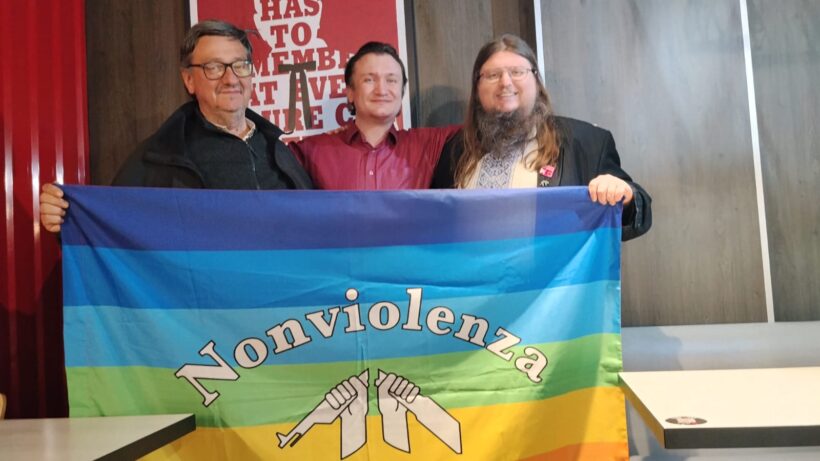
In Kiev, I met up with Yurii Sheliazhenko, recently released after arbitrary detention; we met up with another conscientious objector, Oleksandr Ivanov, a pacifist and Quaker. Oleksandr was born in Donetsk and has lived in Kiev since 2015, when the war in Donbass began. Before being conscripted, he worked in a bank.
Tell me what happened to you. How did the police behave, whether you saw a judge, and whether you were able to speak to your lawyer.
Like many people, Oleksandr went to Kiev to escape the Russian occupation. He worked in a bank as a clerk and, occasionally, as a courier. Now he can’t officially work because he was forcibly conscripted, held in a military unit for a month and a half, subjected to mistreatment and attempts to force him to abandon his anti-militarist beliefs, and left the military unit without authorization; for this, he faces a prison sentence of five to ten years. However, there are more than 200,000 people in his situation, so the police are in no rush to look for him, even though he could be arrested during raids or at checkpoints. He is a student at the FREE CIVILIANS School of Pacifism. When he left the unit, a sympathetic officer advised him to keep a low profile—he suspects someone is simply pocketing his soldier’s salary.
Is Oleksandr considered a deserter by law? Were you instead ordered to enlist? Are you a draft dodger, Yurii?
When Oleksandr demanded that his rights as a conscientious objector be respected in a democratic society, a commander responded: Forget democracy, there is no democracy in Ukraine and there never will be. Recruits were treated like prisoners, escorted under guard from the tent to the mess hall. They fell ill easily and coughed constantly, especially after rain, in the cold, when the tents were flooded with mud and no one provided them with adequate medical care.
At the shooting range, Oleksandr was targeted by live ammunition, putting his life at risk because he refused to take up arms. He was later told that this was a common way to humiliate conscientious objectors, a practice in the military dating back to Soviet times.
I obtained a court ruling ordering an investigation into Oleksandr’s forced conscription and mistreatment, but the State Investigative Bureau ignored the court’s decision. The Lubinets Ombudsman, the parliamentary human rights commission, wrote that it would not take action following my complaint regarding Oleksandr’s rights violations.
I’m currently not charged or officially sanctioned for noncompliance with the regulations on military registration or service, either in administrative or criminal proceedings, despite having repeatedly declared my conscientious objection. Perhaps they’ll charge me with something after my detention and torture, just to pretend their actions were legal—I don’t know.
Furthermore, I’m not a draft evader; I’m a conscientious objector. This is a distinction that many in Ukraine don’t understand, sadly including judges and lawyers. A draft evader is someone who simply seeks ways to evade the obligations of military duty, usually out of fear of death, a lack of civic responsibility, or other predominantly selfish reasons. Draft evaders don’t care about the common good. Conscientious objectors, on the other hand, care about the common good, especially the sanctity of human life and dignity: we understand war as mass murder on an industrial scale, and armies that perpetuate this bloodbath are profoundly inhuman institutions.
Conscience, enlightened by religion or personal conviction, tells us that it is absolutely immoral and impossible to participate in or support such barbaric institutions of death.
Conscientious objectors refuse to kill in order to create a better world, where everyone refuses to kill and there are no more wars—or at least to take steps toward that world, showing a personal example of courage in nonviolent resistance to war and militarism. Ideally, every country should have a non-military service to protect peace from threats of aggression and tyranny through nonviolent action; such agencies could be managed and staffed by conscientious objectors who volunteer or are called up (instead of any form of conscription) and, over time, could replace armies. The world will be better without armies and without wars.
Is it possible to estimate how many people are imprisoned for refusing to fight?
Currently, there are 110 prisoners of conscience, clearly imprisoned for their religiously motivated conscientious objection, according to court decisions. There are also thousands of conscientious objectors forcibly detained in military units. There are countless cases of torture and cruel treatment, although only dozens have been documented—it is very difficult to document them—and they are still not investigated in Ukraine, despite having been reported internationally by the Office of the United Nations High Commissioner for Human Rights (OHCHR) and several civil society organizations.
The number of people convicted of related crimes is higher. According to 2025 statistics, there are 377 convictions for draft evasion, 583 for AWOL [Absent without official leave], 78 for desertion, 408 for disobedience, and 46 for evading military service through self-harm or other means. The number of unconcluded investigations is much larger and has been kept secret to hide the hundreds of thousands of people who do not wish to be slaves of war and the army, a grim reality for militarists.
Since your release, have you been left alone?
Yes and no. The threats mentioned in the press release about my situation remain: I could be forcibly conscripted, and I am still on trial, which could result in a sentence of up to five years in prison, for the absurd charge of justifying Russian aggression in the pacifist declaration “Agenda for Peace for Ukraine and the World,” which in reality condemned the aggression and called for nonviolent resistance.
The problem is that no one wants to investigate my arbitrary detention and torture. I received a letter from the State Investigative Bureau stating that they do not consider what happened to me a crime and have forwarded my complaint to the recruitment center, as if to encourage them to continue treating people cruelly while ensuring their impunity. Furthermore, the Parliamentary Commissioner for Human Rights, Dmytro Lubinets, personally signed a letter refusing to end attempts to force conscientious objectors to serve in the army and register for conscription contrary to their religion or beliefs. By treating me and others this way, Ukraine is violating its international human rights obligations under Articles 3, 5, and 9 of the European Convention on Human Rights.
When I was forcibly taken to the recruitment center, beaten and tortured, there were no charges or formal procedures, no official administrative or criminal arrest. It was arbitrary detention. I was held and humiliated for two days, but some conscientious objectors were held in much worse conditions for months. According to the Independent International Commission of Inquiry on Ukraine, some conscientious objectors were subjected to punishment and psychological pressure in military camps, such as mock executions, confinement in a pit dug in the ground for long periods, even in winter, threats of sexual violence, and food deprivation.
As you know, I am a Quaker and a pacifist, a conscientious objector. So, when I was stopped one evening by two police officers and a uniformed man who refused to identify himself, I declared myself not subject to military duty and expressed my conscientious objection. They forcibly loaded me into a car and took me to the recruitment center, where I was beaten, pepper-sprayed in the face, dragged across the floor by my feet and even by my hair—it was very painful—and subjected to numerous verbal abuses, threats, insults, and hate speech. All this because of my conscientious objection and my demands for my human rights to be respected, for an end to the abuse, and for my release from unlawful detention.
They forcibly took my smartphone from me and refused to return it, depriving me of all communication with family, friends, or a lawyer. They refused to release me even when I explained that I was supposed to represent the European Conscientious Objection Office (EBCO) in a webinar at the European Court of Human Rights. Every attempt I made to explain my position and seek release was violently interrupted. The other people detained with me were desperate and said we were being treated like animals, not human beings; I tried to reassure my fellow detainees with prayers and stories of nonviolent resistance to the war.
Then, suddenly, on the second day of detention, I was released. It seemed like a miracle, and on the way home, I cried on the subway. Of course, such miracles don’t happen without a good deal of hard work and solidarity, so I’m grateful to all the people who expressed concern and sent letters of protest to the various authorities. I’m grateful to the great worldwide Quaker family who supported me in the Light, in their prayers, and acted according to our testimony of truth. When an injustice occurs, the truth must be told to those in power, so that consciences can be awakened and the wrongs suffered can be redressed.
At the end of the interview, Yuri suggests we take a selfie with the peace flag; a man offers to take the photos and expresses his full solidarity. He’s a teacher and, after complimenting Yurii, gives him his contact information to stay in touch.
Finally, Yuri helps me call a taxi because my hotel is on the other side of the city and there’s a curfew. I greet him and hug him on behalf of the entire Pressenza community.



