
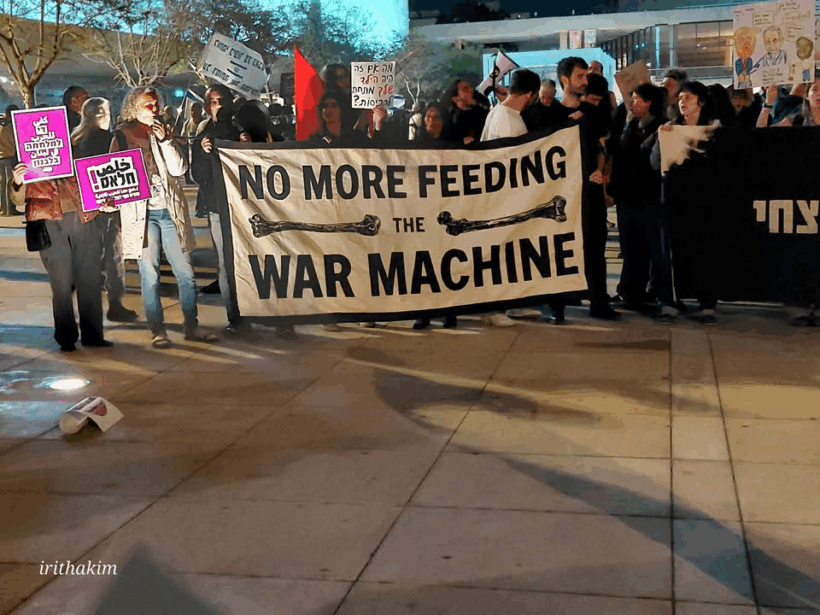
This Arab-Israeli peace movement never ceases to amaze us. Week after week it is reclaiming the streets, with a large number of demonstrations taking place at the same time on the evening of Saturday, April 11: beside the main protests in Tel Aviv, Jerusalem and Haifa, a total of 17 locations responded to the call!
And the first to seem surprised is Omri Evron himself, a lifelong pacifist, as well as an active member of Hadash (the Israeli Communist Party). For the past couple of years, Evron has been co-director of the Peace Partnership Coalition, which has been the main driving force behind this last mobilization and many more in the past.
We reached him by phone, and here is what he told us:
“When I think back to the first demonstrations that we dared to stage, in response to the Israeli/American attack on Iran on February 28, I can hardly believe the turnout we witnessed the other night: extraordinary, colourful, loud, creative, in just over a month we’ve grown tremendously. And despite the repression we suffered on April 4, when we were violently attacked by law enforcement, dispersed with water cannons—not to mention the several arrests—here we were again in large numbers the other night in Tel Aviv: Habima Square overflowing with signs, banners, drums, floats, and puppets with the faces of Trump and Netanyahu to send them home, there were at least ten thousand of us. This success was made possible by the sheer number of organizations that joined the call to action. It’s impossible to name them all, but just take a look at the poster: there are about sixty different logos, and the key point is the presence of Arab organizations alongside the Israeli ones. This response clearly signals a sharp decline in support for this regime of endless war that Netanyahu’s government would like to impose on us as the only possible solution!”
Tell us your story: Israeli, communist, and a staunch pacifist…
“I was born in Jaffa, which was originally a Palestinian city, later absorbed by the expansion of Tel Aviv. I therefore grew up in a mixed environment, where Judaism was forced to coexist with Arab traditions—a rarity for those living in Israel, where people inevitably suffer from mutual segregation, with very few opportunities for interaction. I consider myself privileged, both because of the environment and the family that raised me, which was in no way aligned with the dominant Zionist ideology: my grandparents were communists, my parents supported me in all my choices, especially the most difficult ones. For example, when I was 18, in response to the call for military service, I contributed to that letter from the shministim (young conscientious objectors).
It was 2005, in the midst of the Second Intifada, and since 250 of us declared ourselves refuseniks, it caused quite a stir. It also cost some of us a few months in prison, because the IDF has never recognized conscientious objection… As for my political commitment: I started as a teenager, affiliated with the Communist Youth League and increasingly involved in all sort of protests against the occupation in the West Bank. For a couple of years now, I have been leading this Peace Partnership Coalition, which, in addition to opposing war as the sole and permanent solution, represents a rare example of successful coexistence among many different Jewish and Arab groups, increasingly active together. It is a very engaging and demanding role, which I have the privilege of sharing with the Palestinian Sulafa Makhoul.”
How did this Peace Partnership Coalition come about, and in what way does it differ from the It’s Time coalition, which will gather on April 30 for the Peace Summit in Tel Aviv?
We were formed in response to the events of October 7. It was December 2023 and all factions of the so-called Israeli “peace camp” were in disarray: no one dared to voice dissent against the government, and even the slightest expression of public protest—including by Hadash, which is a legally recognized party—was broken up by law enforcement. The conclusion was to try the coalition card: if on our own we counted for almost nothing, together we could hope to make ourselves a little less invisible, even though we were in the minority compared to the prevailing warmongering in Israeli society. And so it went: most of the demonstrations denouncing the occupation and the war that have taken place in Israel over the past two and a half years. happened thanks to our Peace Partnership Coalition, which now includes some sixty organizations.
Of course we are also part of the It’s Time Coalition, with which we share fundamental objectives, in addition to the dozens of organizations that belong to both fronts. The main difference is operational. While they focus on one or two major events a year, our coalition represents an almost permanent grassroots mobilization, thanks to the contribution of the many active committees in Israel within Hadash and their counterparts in the West Bank. The fact that our numbers are growing confirms the value of our intervention, in response to the increasing social challenges everywhere. We can therefore describe ourselves as a bridge—or indeed, a widespread network—between the peace movement within Israel, with its history, and the active representatives pursuing similar paths within the Arab society. An undeniable strength of our coalition is the Hadash Party and the credibility it enjoys within the Arab front: in its radical opposition to the apartheid and genocide; and in defense of democratic values, under conditions of full equality of rights. Starting with the right to self-determination: an essential step toward the recognition of the Palestinian people and the sole prerequisite for a sustainable peace in this region.
However, polls indicate growing support for Netanyahu, thanks to this war with Iran.
I believe the situation is far more dynamic than the polls suggest: things change very quickly. It is true that at the start of the Israeli-American attack on Iran there was a general consensus in favour of the war, which explains the limited success of our initial demonstrations, immediately dispersed by law enforcement. But compared to previous wars, that consensus has crumbled very quickly.
Even though they are not suffering as much as the people in Gaza or Lebanon, the Israeli public is fed up with this permanent state of war, with no end in sight. Even before the fragile ceasefire, there was a general aversion to this state of affairs, and the situation is bound to worsen with the failure of the Islamabad negotiations. And that is why we must continue to mobilize, in Israel as well as around the world—which is exactly what is happening! This is why I remain optimistic.