
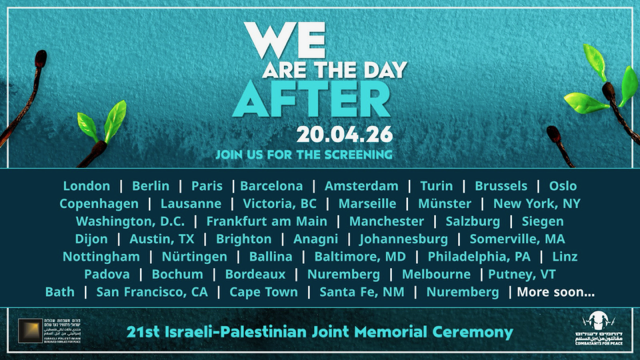
We are just a few days away from the Memorial Ceremony, which each year marks the most significant moment for the Combatants for Peace. This year, on April 20, not less than 58 locations around the world will answer the call, including 11 in Israel and Palestine—in addition to the countless individual contributions that we will never know. The response from the newly formed European network has been very significant this year, complementing the very strong support from long time supporters in the United States, with screenings in Melbourne, not to mention event in South Africa, in Johannesburg and Cape Town.
The significance of this event lies in its coincidence with a crucial date on the Israeli calendar: Yom Hazikaron, the day that the State of Israel honors in memory of those who died in the many wars of its brief history. Every year, the official ceremony begins in the evening with a siren, which echoes from the Western Wall in Jerusalem across the entire country, and for a few minutes everything comes to a halt: commercial activities, passing vehicles, radio and television programs, while the long broadcast of the names of the deceased begins… Every sound falls silent across the country that day, and life pauses. The commemoration is set to end the following day around noon, only to give way to an even more patriotic and solemn date: Yom Ha’atzmaut, which is Independence Day.
Let’s imagine, then, what it must have been like for the Combatants for Peace to decide to launch their joint movement on that very date, in partnership with former Palestinian militants (former inmates of Israeli prisons, and thus considered terrorists). As the co-founders of the movement, Chen Alon and Sulaiman Khateeb whom I reach by phone at their respective locations, can confirm:
Chen: “For Israelis, that has always been a day of silence and reflection. But in fact, what is celebrated on that date in memory of the deceased is the inescapable necessity of war. And in fact, ever since that first Joint Memorial Ceremony in 2006, and even more so in subsequent years as the event gained traction, controversies—sometimes violent, as was the case last year in a synagogue in Ra’anana—have been inevitable: the idea of challenging that unilateral celebration of grief, going so far as to suggest a reflection on the enemy’s pain as the key to overcoming the conflict, is diametrically opposed to the mainstream.
And so, the decision to launch our movement in precisely that way—with that public event we would later call the Memorial Ceremony—was indeed significant and challenging. The idea was suggested by Buma Inbar, a former soldier who in 1995 had lost his beloved son Yotam: blown up along with six comrades in a minefield, during the long war in Lebanon. A loss that Buma had worked to come to terms with by joining the Parents Circle Families Forum (which he himself had co-founded). And the vision, the work of the PCCF was something Buma had long wanted to expand in precisely that way—with an Alternative Memorial Service for All the Fallen, so totally different from the official one.
It was an idea we naturally embraced. The event took place at the Tmu-Na Theater in Tel Aviv attended by ca 600 people, which we considered a success: a sign of a desire for dialogue, for going beyond revenge, that was evidently alive. A few months after that first edition, in January 2007, it was Bassam Aramin’s turn to lose his beloved daughter Abir, killed for no reason by an Israeli bullet as she was leaving school. Bassam had been one of our most active Palestinian co-founders and that tragedy made the Alternative Memorial Ceremony more than ever meaningful for all of us, an event that has grown enormously year after year, until reaching its current global dimension. During the pandemic, we launched an attendance via video link that allowed us to reach countless homes in the US and other parts of the world. And at the May 2023 edition, no fewer than 15,000 people gathered in a park in Tel Aviv, despite the noisy protests outside the gates…
I must however admit, that it took some time for our Ceremony to strike the right balance in reflecting both narratives of the conflict: not only overcoming the initial and perhaps inevitable asymmetry, given the greater presence of Israeli participants compared to Palestinians; but paying close attention to what I like to call ‘the aesthetics of ethics’. Which means: carefully choosing to use certain terms rather than others; avoiding the use of photos, video footage, and graphic elements that might have risked emphasizing a certain narrative at the expense of the main objective, which is to recognize one another as human beings, to meet in a space of attentive, authentic, and mutual listening, with a view to re-humanizing the person you would normally see as an enemy.
But on a practical level, the problem remains of ensuring an equal number of in-person testimonies from both sides. Every year we are forced to appeal to various courts to obtain entry permits into Israel for Palestinian speakers, most often in vain. And the particular challenge this year will be security: unlike last year, when we filled an entire theater in Tel Aviv, with simultaneous screenings in various other cities, this year we will have to opt for a closed-door event. Given the particular tension of this period, the location will be disclosed only at the last minute, and the entire event will be streamed with extreme precaution.”
Soulaiman: “From its very 1st edition, considering the ongoing conflict, our Memorial Ceremony has been a one-of-a-kind event, given the violence and dehumanization we are witnessing. An event that is anything but ritualistic or predictable, with powerful transformative potential for anyone who participates: I would not hesitate to call it a sacred moment. Sacred because it underscores the value of choice, the option of responsibility that we all have as human beings. And for me, as a Palestinian, thinking of our tradition of ‘conflict resolution’ within our tribal society, it resonates as tasamuh, that means forgiveness. Difficult, but not impossible if we only think of ourselves as human beings, prone to error, yet at the same time endowed with the possibility to choose, to decide how to move forward, aware that on that very patch of land we must coexist, hopefully in peace.
It is precisely in this spirit that the title for this year’s Ceremony was chosen: We Are The Day After. We already embody, represent, experience, we are the living proof of that thing that happens at the end of all wars, which is called peace. It is hard to imagine that something like this could happen here too, for us Palestinians (and of course Israelis) after October 7, after the catastrophe of the Nakba, which since 2000 we have decided to commemorate every May 15 with a Nakba Ceremony no less important than the Memorial Ceremony. It is hard to come to terms with the devastation, the bombs, the amputations, the deaths, the famine as another weapon of destruction, the misery of the tent cities in Gaza.
It is difficult to imagine peace as a possibility when every day we witness the escalating violence of the settlers in the West Bank, even here where I live: and I would like to remind that just the other evening, April 16th, Habima Sq. in the heart of Tel Aviv became once again the theatre of a massive demonstration in order to denounce the attacks recently suffered even by Israelis citizens, engaged in Protective Presence operations, for example in Qusra. Not to mention the conditions of detention in Israeli prisons, as we denounced once again yesterday in Beit Jala, for the day dedicated to Palestinian prisoners.
But it is precisely this awareness of suffering that increasingly pervades the Israeli society as well, and this growing commitment on the part of so many Israeli brothers and sisters alongside my Palestinians brothers and sisters, that compels me to say: we are on the right path. In the twenty years since our movement began, something has happened. Many other movements have emerged, some following our paths or taking different approaches. Just this morning I recorded a speech that will be broadcast at the Peace Summit, which for the third time in three years will take place once again on April 30 in a large arena in Tel Aviv, thanks to a coalition of no fewer than 80 different organizations, with thousands of activists participating from all over Israel and (flights permitting) from abroad as well. And so, all these Memorial Ceremonies have not been in vain: Indeed We Are The Day After.”
For information on the Combatants for Peace Memorial and Nakba Ceremonies:
https://www.cfpeace.org/joint-ceremonies
To register and take part to the Ceremony (the link will be sent shortly before 8:00 p.m. Jerusalem time):
https://www.cfpeace.org/memorial-ceremony
To contribute with a donation to the production of the event:
https://www.drove.com/campaign/69b82f0c532f12b49155832f?utm_source=droveShare&utm_medium=copy+link&lang=en&skey=.2PwY