

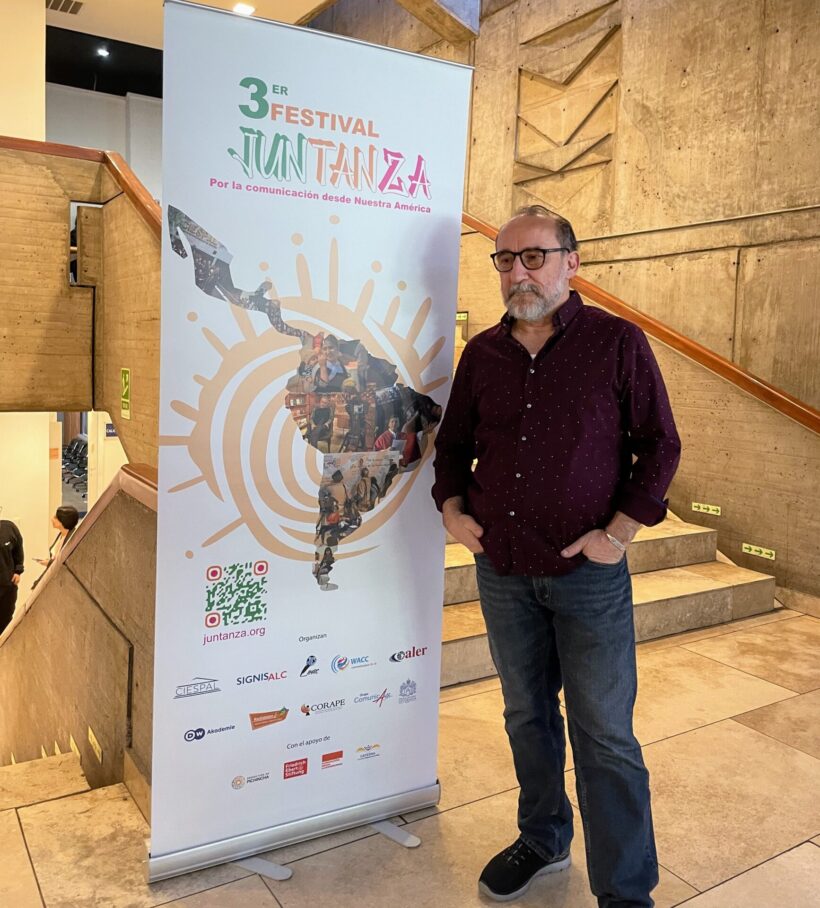
Talk presented as part of Pressenza’s panel titled “Nuclear Weapons, Existential Threats, and Journalism: Looking to the Future” during the 3rd Juntanza Festival for Communication from Our America CIESPAL, in Quito, Ecuador, on Friday, March 20, 2026.
Nuclear weapons have already destroyed the society they were supposed to protect. Even without a single bomb exploding, their mere existence has corroded the moral, ethical, and human fabric of our civilization. They generate a form of institutional violence so profound—a dehumanization so complete—that the society meant to be shielded by them is collapsing from within, disintegrating before our eyes.
We tend to think in material terms. We reassure ourselves: no nuclear bomb is going to fall on New York, Mexico City, Paris, Berlin, Kolkata, or Beijing. But what we fail to see is the level of psychological and spiritual destruction these weapons have already produced—a pervasive fear and ambient violence that exceeds what human beings can absorb and still grow, still develop, remain fully human. This is the true crisis of the nuclear age.
Consider the United States—the only country to have ever used these weapons, and still the most powerful in the world, and yet a nation in a permanent state of fear, operating in survival mode. It spends more on security and military than the rest of the world combined, not out of strength, but to manage an irrational dread: fear of the other, of immigrants, of political opposition, of change itself. Nuclear weapons didn’t create security—they created a civilization held hostage by its own arsenal.
These weapons have also done something subtler and perhaps more damaging: they have distorted our inner compass. They have eroded our capacity to distinguish between internal states of decline and compulsion—the crepuscular, the dying—and something far more meaningful: the possibility of internal growth, of depth, of a life oriented toward purpose rather than survival. When annihilation is a permanent state of mind, it becomes harder to imagine, let alone build, something worth living for.
We as communicators are also part of the problem. We broadcast violence like a kind of radiation, normalizing it, making it a fixture of our daily consciousness—until fighting back feels almost impossible. Conflict after conflict, bomb after bomb, genocide after genocide, the human spirit is ground down by an invisible enemy. Even when drones do much of the killing and no nuclear weapon is detonated, the spiritual destruction is the same.
We are surprised by the collapse of the international order—but why should we be? The same structures that produced this demonic weapon, transforming the balance of power into a mechanism of mass destruction, are now desperately clinging to control at any cost. We normalized the absurd, and now we are living with the consequences.
We are at the final phase of that process. And even if no nuclear weapon is used in Iran, Ukraine, or anywhere else, their existence is ultimately unsustainable. The coming civilization will have no choice but to move beyond them—not as an act of idealism, but as a necessity—redirecting the energy and resources spent on nuclear arsenals toward the priorities that actually make human life possible and worth living.
To work for the eradication of nuclear weapons is to work for the humanization of the world.
Podcast:
Full video of the discussion:
The Juntanza Festival has established itself as a regional forum for reflection and exchange on community, grassroots, and alternative communication—understood as a political, cultural, and social practice in service of the full right to communicate.



