

We are living through a critical moment. The recent attack on Iran not only aggravates instability in the Middle East but also reminds us once again of an uncomfortable truth: war never offers sustainable solutions. Every military escalation opens a cycle of violence that always falls upon the most vulnerable and those who bear the least responsibility. This illegal war, driven by interests—much like other similar conflicts in recent history—ignores the essential question: ‘What happens the day after?’ Therefore, from an ethical, humanitarian, and global security perspective, it is imperative to be forceful in rejecting this drift toward war.
In this context, the Spanish Government’s decision to deny the United States the use of the Rota and Morón bases for its attacks against Iran constitutes a political gesture of enormous relevance. By demanding strict respect for the United Nations Charter and international law, Spain is demonstrating that coherence between discourse, principles, and action is not only possible but necessary. And now, perhaps, more necessary than ever.
France’s nuclearist drift: a threat to multilateralism
While Spain reinforces its commitment to international legality, France is moving in the opposite direction. President Emmanuel Macron has announced an increase in the French nuclear arsenal and the temporary deployment of nuclear-capable aircraft to eight European countries under a strategy of ‘advanced deterrence.’ His assertion that ‘to be free, one must be feared’ manifests a deeply problematic worldview.
This logic of fear and intimidation is not only dangerous; it is incompatible with multilateralism, the rule of law, and human security. French doctrine even contemplates the possibility of a ‘warning nuclear strike‘ if an aggressor misinterprets its vital interests. That is to say, breaking the nuclear taboo and explicitly using the nuclear threat as a pedagogical mechanism—no longer just against a nuclear attack, but against a conventional one. Essentially, if nuclear deterrence fails and France is attacked, it would resort to a nuclear strike to ‘restore deterrence.’
Nuclear deterrence rests on a grim premise: that human nature is intrinsically violent and that only the possibility of mass destruction prevents conflict. History, however, proves the contrary. Extreme militarization does not generate stability, but rather distrust, escalation, and ultimately, war. Far from protecting the world, nuclear weapons have poisoned international relations and emboldened aggressions under the umbrella of impunity.
Spain and ‘Moral Rearmament’: A Necessary Alternative
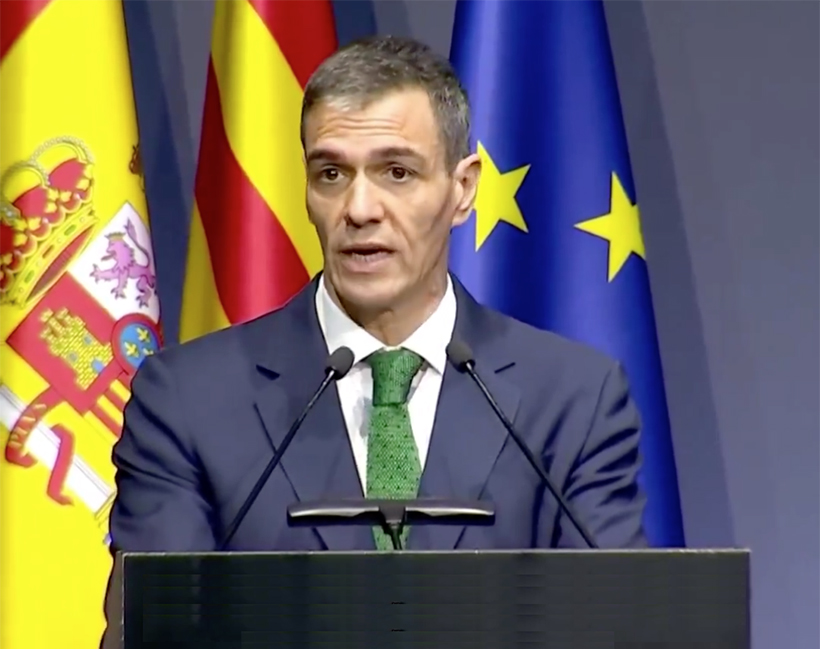
Opposing this vision, Spain is articulating a different path—one based on preventive diplomacy, the strengthening of international law, and cooperation for peace. At the Munich Security Conference, Prime Minister Pedro Sánchez explicitly rejected nuclear deterrence, describing it as a costly, risky strategy that is ultimately incompatible with a modern notion of security. ‘It is not a guarantee,’ he warned, ‘it is a gamble.’
His proposal for ‘moral rearmament‘ is not empty rhetoric. It is an invitation to redefine security through empathy, shared humanity, and institutional strength. It is not enough to denounce the risks of nuclear weapons; it is also necessary to question the logic that justifies them.
The Decisive Step: Signing the Treaty on the Prohibition of Nuclear Weapons
If Spain wants to consolidate this ethical and political leadership, it must take the remaining step: adhere to the Treaty on the Prohibition of Nuclear Weapons (TPNW), as 99 countries have already done.
The TPNW is a legal and moral tool seeking a normative change: it allows for the stigmatization of nuclear weapons, stripping them of prestige and moving toward their abolition, just as occurred with chemical and biological weapons, or even slavery. Signing it would align Spanish security policy with its democratic values and its declared commitment to multilateralism.
A Beacon in Times of Existential Risk
The Doomsday Clock now stands at 85 seconds to midnight—the highest risk of human annihilation in history. In this scenario, Spain can—and must—become an international benchmark. Not because it is a military power, but because it can demonstrate that peace and freedom are not sustained by fear, as France declares, but by justice, cooperation, and humanity.
The opportunity is on the table. The question is whether we will have the political and moral courage to seize it.”