

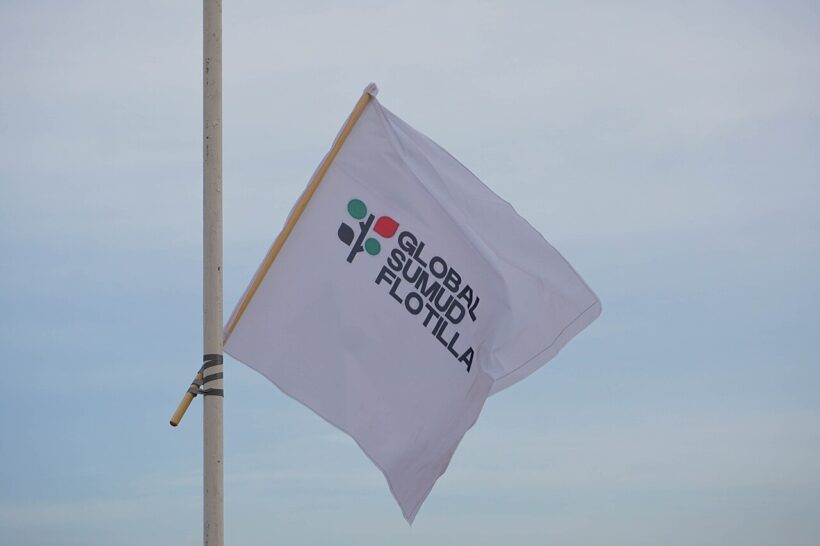
The announcement made this week by the Global Sumud Flotilla marks a turning point in the international civil response to the systematic destruction of Gaza, classified as genocide by the United Nations Special Rapporteur on the situation of human rights in the occupied Palestinian territories, Francesca Albanese. The coalition confirmed the launch of the largest coordinated humanitarian intervention in support of Palestine to date, combining a maritime flotilla and an overland convoy that will depart simultaneously on March 29, 2026.
The initiative mobilizes thousands of people from more than one hundred countries and is explicitly defined as a non-violent response to the ongoing genocide, the prolonged siege, mass starvation, and the deliberate devastation of civilian infrastructure and everyday life in Gaza. This is not a symbolic operation nor a testimonial gesture, but an organized action aimed at breaking the isolation imposed on the Palestinian territory and restoring the centrality of international humanitarian law where it has been systematically violated.
The announcement was made , February 5, at the headquarters of the Nelson Mandela Foundation in Johannesburg, a location charged with political meaning. The choice of venue anchors the initiative in the historical tradition of global civil resistance against systems of structural oppression and reinforces the parallel between South African apartheid and the regime of blockade, collective punishment, and dehumanization imposed on Gaza.
According to information released by the organization, the mission brings together more than one thousand health professionals, alongside educators, engineers, reconstruction teams, and specialists in the investigation of war crimes and ecocide. The composition of the contingent reveals a deliberate strategy: not only to alleviate immediate suffering, but also to document, rebuild, and establish legal records of the systematic destruction of a civilian territory.
The words of Saif Abukeshek, a member of the flotilla’s steering committee, summarize the political framework of the action: the adversary is not a person nor a people, but a way of life based on dehumanization, collective punishment, and the normalization of extreme violence as a tool of domination. In this sense, the flotilla presents itself as a direct challenge to an international order that has tolerated, if not facilitated, the commission of crimes against humanity and acts constituting genocide.
The scope of the initiative also exposes the vacuum left by states and multilateral organizations. In the face of diplomatic paralysis, systematic vetoes, and the erosion of international humanitarian law, coordinated civil society action re-emerges as a first-order political actor. Not to replace the law, but to demand its effective application.
The Global Sumud Flotilla does not claim to resolve a catastrophe that is structural and prolonged. What it does is something more uncomfortable: it exposes the gap between humanitarian discourse and concrete inaction, and demonstrates that, even under conditions of extreme risk, there exists a transnational will ready to act when institutional mechanisms fail.
In a world accustomed to observing the tragedy of Gaza through diplomatic communiqués and depersonalized statistics, this initiative restores centrality to direct human action. It is not merely a maritime and overland journey. It is a political indictment formulated from global civil society in the face of a genocide that continues to unfold before the eyes of the world.



