

The climate crisis is no longer an extraordinary or deniable phenomenon. It is instead an escalating reality that directly and profoundly affects communities across Europe, as consistently evidenced by youth-led movements, historical trends, scientific research, and visible extreme events. It is increasingly clear that, contrary to framing climate change as a series of unexpected emergencies warranting only short-term responses, it represents a structural challenge requiring urgent and sustained political action and investments, particularly to protect underserved communities. For many years, movements such as “Fridays for Future” and “Extinction Rebellion”, among others, have sounded the alarm, forcing attention on its far-reaching consequences while confronting widespread denial, neglect, and underestimation even in the countries hit hardest.
In recent weeks, many southern regions of Europe, including Sicily, Sardinia, Calabria, along with Malta, have suffered severe damage from extreme weather events such as Cyclone Harry. In Southern Italy alone, estimated losses exceed €2 billion, with thousands of people losing their lives in the Mediterranean Sea, and bodies only now re-emerging on the coasts of Sicily and Calabria. Meanwhile, in Valencia and surrounding areas, the consequences of the DANA (Depresión Aislada en Niveles Altos) that struck on 29 October 2024 continue to weigh heavily on local communities struggling to obtain tangible and credible government responses. Over the past three weeks in Portugal, a succession of storms – seemingly innocuous names such as Oriana, Kristine, Marta, and Leonardo – has caused at least 16 deaths and an estimated €775 million in damage, triggering widespread flooding, infrastructure collapse, and power outages. This rapid succession of extreme events underscores the urgent need for coordinated and effective European responses to climate-related disasters.
From Brussels to Lisbon: A Call for Accountability Beyond Borders
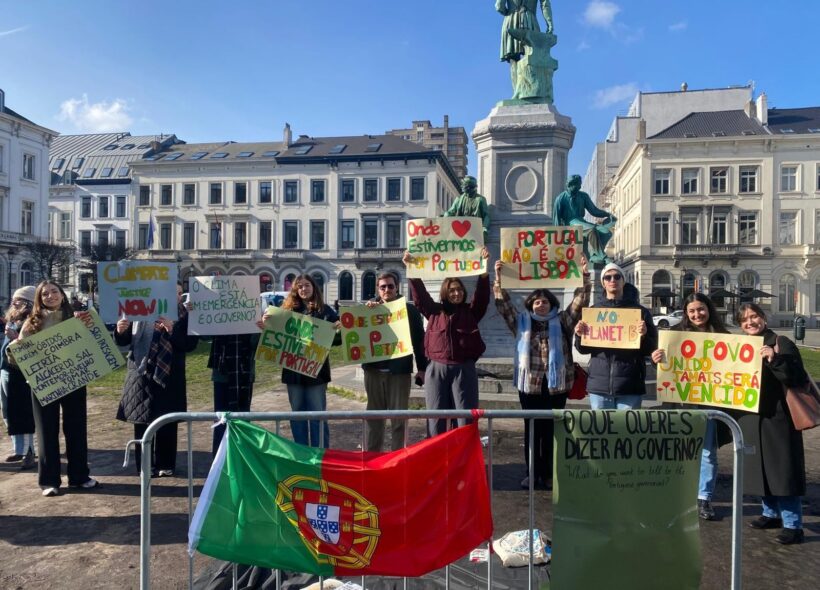
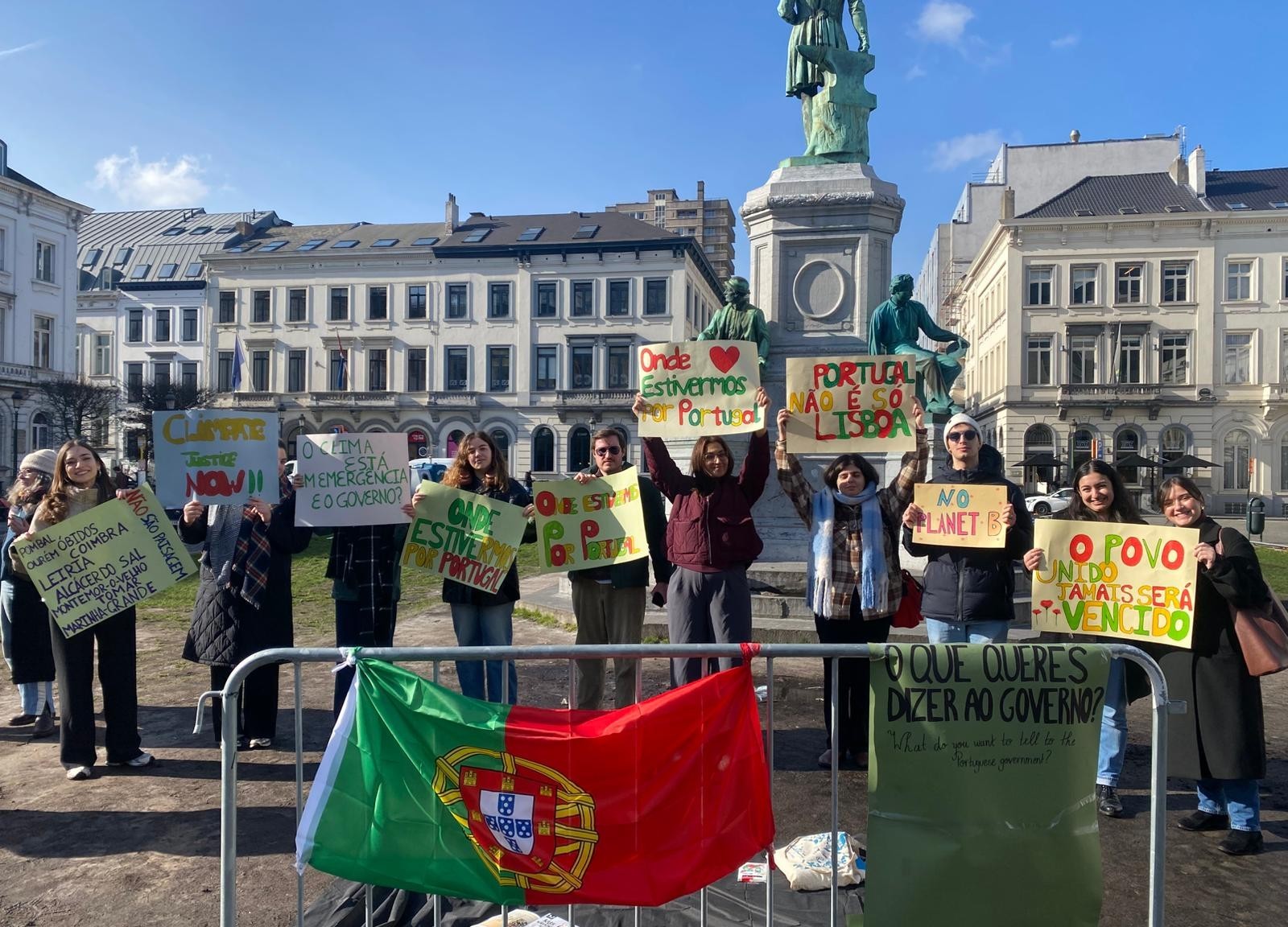
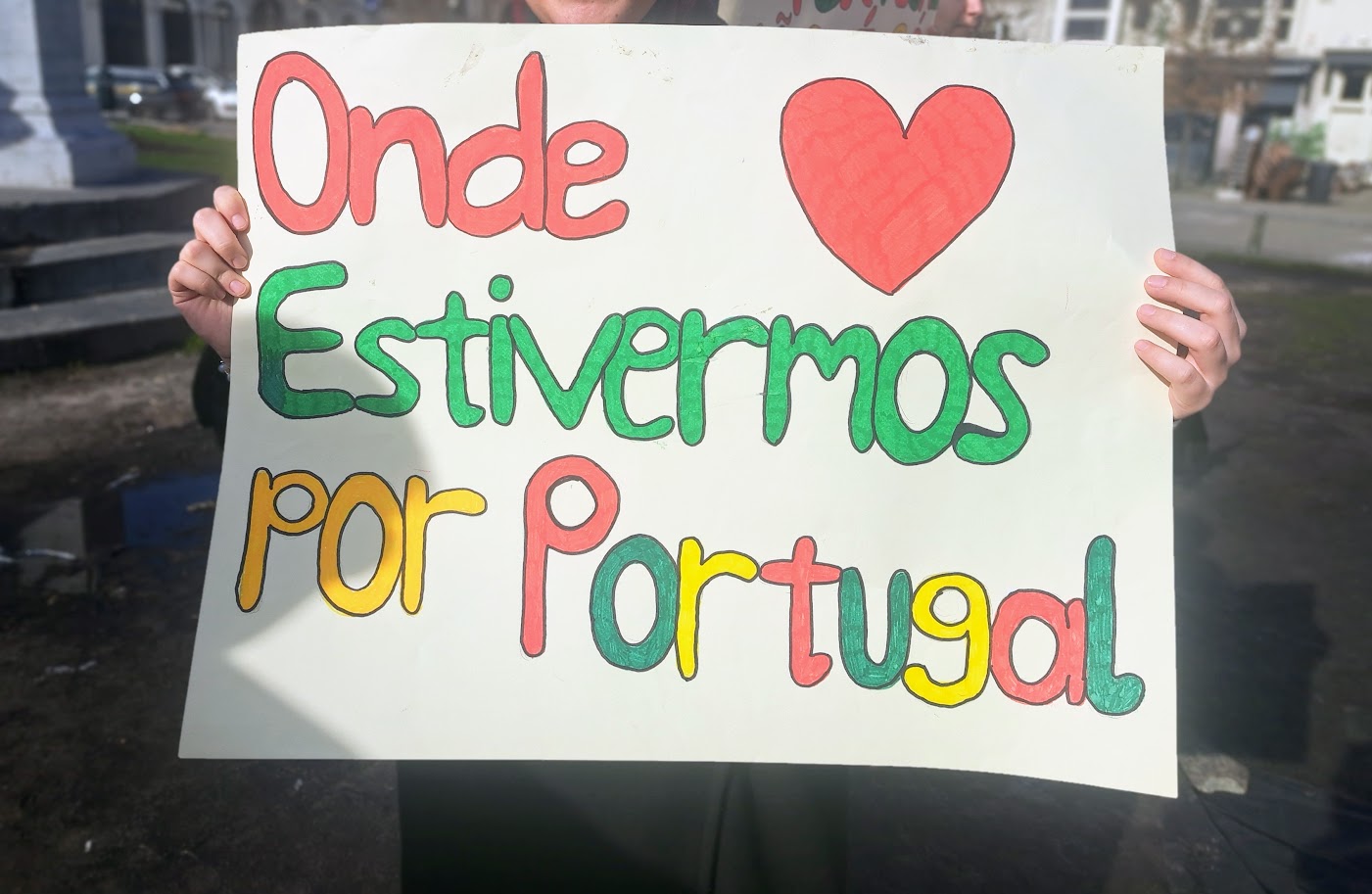
In order to raise awareness of the lack of accountability and insufficient governmental action, a group of self-organised and independent Portuguese citizens, currently residents in Belgium, held a peaceful protest today, 18 February, at Place du Luxembourg in Brussels, in front of the European Parliament. Under the slogan “Wherever We Are, for Portugal”, the initiative sought to draw attention to the ongoing crisis and its severe social, human, and economic consequences.
The organisers stressed the gravity of the situation unfolding within the European continent, where, to this day, thousands of people in regions such as Leiria, Coimbra, Santarém, and Castelo Branco remain without electricity, water, or access to essential services. Last week alone, more than 3,000 residents were evacuated from Coimbra as the Mondego River reached critical levels, and part of the A1 motorway collapsed after a dyke gave way. Prominent scientists have described this as one of the longest and most intense sequences of extreme weather events ever recorded in the country.
In this context, the protest held in Brussels sought to give international visibility to the climate vulnerability of the European continent, of which Portugal is progressively becoming a particularly stark and visible example. Organisers stressed that this is neither an isolated occurrence nor a phenomenon limited to recent storms. As vividly illustrated by the devastating wildfires that ravaged the country throughout the summer, destroying more than 65,000 hectares of land in 2025 alone, the crisis is structural, recurrent, and closely linked to broader European climate dynamics. Through their colourful posters, the demonstrators called clearly for more effective and long-term responses from European institutions, urging a shift beyond reactive emergency management towards sustained climate adaptation, preventive measures, and systemic resilience.
At the end of the protest, the organisers also highlighted the emotional and political difficulty of witnessing such devastation from abroad, emphasising solidarity with affected communities and the urgent need for coordinated European support. Key Members of the European Parliament elected in Portugal, including Catarina Martins, joined the gathering, emphasising the importance of ensuring that these concerns are heard and addressed at the highest political level.
The demonstration also included the presentation of a manifesto calling for concrete and binding measures to address the climate emergency, protect vulnerable populations, and strengthen resilience at both local and European levels, with the full text available in English below:
Manifesto – Wherever we are, for Portugal
We, Portuguese citizens living in Brussels, have come together for a single cause: to raise awareness of the severity of the climate crisis in Portugal, made evident by the recent storms and floods, and to demand concrete and solidarity-based responses. Storm Kristin left a trail of destruction that exposes the fragility of both institutional and human responses to increasingly severe climate phenomena: homes destroyed; livelihoods and sources of income affected; infrastructure compromised; tragically, lives lost; and communities still waiting for effective and coordinated support.
We have witnessed a slow and insufficient response from the Portuguese government to the most urgent needs, leaving those affected isolated and without the level of support that a catastrophe of this magnitude requires. Media coverage, particularly at the European level, has also been scarce, hindering public understanding outside the affected regions of the true scale of the crisis. At a time when it is more important than ever to give voice and visibility to the people and communities struggling to rebuild their lives, this informational silence is deeply regrettable.
Beyond the visible destruction, this catastrophe will leave profound and lasting scars. Damages, estimated at several billion euros, reflect only part of an impact that will unfold over time. Reconstruction will be a long and uneven process, requiring not only immediate responses but also a continuous strategy of support, monitoring, and sustained public investment.A central pillar of this mobilization is the demand for genuine European coordination in responding to the crisis. To date, Portugal has not requested the activation of the European Union Civil Protection Mechanism, the instrument designed to mobilize coordinated support among Member States in emergency situations. Despite national authorities stating that there is “no justification” for activating it, the strain on resources and the scale of the damage are both evident and alarming.
We believe that a solidarity-based response at both national and European levels is only possible through clear political action, transparency, cooperation, and by prioritizing people: their safety and dignity. Their voices must be heard not only in the affected areas, but also in European decision-making spaces.
Accordingly, the objectives of the action “Wherever We Are, For Portugal” are to:
• give public visibility to the reality faced by affected populations;
• demand political engagement that places people at the center of the response;
• provide and disseminate reliable information on how to offer support (locally and remotely);
• advocate for faster, more coordinated, and more effective response mechanisms at both national and European levels.Because silence and indifference can never be an answer, especially at such a critical moment.
Wherever we are. For Portugal.