
This Saturday (24), the Fourth Assembly of the World Humanist Forum began, bringing together a wide cultural diversity of activists, organizations, and institutions.
The challenge set out in the title of the gathering was: “Overcoming uncertainty and the global crisis: Humanity in Action.”
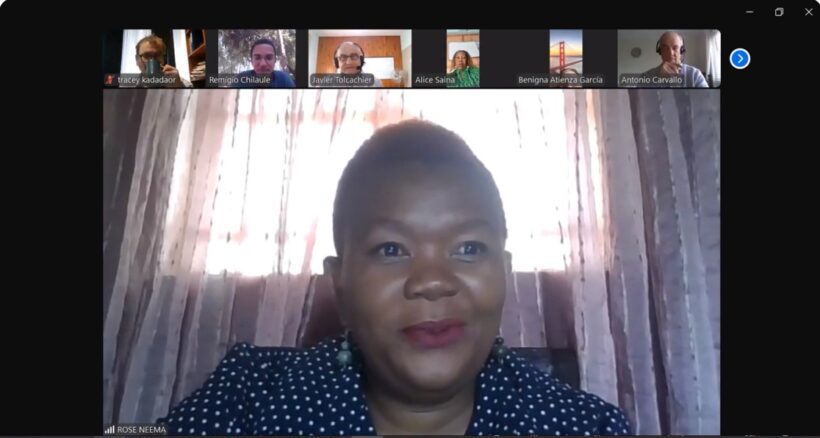
The assembly opened with a reflection intended to feel and honor one’s own humanity and that of others, guided by Rose Neema Onyango from Kenya and Michael Cameron from the United States. Drawing on her long experience as an activist, Neema stated:
“In our humanist tradition, we recognize that within every human being there dwells a ‘Force’. This is not a supernatural force, but the vital force of life, of intention, and of historical direction. It is the force that enables a student to stand up to a regime and a teacher to inspire an entire generation.”
Michael followed her words by saying:
“We do not gather in a vacuum. We come together at a moment of ‘global uncertainty’. We acknowledge the shadows: systemic corruption that drains the lifeblood of our communities, violence that scars our lands, and the confusion that leads to social discouragement.”
Rose continued, her voice calm yet firm:
“We recognize that we are the architects of the future. There is no destiny written in the stars that we cannot rewrite with our own hands.”
— “May we find today the clarity needed to see beyond this ‘age of confusion’. May we find the courage to move from discourse to ‘Humanity in Action’. We honor the best in each of us: the resilience of the youth, the wisdom of the elders, and the creative spirit of artists,” — the young American expressed with deep feeling.
After a few brief moments of inward reflection, the meditation concluded with an invitation for the hearts of those present to speak the words:
“I feel the humanity within me and see that same humanity in all of you. This is our shared horizon. This is humanity in action.”
From there, the day continued with the presentation of reports on two outstanding activities carried out within the framework of the World Humanist Forum. Adoch Fortunate, from Uganda, reported on the East African Humanist Seminar, which brought together participants from Uganda, Tanzania, Burundi, the Democratic Republic of the Congo, Sudan, and Kenya. The seminar was supported by humanists from Iceland, Great Britain, Spain, Argentina, Chile, and the United States.
Next came the presentation of a report prepared by students from the University of Baguio City in the Philippines, under the guidance of Dr. Genevieve B. Kupang, on the international forum “Can generational movements put an end to systemic corruption?”, which included the participation of students, academics, and activists from the Philippines, Indonesia, and Nepal.
To open the subsequent debates, one of the members of the Secretariat of the World Humanist Forum, Antonio Carvallo, presented an analysis of the current global situation, stating:
“Guided by an evolutionary direction toward increasing adaptation, the social world must articulate a threefold response: in its relationship with the environment, in the relationships among human beings, and in the relationship with ourselves.
If one observes the Global situation, it becomes evident that the current system does not provide adequate responses in any of these areas.
Prevailing ideologies place money and financial speculation above Human Rights, above Human life, and above the life of nature. These are ideologies that justify genocide, dispossession, and the elimination of entire nations, as in Palestine, he added.
After recounting the path that has led to this historical moment—one in which multilateralism is clearly gaining ground—the humanist scholar affirmed:
“Not everything is wrong. From the World that is dying, there will be elements worth rescuing, and others that will need to be conceived, designed, and developed in the greatest adaptive effort in human history. Humanists are optimists. We believe that as the human rights of all are increasingly fulfilled, the world itself becomes more human.”
He concluded his presentation by saying:
“We human beings are transformers of the world—and, of course, of ourselves. In the midst of chaos, we must affirm our humanity. The women and men who came before us always had to face adversity. With greater or lesser intensity, they always managed to overcome it. Like Odysseus, we must survive the deadly song of the sirens and continue our journey toward the future world.
That is the direction and the message we must never forget and must always convey with the certainty of lived experience: ‘all the good that has happened to us and to others close to us.’”
The session then divided into working groups to generate humanist positions and proposals in response to the current situation.
The first challenge was met. The feeling among participants was unanimous: despite the difficulties of the moment, the future remains open.
On the second day of the Assembly, scheduled for Sunday the 25th, the objective will be to consolidate the conclusions reached into determined collective action through work in 17 specific thematic roundtables.
Only then will the full meaning of the closing motto be realized: “Humanity in Action.”