

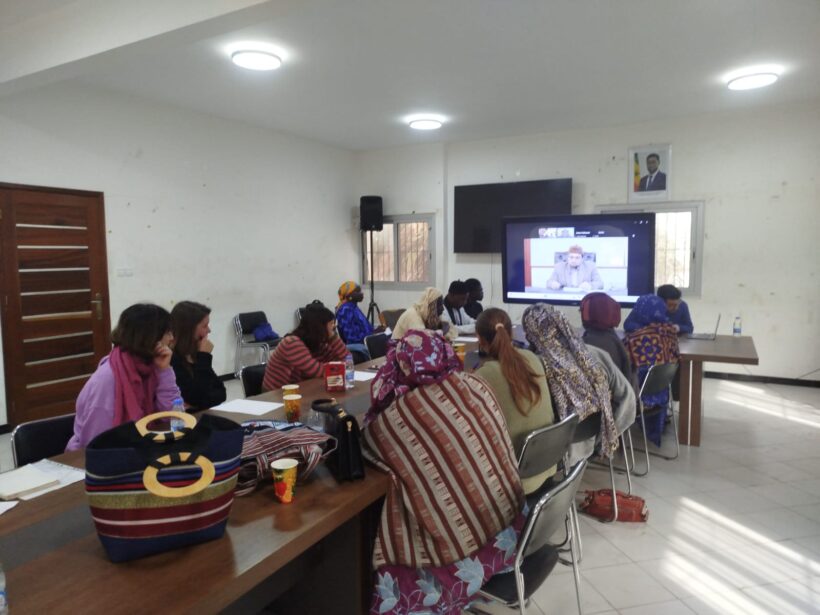
On 10 January 2026, as part of the activities promoted by Energia per i Diritti Umani, a virtual meeting was held in Malika connecting Senegal and Pakistan. On the other side of the screen, live from Pakistan, was Professor Hussain Mohi-ud-Din Qadri, Vice President of the Board of Trustees of Minhaj University Lahore (MUL), home to the School of Religion and Philosophy founded by Professor Qadri himself in 2016.
The professor had already connected with Senegal a year earlier, to initiate a dialogue with the facilitators of the project “Voix des femmes – Autonomisation féminine, droits et santé” regarding the contents of the Qur’an relating to the condition of women and their correct interpretation.
This time, the meeting was structured as a round table composed of Professor Qadri, Imam Soumaré of Yeumbeul Nord (Dakar), and Imam Keïta of Malika (Dakar). Also present were the facilitators of the “Voix des femmes” awareness-raising campaigns, together with volunteers from Energia per i Diritti Umani, to listen to the speakers’ discussion of domestic and economic violence as interpreted in the light of the Qur’an, Sunnah, and Hadith.
The discussion opened with Professor Qadri’s contribution, in which he addressed the issue of domestic violence, highlighting how it is condemned by the Islamic religion and considered unacceptable, despite (distorted) interpretations that seek to justify it under certain circumstances. The Islamic family, based on balance and equality between husband and wife, is not characterized by unilateral power, but rather by a partnership that allows the couple to support each other mutually. Indeed, many anecdotes and references to the life of the Prophet were cited, pointing to marital care toward one’s wife and to the value judgment according to which a righteous man knows how to treat women with kindness and respect.
Female economic autonomy is also valued in the sacred texts of the Qur’an: a woman must be able to work if she so wishes, just as the Prophet Muhammad’s first wife did by devoting herself to trade (with her husband’s full support). Here, too, numerous stories drawn from the sacred texts were cited concerning women engaged in a profession.
In any case, money cannot constitute an element of control over a woman’s life, and a husband cannot monitor her expenses. Moreover, although a man is required to offer as generous a dowry as possible for marriage, this does not entitle him to claim any power over his wife, since the dowry is given out of love and not to “buy” the woman and turn her into a slave. Proof of this lies in the fact that household chores are not a female prerogative; on the contrary, according to Islam, a man is required to contribute to domestic management.
On the same themes, Imam Soumaré and Imam Keïta subsequently intervened, addressing respectively domestic and economic violence, adding some insights into Senegalese society. For example, it emerged that even today the birth of a male child is welcomed with greater participation and joy than that of a female child—a cultural legacy of a patriarchal society that is completely at odds with the Islamic religion, according to which every child who is born is to be considered a gift from God, regardless of sex.
The opinions of the Imams on both issues largely coincided with that of Professor Qadri, reaching the conclusion that many women are discriminated against in the name of religion simply because it is not studied and, as a result, women themselves are unaware of their rights.
On some points, however, a divergence in interpretation was noted, which was nonetheless bridged through attentive and respectful mutual listening. A particularly relevant example in this regard is the controversial issue of polygamy: according to Professor Qadri, it is even discouraged by the Qur’an, since the scriptures state that although a man may take up to four wives, it is considered very difficult for him to do so while guaranteeing equal treatment to all. According to the Imams, on the other hand, the correct interpretation would lie in the possibility for a man to remain polygamous until he finds the woman who embodies all the ideal characteristics.
This was followed by a long question-and-answer session led by the facilitators present, touching on various topics, from the religious stance on family planning to women’s right to inheritance, to possible solutions for addressing inadequate religious education among both the adult population and younger generations.
On this last point, the fundamental role of religious leaders emerged: by acting as spokespersons for religious teachings and their correct interpretation, they can serve as a sounding board for the dissemination of a religious education that becomes a vehicle for a culture of human rights and gender equality. In this regard, the speakers concluded with a commitment to promote moments of community outreach within local religious communities, specifically addressing gender rights and the fight against discrimination.
On 10 January, what took place was not just a seminar, but a moving attempt to transcend what most complexly characterizes human society—differences in viewpoints, culture, thought, and geography—all in the name of an intentional work of internal and external humanization, with the will and purpose of passing on the same aspirations to others.
Behind this meeting, there are hundreds, if not thousands, of potential beneficiaries of these understandings, from the religious community to the people whom the facilitators will have the opportunity to raise awareness among in schools and homes as part of campaigns to combat gender-based violence.
In conclusion, the meaning of this day lies entirely here: launching intentional actions may seem like a tiny drop, but it is precisely from the drop that the ocean is born… And this restores hope and meaning to everyone’s tomorrow.



