

The Casalecchio di Reno Massacre
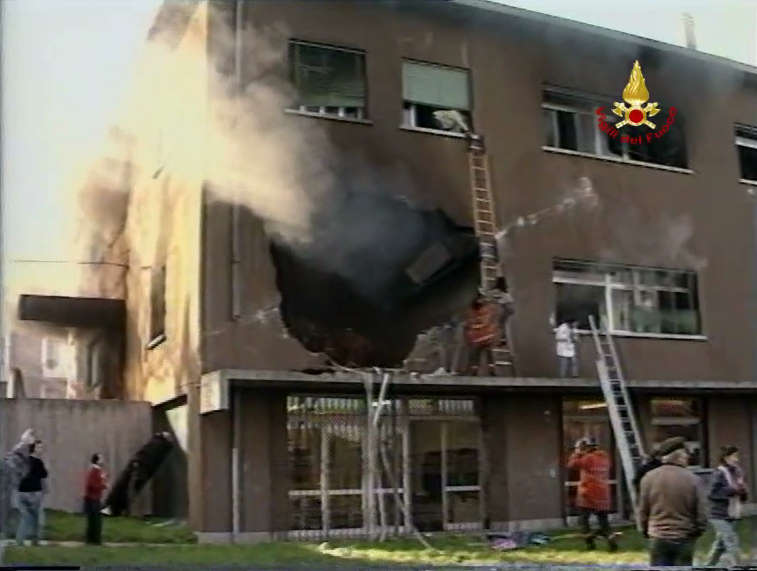
Exactly 35 years ago, on 6 December 1990, an out-of-control Italian Air Force Aermacchi MB-326 crashed into the Salvemini Institute in Casalecchio di Reno (Bologna), killing 12 young people and injuring 88 others, including students and school staff.
The aircraft had suffered a failure. After about ten minutes of flight, it was abandoned by the pilot, who parachuted out and was injured. At 10:33, the now pilotless plane impacted the classroom of class 2ª A. At that moment, there were 285 students and 32 teachers and non-teaching staff inside the building.
In the impacted classroom, there were sixteen pupils, twelve of whom died instantly; four others were seriously injured, as was the teacher giving the lesson at the time.
The Public Prosecutor’s Office of Bologna initiated proceedings against the pilot, the commander of the 3rd Wing, and the control tower officer at Verona-Villafranca airport, accused of multiple involuntary manslaughter and air disaster.
In the first-instance trial, the prosecution argued that the pilot, as soon as he detected the engine failure near Ferrara, should have directed the plane eastward, towards the Adriatic Sea, before parachuting out, instead of heading towards a densely populated area like that around Bologna, so that the aircraft, once left to its fate, could crash into the sea, avoiding causing victims and other damage.
According to the prosecution, the other two officers, who were in radio contact with the pilot from the Villafranca control tower during the flight, had given the pilot incorrect instructions on how to manage the emergency.
The three military personnel were defended by the State Attorney’s Office, which rightly caused controversy as it constituted a clear breach of effective judicial protection: the victims, who were in a state school, did not have defence counsel of the same standing, having to face, with their private lawyers, none other than a State Attorney.
In February 1995, the three defendants were found guilty and sentenced in the first instance to two years and six months in prison, while the Ministry of Defence was held liable for civil damages. However, the appeal ruling by the Court of Assizes of Bologna, on 22 January 1997, unusually overturned the conviction and acquitted the military personnel, arguing that “the fact does not constitute a crime.”
On 26 January 1998, the 4th Section of the Court of Cassation in Rome rejected the final appeals by the victims’ families and confirmed the acquittal. The massacre was thus officially reclassified as a tragic, inevitable fatality.
The twelve victims, eleven girls and one boy, all aged between 14 and 15, were:
- Deborah Alutto, from Zola Predosa
- Laura Armaroli, from Sasso Marconi
- Sara Baroncini, from Casalecchio di Reno
- Laura Corazza, from Sasso Marconi
- Tiziana de Leo, from Casalecchio di Reno
- Antonella Ferrari, from Zola Predosa
- Alessandra Gennari, from Zola Predosa
- Dario Lucchini, from Bologna
- Elisabetta Patrizi, from Casalecchio di Reno
- Elena Righetti, from Sasso Marconi
- Carmen Schirinzi, from Sasso Marconi
- Alessandra Venturi, from Monteveglio
The 88 injured were hospitalised, and 72 of them suffered permanent disabilities of varying degrees or severity. Many occupants of the upper floors were in fact injured while jumping out of windows to escape the toxic smoke released by the fire.
The Cermis Massacre
On 3 February 1998, a US military *EA-6B Prowler (“Predator”)* fighter jet severed a cable of the Cermis cable car in Val di Fiemme, Trentino. Twenty people died: 19 tourists and the operator. However, it was not possible to prosecute the military personnel in Italy.
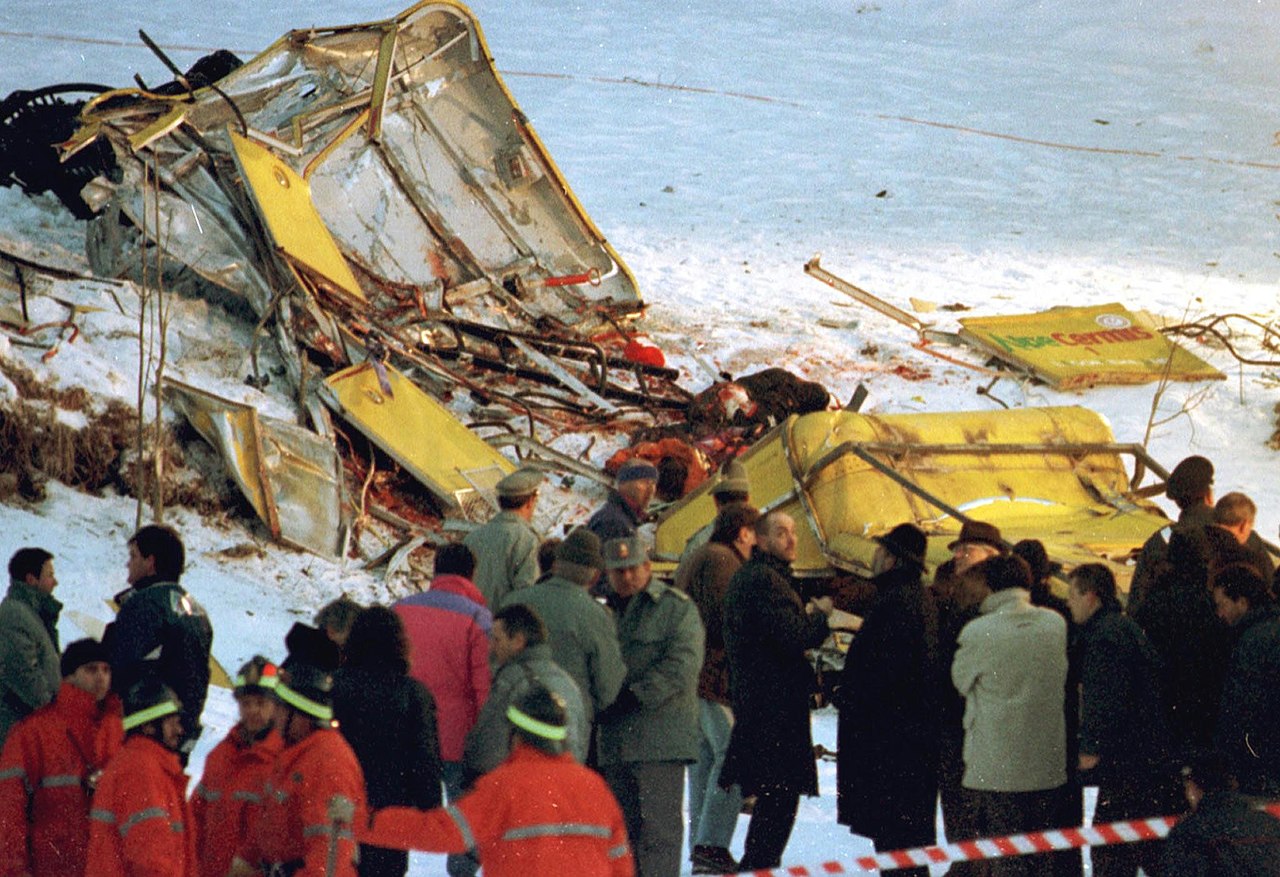
The remains of the cable car cabin after the impact
The following year, on 5 March 1999, the Court Martial at Camp Lejeune, USA, found the captain and his navigator not guilty of the massacre, despite reconstructions showing the aircraft was clearly at an altitude lower than permitted, violating regulations.
The video recorded on board was destroyed by one of the accused: apparently, they were betting a couple of beers, amidst great laughter, on the acrobatic skills of the pilot, who was racing another aircraft.
In 1999, a new trial was held, again in the USA, this time for obstruction of justice against the two aviators, accused of destroying the “phantom video.” Both marines were discharged from the army, and one of them was sentenced to six months in prison, though he ultimately served only four.
The Ustica Massacre
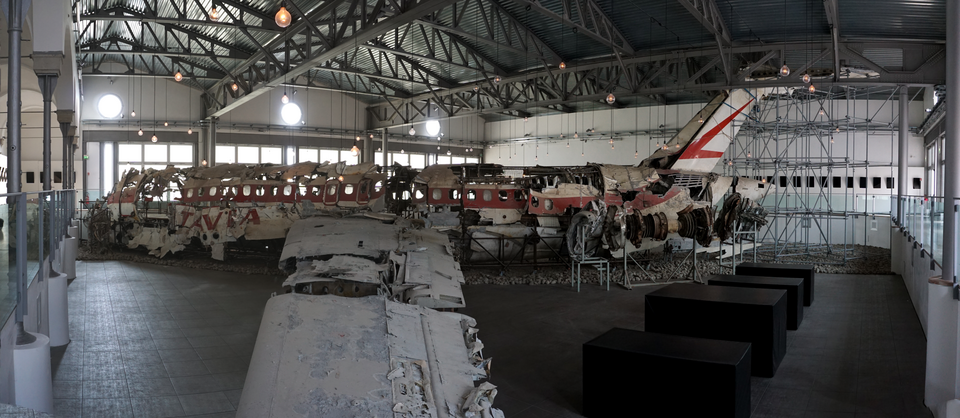
What can be said about the Ustica massacre on 27 June 1980, when the skies of our country became a veritable theatre of war between NATO and Gaddafi’s Libya?
The victim was an Itavia DC 9, hit by a missile fired from a French fighter jet (according to statements by Francesco Cossiga and, more recently, Giuliano Amato). The result was eighty-one dead, countless false leads, several suspicious deaths, and the top brass of the Italian Air Force, who were first charged and then, as usual, acquitted of the charge of obstructing the investigation… In short, no one was held responsible.
The Strategy of Tension
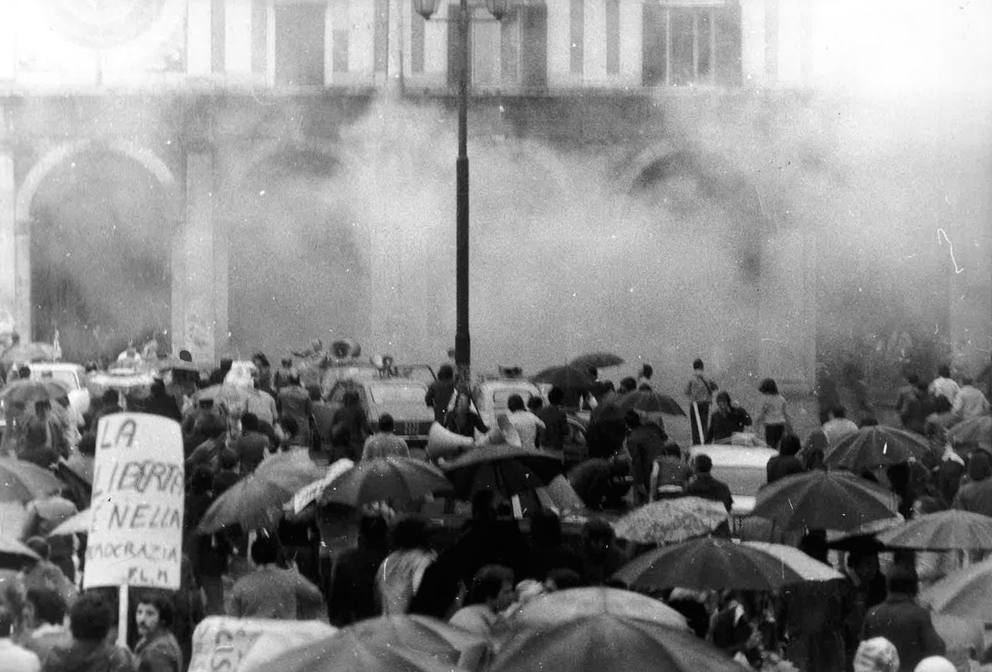
Piazza della Loggia, Brescia, in the moments immediately following the explosion, May 1974.
I wish to recall the dark role (though some may not want to see it) played by the US Secret Services, also through the logistical support of NATO bases, in what we can call a low-intensity war against the Italian workers’ movement: the so-called strategy of tension, with its long sequence of unpunished massacres and the “clattering of sabres” denounced by the Secretary of the Socialist Party, Pietro Nenni, on the part of potentially coup-minded sectors of the Armed Forces.
The Otranto Massacre
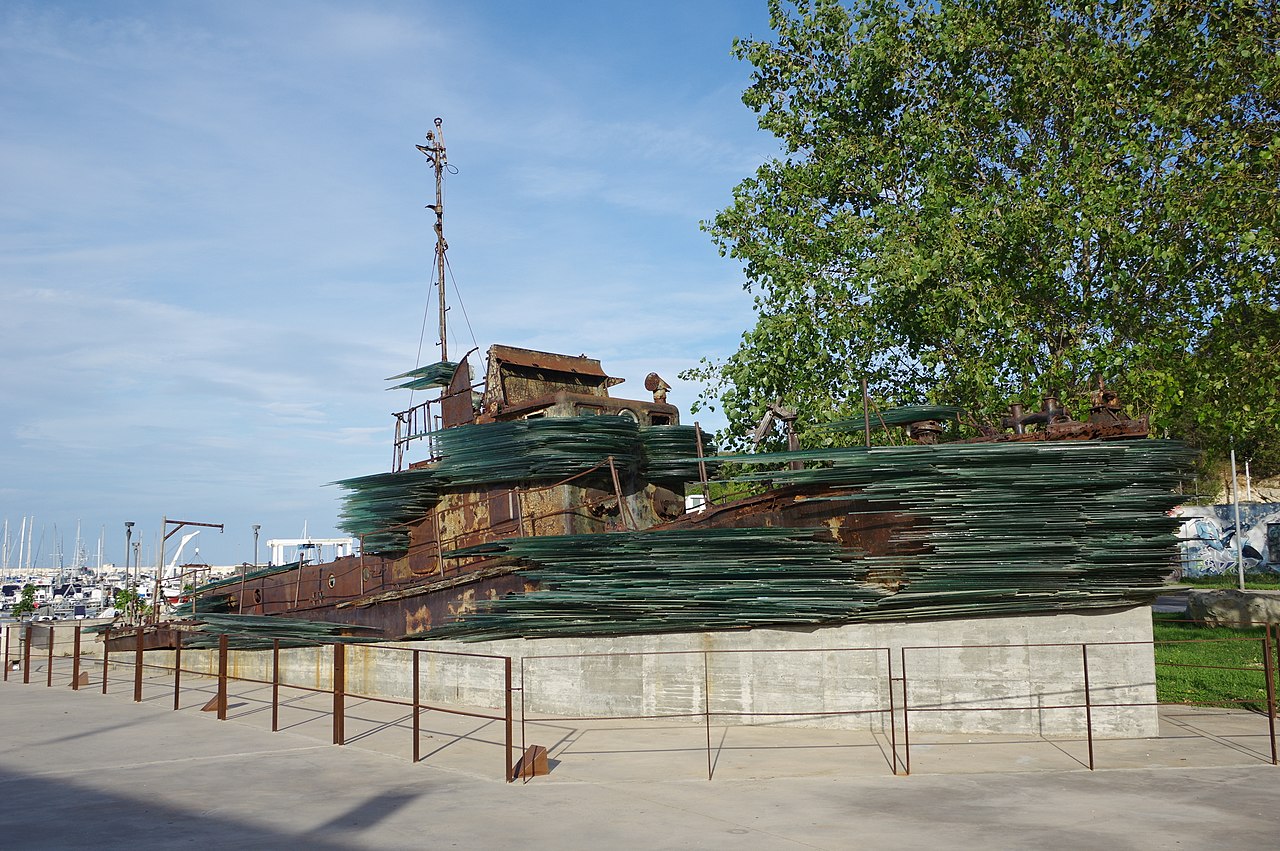
The remains of the Katër i Radës at the L’Approdo memorial. Work by Costas Varotsos “To Migrant Humanity” (port of Otranto)
Finally, the Otranto Massacre on Good Friday 1997. It was 28 March, when the Italian Navy corvette Sibilla rammed the Albanian speedboat Katër i Radës, overloaded with migrants, to carry out the orders of a naval blockade by all necessary means, causing the death of over a hundred people (81 bodies recovered and between 24 and 27 missing).
Let’s Abolish the Armed Forces and Leave NATO
For our security, we need neither European rearmament policies nor the reintroduction of compulsory military service.
On the contrary, as a peace movement that is reawakening in Italy, we should have the prophetic courage to call for the dissolution of the Armed Forces, however gradual, as Costa Rica has already done.
We should also demand our country’s exit from NATO and the closure of US military bases. These bases, far from protecting us, turn our cities into targets for potential attacks by the Russian Federation, Iran, or China.
Instead of provoking them, Europeans should push for negotiations to achieve true peace through a new policy of détente and disarmament.
The only security today is the full respect for our beloved Constitution, which repudiates war.
This implies our country’s neutrality in ongoing conflicts and a foreign policy aimed at fostering dialogue and peace. It also includes a Civil Service, offered to young women and men, because today “the defence of the Fatherland is the sacred duty of the citizen” (Art. 52 of the Constitution).
But the land of our fathers and mothers is defended solely through the absolute repudiation of war and the construction of a true peace, based on respect for the fundamental rights of every human being.
*Sources: various Wikipedia entries



