

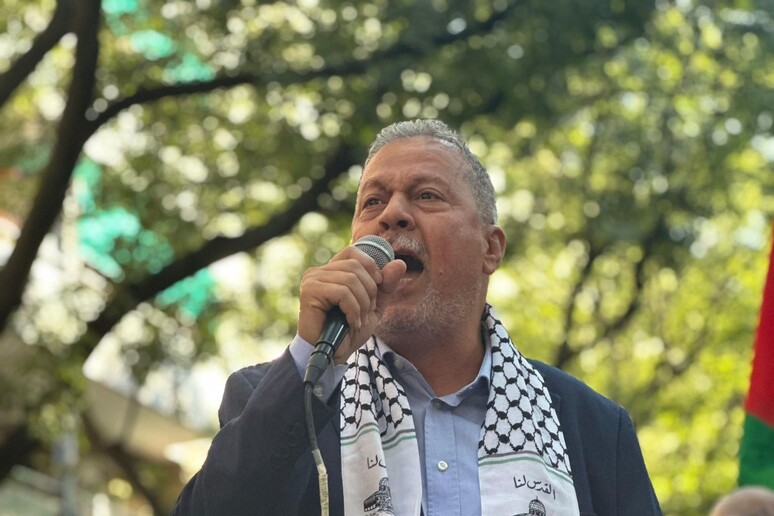
We report a press release from the Center for Research and Development for Democracy regarding the precautionary measures against Mohammed Hannoun and other pro-Palestinian activists.
CRED (Center for Research and Elaboration for Democracy) expresses serious concerns regarding the precautionary measures issued against Mohammed Hannoun and other activists engaged in solidarity with the Palestinian population.
The prosecutorial framework reveals an element of exceptional gravity: a significant portion of the charges is based on documentation produced by the Israeli army during military operations conducted in the Gaza Strip. Such materials are accepted as documentary evidence without any effective assessment of neutrality, reliability, and verifiability.
Israel is neither a neutral actor nor merely a “party to a conflict.” It is a State currently under scrutiny for genocide before the International Court of Justice and subject to binding provisional measures. This legal reality cannot be ignored when its armed forces generate evidentiary material intended to affect the personal liberty of citizens and residents in Italy. These documents are produced in a context radically incompatible with the guarantees of due process: absence of adversarial proceedings and production by a military apparatus directly involved in crimes under international investigation. Their use results in a serious slippage from judicial cooperation to the uncritical reception of military intelligence.
Particularly alarming is the classification of humanitarian assistance activities as “financing terrorism,” based on the inclusion of beneficiary organizations on lists drawn up by a foreign government. In this way, political labeling replaces judicial fact-finding: if the Israeli army designates an individual as a “relative of a terrorist,” such a definition is adopted as a presupposition of criminal liability by an Italian judge, without any independent verification.
In this context, the criminal action appears to bend toward a unitary reinterpretation of more than twenty years of activity, attempting to confer criminal relevance on facts that were already the subject of previous dismissals. The use of alleged “new elements” provided by the Israeli army after October 7, 2023, creates a sort of “interpretative emergency climate” that overrides the principles of legality and legal certainty, acting retroactively on conduct that originated as lawful solidarity.
What emerges is a paradigmatic case of lawfare: the use of criminal law as the projection of an external political and military strategy, in which the intelligence of a State accused of genocide ends up shaping the assessments of a court of the Italian Republic. It is an institutional short circuit that compromises the sovereignty of the judicial function.
CRED calls upon the judiciary to rigorously uphold the principles of autonomy and independence. Criminal adjudication cannot be based on evidence produced by a military apparatus at war, nor on political labels. At stake is not only the position of the accused, but the resilience of the rule of law and the increasingly fragile boundary between justice and juridical warfare.
Centro di Ricerca ed Elaborazione per la Democrazia (CRED)



