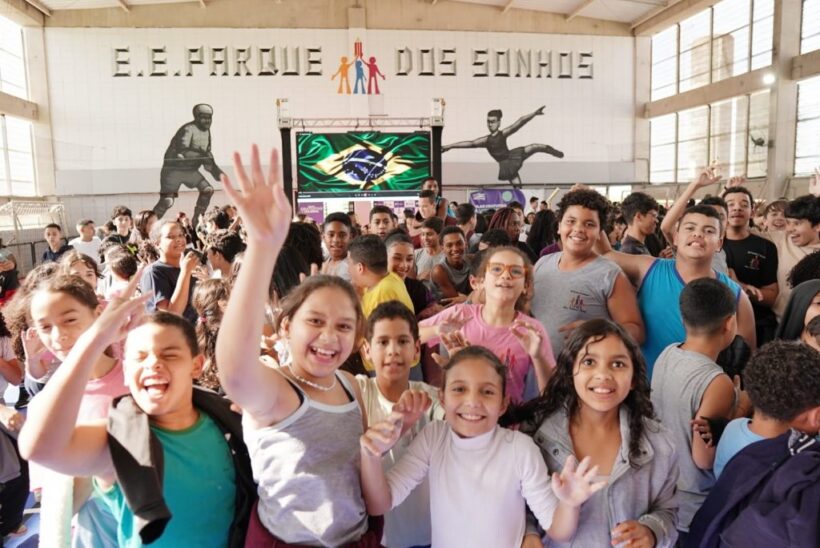
The Parque dos Sonhos State School, located in Bolsão 9 in Cubatão, on the coast of São Paulo, has just received the International Award for Best School in the World 2025, in the category “Overcoming Adversity,” awarded by a global jury of education experts.
This achievement not only marks the recognition of a public institution in the Brazilian periphery, but also symbolizes the strength of humanistic popular education, inspired by the teachings of Paulo Freire and Argentine philosopher Mario Rodríguez Cobos (Silo), whose legacy in defense of nonviolence inspires pedagogical practices in various parts of the world.
A school that flourishes amid adversity
EE Parque dos Sonhos is now an international benchmark in transformative education, built on the pillars of a culture of peace, solidarity, and student leadership. Located in a region historically marked by social exclusion, the school has transformed its daily life into a space for dialogue, empathy, and collective action.
Among the projects that marked the school’s award:
● Sports, arts, and culture programs, with the active participation of students.
● Nonviolence Week in Schools, celebrated annually on the anniversary of Mahatma Gandhi, mobilizing students, families, and the
local community.
● New Humanism pedagogy, a movement that values the integral development of the human being, recognizing their dignity, freedom, and capacity for transformation.
● Conflict mediation and active listening initiatives, which significantly reduced rates of school violence in the community.
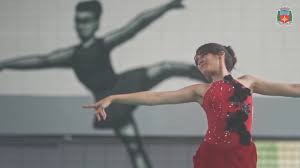
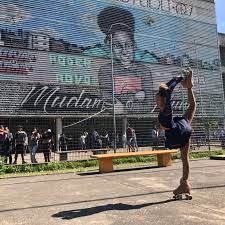
The school also stood out for combining formal education with extracurricular activities that strengthen young people’s self-esteem. Sports, especially skating and volleyball, became one of the pillars of inclusion and healthy coexistence, bringing students closer to collective practices that develop discipline, solidarity, and mutual trust. These sports projects, conducted in dialogue with the community, directly contributed to a sense of belonging and reduced school dropout rates.
Another innovative initiative is the school newspaper produced by the students, which has become a space for free and democratic expression. In it, students recount their experiences, denounce situations of exclusion, and celebrate achievements, learning early on the value of responsible communication and freedom of expression as tools for active citizenship.
The humanistic career of Director Régis Marques Ribeiro
At the helm of the institution is history teacher Régis Marques Ribeiro, a popular educator, humanist activist, and human rights defender.
With a degree in history from Unesp in Assis and a postgraduate degree in education for nonviolence, Régis has 20 years of dedication to public education.
His career began in the student movement, coordinating humanist pre-university courses with volunteer teachers in the outskirts of São Paulo and in the city of Assis, experiences that were fundamental for thousands of young people who were the first generation in their families to reach higher education.
These courses, linked to the Institute of Nonviolence, became a veritable laboratory for humanistic teaching practices based on dialogue and cooperation, in contrast to the traditional competitive model.
A member of the International Humanist Movement, Régis is also one of the founders of QuatroV, an independent media outlet created to give voice to social movements that are invisible in the traditional media. He co-authored the Manual for Defense against Censorship in Schools, a reference for educators in times of attacks on freedom of teaching.
His work is not limited to Brazil. In 2013, after traveling to the inauguration of the Marracuene Study and Reflection Park in Mozambique, Régis conducted field research in Johannesburg, exploring the paths taken by Nelson Mandela in the fight against apartheid. These experiences reinforced his conviction that education is, above all, an act of liberation.
An award that resonates beyond the school
The international recognition of EE Parque dos Sonhos is not only a victory for the Cubatão school community, but also a symbol of hope for public schools around the world. In times of social and educational crisis, the award reaffirms that it is possible to overcome adversity when education is based on human dignity, solidarity, and non-violence.
The award also recognizes the efforts of the entire teaching team and students who believe in the transformative power of education. Collective projects in sports, student communication, and community practices are concrete proof that a public school, when guided by humanistic values, can be the beating heart of social transformation.
“We believe in an education that not only transmits knowledge but also awakens consciousness, strengthens community ties, and promotes peace. This award belongs to every student, teacher, and family who builds Parque dos Sonhos every day. It is also a tribute to Silo, whose humanist philosophy inspires our path.” – Régis Marques Ribeiro, Director of EE Parque dos Sonhos
The doors that speak: graffiti at EE Parque dos Sonhos
One of the most striking symbols of the identity of the Parque dos Sonhos State School is the graffiti gallery that covers the doors of each classroom. More than art, these murals are a daily invitation to dialogue between generations and cultures. Each door pays tribute to a humanist figure, social activist, or defender of freedom, creating a corridor of inspiration for students:
● Malala Yousafzai – Global symbol of the fight for girls’ right to education.
● Silo (Mario Rodríguez Cobos) – Argentine philosopher, founder of New Humanism, and inspiration for the school’s pedagogy.
● Marielle Franco – Sociologist, Rio de Janeiro city councilor, and human rights defender, silenced by political violence.
● Paulo Freire – Educator and patron of Brazilian education, known for his humanizing pedagogy and the book Pedagogy of the Oppressed. He advocated for critical, dialogical education focused on student autonomy.
● Leo Tolstoy – Writer and Christian pacifist thinker, author of works such as War and Peace and Anna Karenina. In his later years, he devoted himself to literature,
popular education, and non-violence.
● José “Pepe” Mujica – Former president of Uruguay, a global reference for simplicity, solidarity, and participatory democracy.
● Mahatma Gandhi – Inspiration for nonviolent resistance against British colonialism and the Indian caste system.
● Nelson Mandela – Leader of the struggle against apartheid, symbol of reconciliation and racial justice.
● Martin Luther King Jr. – Voice of racial equality and the struggle for civil rights in the United States.
● Rosa Parks – Icon of peaceful resistance against racial segregation.
● Carmen Hertz – Chilean lawyer and leading figure in the defense of human rights during and after the dictatorship.
● Milagro Sala – Argentine social activist, defender of indigenous peoples and popular cooperatives.
● Aung San Suu Kyi – Nobel Peace Prize winner and symbol of democratic resistance in Myanmar.
These graffiti murals are part of an educational initiative to transform school corridors into spaces of active memory, where each student is invited daily to engage with the stories of those who, in different times and places, fought for dignity, social justice, and nonviolence.
A collective legacy: gratitude to Silo, Gandhi, and Luther King Jr.
The award received by EE Parque dos Sonhos is dedicated to all those who, on a daily basis, build the possibility of a liberating education in the midst of difficulties.
But above all, it is a gesture of deep gratitude to the humanist thinker Silo, the “Wise Man of the Andes,” whose vision of a nonviolent world continues to illuminate pedagogical and social practices in diverse cultures.
According to the conception of New Humanism, a student is not an ant or a simple piece molded for work. On the contrary, each student represents the future of humanity and carries within herself or himself a universe of possibilities.
According to the conception of New Humanism, a student is not an ant or a simple piece molded for work. On the contrary, each student represents the future of humanity and carries within themselves an entire universe—made up of stories, dreams, and songs. It is up to education to create lively and welcoming pedagogical spaces, capable of allowing that universe to flourish, so that each human being can realize their deepest vocation.
Silo, Gandhi, and Luther King taught that “the real revolution is that of consciousness,” and it is precisely this conviction that guides the work of the school in Cubatão. From sports to the student newspaper, from regular classes to weeks of reflection on peace and active nonviolence, each initiative seeks to embody the principle that education is only complete when it respects the dignity of the human being, working holistically on the student’s intellect, emotions, and motor skills, recognizing in them their infinite capacity for transformation.