

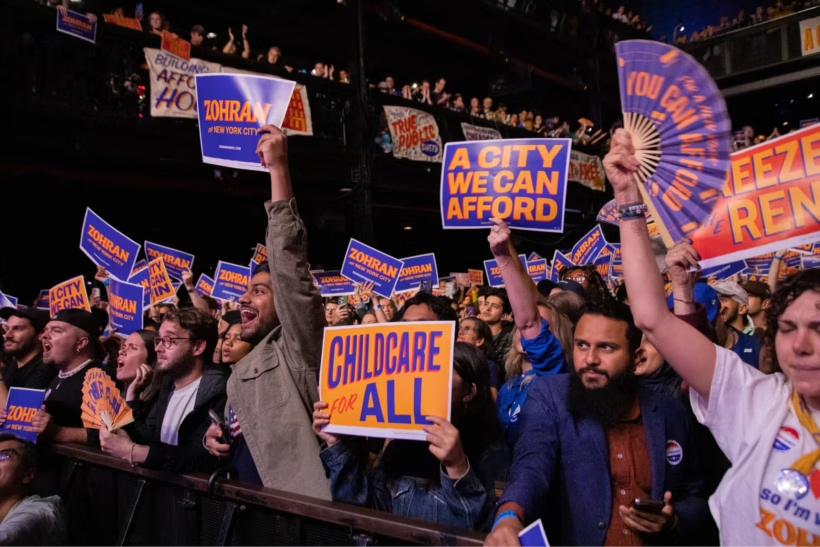
Zohran Mamdani’s insurgent campaign tests whether grassroots momentum can withstand establishment media, elite politics, and a manufactured climate of fear—with major unions and progressive surrogates providing the counterweight.
In a city long captive to establishment mechanics, Zohran Mamdani’s historic primary victory—winning despite being heavily outspent—is a seismic signal: progressive insurgency has arrived. Now the general election approaches, and the question looms: can Mamdani’s Second Circle coalition fend off the forces of media exclusion, elite fear-mongering, and centrist consolidation?
Unions Rally to the Second Circle
While the usual narrative paints unions as conservative heavyweight gatekeepers, this time they’ve aligned with the insurgency. The largest healthcare union in the country, 1199SEIU United Healthcare Workers East, formally endorsed Mamdani, citing his commitment to affordability, housing, and public services—and representing 200,000 NYC members (reference 1199seiu.orgGothamist. ) Meanwhile, the New York City Central Labor Council (AFL-CIO)—uniting 300 local unions—endorsed him in late June, praising his campaign’s ability to mobilize volunteers and speak directly to working people (reference NYC Central Labor Council+1.)
Further expanding his labor base, 32BJ SEIU, which had initially back Andrew Cuomo, publicly switched to Mamdani following the primary (reference NY1Politico. ) And DC37, the largest city-workers union, also lined up behind him (reference ABC7 New York. ) These endorsements serve not only as political capital—they validate Mamdani’s coalition across class and sector, embodying the Second Circle.
Journalism of Exclusion on Full Display
Even as labor power shifts, the media’s gatekeepers—The New York Times, CNN, and Fox—continue their familiar role: framing Mamdani as risky, radical, and unelectable. The Times, for instance, portrayed him as “too inexperienced” and a “turbocharged version of de Blasio’s dismaying mayoralty” (reference Wall Street JournalThe Guardian. ) This is classic Journalism of Exclusion: excluding New Yorkers’ voices in favor of elite saviors.
We are déjà vu: Sanders’ campaigns were routinely marginalized—coverage slanted, airtime denied—even as his grassroots energized entire regions (reference Wall Street Journal. ) Mamdani now faces the same media calculus.
Fear-Mongering Over Wealth Flight—and Its Rebuttal
Cue the next weapon: fear. Headlines will warn of wealthy New Yorkers fleeing, businesses collapsing, tax bases evaporating under a progressive mayor. This narrative jives with elite anxiety—but ignores two realities:
1. Cities governed by progressive leadership—like Berlin or Amsterdam—often retain or grow investment through equitable policy and infrastructure planning.
2. True economic resilience comes from inclusion, not exclusion. Mamdani’s proposals—public buses, rent freezes, grocery co-ops—aren’t chaos generators; they are shock absorbers for working families and local ecosystems.
We can introduce this as:
“Yes, Mamdani’s plan means fewer tax breaks and more regulation—but history shows that policies rooted in equity and planning don’t drive wealth away; they anchor communities and businesses alike. This isn’t an exodus. It’s a shift toward shared prosperity.”
Week-by-Week Projection Timeline
Here’s a skeleton for a week-by-week timeline you can translate into graphics or infographics:
Weeks and Key Developments
Now – Mid-September (Weeks 1–3): Ambassadorship rumors swirl. Mamdani’s union endorsements gain traction. Cuomo leans into establishment figures like Bill Clinton.
Mid-September (Week 4): Media intensifies fear narratives—wealth flight, tax fearmongering, governance panic.
Late September – Early October (Week 5–6): Mamdani’s campaign spotlights labor coalition, reveals media bias, rebuts economic fear with facts and stories.
Mid-October (Week 7): Watch for potential endorsement shifts—especially Chuck Schumer. An endorsement would validate Mamdani across establishment wings.
Late October (Week 8): Final surge of fear tactics—law-and-order scare stories, financial panic. Mamdani must sustain grassroots messaging.
Early November (Election Week): If the public sees through the theatrics, the Second Circle could hold the city steady.
Schumer: Silent—or Strategic?
In our last piece, we noted Chuck Schumer’s cautious stance. So far, his silence continues—described by campaign sources as “no immediate endorsement” while engaging in discussions (reference Politico. ) This void matters: Schumer’s voice could sway moderates who seek legitimacy. Without it, that demographic remains politically orphaned.
Conclusion: The Long Arc of Inclusion
This mayor’s race is far from a short-term political duel. It is a test of whether American democracy can still entertain radical unity and hope—or if our institutional powers will close the gates once more.
A Mamdani win would symbolically and materially validate the Second Circle—showing that labor, youth, immigrants, and everyday New Yorkers can wrest power from centrist elites. Even in defeat, the insurgent coalition has already exposed the Journalism of Exclusion and laid groundwork for future breakthroughs.



