

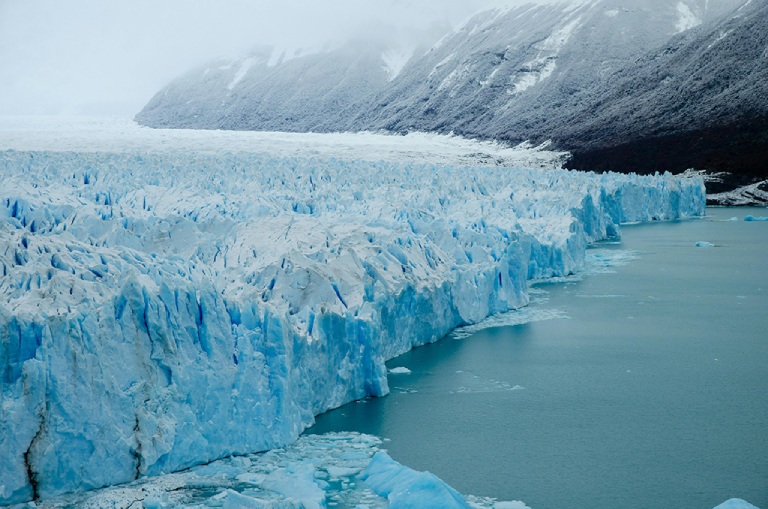
When a trade agreement becomes an ecological warning
The recent submission of the Free Trade Agreement (FTA) between Chile and the United Arab Emirates (UAE) to the Chilean Chamber of Deputies has been celebrated by political and business sectors as a milestone in the South American country’s market diversification strategy. The UAE, a financial and commercial power in the Gulf, offers preferential access to one of the highest per capita income countries in the world. The agreement includes tariff reductions for Chilean products such as fruits, wines, and processed foods, and opens the door to investments in infrastructure and logistics.
However, within its pages, the treaty harbors silences that raise concern. It does not mention glaciers even once, nor freshwater as a strategic resource, nor the Patagonian territory where the largest natural freshwater reserves of the Southern Hemisphere are located. And this silence, in the context of an agreement with a country already importing glacial ice from Greenland, becomes a warning sign.
The UAE and the unthinkable trade: water as a luxury item
The UAE is one of the driest countries in the world. Its water survival depends on desalination, the importation of bottled water, and long-term strategies to ensure the supply to its urban and tourist zones. In 2024, media outlets such as The Guardian and Khaleej Times documented the start of regular imports of glacial ice from Greenland, destined for luxury cocktails and exclusive experiences in Dubai.
This practice, beyond its exoticism, reveals a structural reality: the UAE needs external sources of pure water and has begun to build logistical chains to obtain it from distant areas, through bilateral agreements and trade treaties. The FTA with Chile—a country that has already shown business interest in exploiting glacial water for export—must be read in this context.
Chile: glaciers without law, resources without safeguards
Despite being one of the countries with the largest glacial coverage outside the polar regions, Chile still does not have legislation that comprehensively protects these ecosystems. The current regulations only safeguard glaciers located within protected areas, leaving vast expanses—especially in Patagonia—exposed to extractive activities.
Nor is there, to date, any explicit prohibition on the export of freshwater in its natural or frozen state. The Water Code reformed in 2022 advanced in prioritizing human consumption and the designation of water as a national good for public use, but maintains legal gray areas that could be exploited by private actors to acquire use rights over glacial meltwaters.
The bill that could save water sovereignty
In this context, the Glacier Protection Bill, under parliamentary discussion since 2019, emerges as a critical tool. Its Article 6 expressly prohibits any form of removal, transfer, or industrial use of glaciers, periglacial environments, and subglacial areas. This wording explicitly includes the bottling or export of water originating from glaciers.
If passed, this law would legally shield Chile from any commercial claims under the FTA with the UAE. But its delay—due to sectoral pressure, lack of legislative priority, or political indifference—keeps a dangerous door open.
FTA and legal risk: water as a non-excluded commodity
The Chile–UAE Treaty, in its official version, contains clauses for investment protection and investor–state dispute settlement mechanisms. Although it recognizes the sovereign right of States to regulate in pursuit of legitimate objectives such as environmental protection, it does not explicitly exclude natural water resources from bilateral trade.
This means that, in the absence of a national law prohibiting the export of glacial water, an Emirati company could acquire rights or develop operations in that field. If the Chilean State later decided to revoke those authorizations for environmental reasons without a clear legal basis, it could face international lawsuits and the obligation to pay compensation.
Urgent recommendations to prevent dispossession by omission
Interpretive declaration tied to ratification: Congress must accompany the approval of the treaty with an interpretive declaration excluding from bilateral trade any form of extraction, bottling, or export of water originating from glaciers.
Immediate approval of the Glacier Bill: Its approval would resolve the current legal vacuum and constitute a structural guarantee of water sovereignty.
Preventive legal moratorium: While robust legislation does not exist, an explicit moratorium on exports of natural water from glacial zones is recommended.
Environmental review of all FTAs: Going forward, each new trade agreement must undergo rigorous environmental scrutiny, including an exclusion matrix for strategic common goods.
Conclusion: water does not defend itself
The FTA with the UAE is a legitimate commercial opportunity. But without clear internal regulation, it could become a backdoor for luxury water extractivism. Patagonia—silent and vast—has no representation in treaties. It is up to the Chilean Congress to decide whether the water that belongs to all will be turned into merchandise for a few.



