

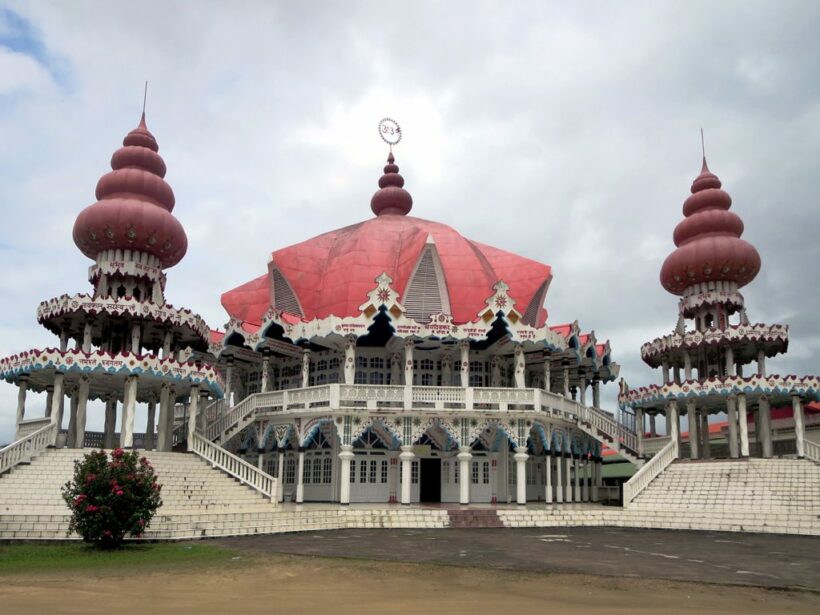
Some wars are being justified by maps, others by dogmas, and others by oil. But the most dangerous are fueled by symbols. And there is no symbol more flammable than an ancestral temple disputed by two wounded peoples.
In the jungle heart of Asia, the carved stone of Shiva’s temples has once again echoed under crossfire. Preah Vihear and Ta Muen Thom are no longer just sacred ruins: they are trenches. And what is at stake is not only territory: it is national dignity, colonial memory, and the right to name history.
On the morning of July 24, 2025, six border points between Cambodia and Thailand erupted into real combat. BM-21 rockets launched from the Cambodian side struck Thailand’s Surin province, killing eleven civilians, including an eight-year-old child. The Thai response was immediate: F-16 fighter jets flew over the border and bombed Cambodian military positions near the Prasat Ta Muen Thom temple. The sleeping war had awakened.
It was not the first time. Since the ruling of the International Court of Justice (ICJ) in 1962—which granted Cambodia sovereignty over the Preah Vihear temple—both countries have dragged along a latent disagreement over the adjacent lands. That dispute, worsened by colonial maps, internal political interests, and unresolved nationalist memories, has turned eleventh-century Hindu temples into epicenters of contemporary conflict.
Preah Vihear is not just an architectural complex. Located 525 meters above sea level on the Dângrêk Mountains, it represents for Cambodia a sacred symbol of its Khmer heritage, and for Thailand, an irreplaceable part of its national imagination. It was declared a UNESCO World Heritage Site in 2008, which reignited regional tensions. The most recent flashpoint is Ta Muen Thom, another Hindu shrine from the eleventh century, enveloped in jungle and strategically positioned along one of the historic military routes between the two countries.
This conflict cannot be understood without examining the hidden architecture of power that sustains it. Thailand, governed by an unstable coalition and marked by internal crises, has instrumentalized border nationalism as a pressure valve. Cambodia, under Prime Minister Hun Manet, son of the long-time leader Hun Sen, turns to heritage defense as a sovereign banner. Both nations have used the temples not only as geographic markers, but as war monuments that confer political legitimacy and consolidate identity narratives.
The humanitarian dimension is alarming. The July 24 clashes left at least twelve dead, dozens wounded, and forced the evacuation of between 40,000 and 86,000 people, according to various regional sources. Villages near the temples have been emptied; hospitals damaged, schools closed, and borders completely sealed. Embassies have been withdrawn. Mutual accusations are intensifying.
And while the projectiles fly, the world reacts as if it had already seen it coming. The Association of Southeast Asian Nations (ASEAN), chaired this year by Malaysia, has called for dialogue. The United States issued a formal warning. Israel, ironically, has advised its citizens to avoid border areas due to “serious instability risk.” But it is China that occupies the silent center of this scene.
China’s role is both strategic and revealing. In the immediate term, its Foreign Minister Wang Yi offered to mediate the dispute, appealing to a “fair and impartial stance” and to principles of regional cooperation. Foreign Ministry spokesman Guo Jiakun publicly declared that China is “deeply concerned” about the clashes and “trusts that the parties will resolve their differences through dialogue.” Beyond the rhetoric, China’s position responds to structural geopolitical interests.
For over a decade, Beijing has built its influence in Southeast Asia not only with railways and loans, but with narratives. In a world increasingly fractured, China positions itself as a guarantor of stability against Western chaos. Its apparent neutrality in this war is, in truth, a sophisticated act of positioning: peace mediator and indispensable actor. If Cambodia and Thailand sit down at the table, it will not be because of the UN, but because of Beijing’s weight in the region’s economic and diplomatic fabric.
But beyond summits and chancellors, something deeper is at stake here. Can a temple be a reason for death? Can a wall of carved stone with figures of Shiva become a sentence of mass displacement? What kind of civilization have we built, when ancient spirituality becomes the trigger for modern war?
Cambodia has requested urgent intervention and a binding resolution from the UN Security Council. It has also petitioned the ICJ for a new precise delimitation of the lands adjacent to the temples, as a continuation of the 2011 ruling that ordered the withdrawal of troops from the Preah Vihear area. Thailand, for its part, has accused Cambodia of “territorial violation and civilian aggression,” reinforcing military deployment in the border provinces of Sisaket and Surin.
In this dispute, there are no foreign invaders or colonial occupations, but there are unresolved colonial wounds. The border between Cambodia and Thailand was drawn with the ink of empires: French, Siamese, British. And although the maps have changed, the wound remains. Preah Vihear is also the story of how an unresolved past poisons the present.
What we are witnessing today is not an isolated incident, but a symptom. A warning. And a mirror.
A mirror that reflects the mechanisms by which nations manipulate religious symbols to galvanize wills, justify offensives, and suppress dissent. A mirror where diplomacy is emptied of meaning if not accompanied by real justice and memory. A mirror where, if no one intervenes with clarity and strength, the temples will once again become ruins—not by the passage of time, but by the relentless weight of bombs.