

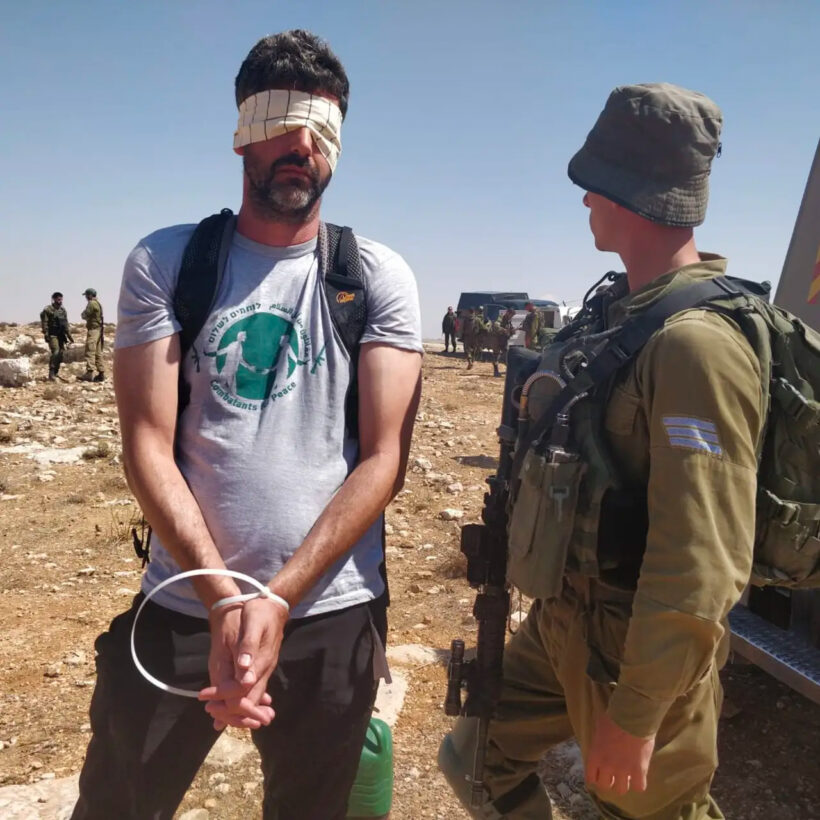
By Avner Wishnitzer. Avner is a co-founder of Combatants for Peace and a professor of history at Tel Aviv University. We reprint with his permission this recent article for the Hebrew-language online publication Local Call.
One day they’ll tell about what happened there. A few at first, later a bit more.
From the intensity of pressure in their chests, the words will be whispered, like the hiss of steam, a few at first, hesitant. Later a little more.
There will be those who succeed in holding them inside and will speak only in decades, when they cool down a bit and don’t burn on the lips. There will be those who never speak. Only in their sleep will images return to them, nightmares, and they will wake up sweating. To those lying next to them, who also wake up in alarm, they will say it’s nothing. It was just a bad dream.
One day they’ll tell about what happened there. Maybe it will be a drone operator who will tell about the “uninvolved” people that he killed. “It was different then,” he’ll explain. “It was after the horrors of October 7 and everyone said there are no innocents there, and the president of the country signed an artillery shell. Then they said you can’t give up the Philadelphi Corridor and that military pressure will free the hostages, and I was only twenty years old and I believed it. And most of all I wanted to be a good soldier. I remember the commander patted me on the shoulder when I brought down a building and I felt pride, but also a bit of embarrassment. Maybe the embarrassment came later, I’m not sure anymore.”
Maybe it will be an armored battalion commander. “We shot at the hospital because they said it was ‘הופלל – hoflal’ (in IDF or security jargon, when a building or location is said to be “הופלל – hoflal”, it means: it is allegedly used by combatants). In retrospect, I think that’s exactly what we did: we incriminated. We accused, and even if there wasn’t always evidence, we passed judgment — often [the judgment was] death.
But then we simply thought these were the orders. And also, not nice to say, we were afraid. About that we didn’t talk with the military reporters who went inside, and the politicians who sent us didn’t care too much about it. But that fear all the time, the fear and the nerves — they make you dull. I saw them, through the binoculars, straggling in convoys, having nothing, lost, and I thought about those images we grew up on.
You’re not supposed to compare, but hand on heart, that’s what came into my head.
You don’t control those things. But what could I have done, really? Looking back, it seems to me that what I feared most was that my officers, even my soldiers, would think I’m yafeh nefesh [“beautiful soul”; derogatory slang for someone seen as too moral or naive], that they’d say that… I don’t know. It’s hard to explain today.”
And maybe it will be an IDF spokesperson who will reveal in a post on social media, if there are any more, that she drafted a press release that the hospital was a Hamas headquarters. “Later, I heard on one of the TV channels how the statement I drafted took on a life of its own. One of the reporters said that the hospital was a ‘hornet’s nest.’ I moved on. And in all the columns I’ve written in the newspaper since then, I’ve never written about it. Strange, isn’t it?”
Maybe it will be one of those commentators who will be remembered from those days. “You have to understand,” he’ll say, “that was the atmosphere. It came down from the editors and ultimately from the owners of the channel. And besides, if the IDF Spokesperson passed us information, certainly they checked it first. After all, one doesn’t destroy a hospital just like that. What are we, animals? And yet, maybe I should have said more. I suspected we were doing things—how to say… After all, so many videos came out, hundreds. But no…”
And an older man will tell his granddaughter that throughout this time he went to work as usual. “It’s not like everything stopped or anything. Every day dozens of people were killed there, in Gaza, sometimes more than a hundred, but they didn’t talk about it on TV. I mean, they talked about Gaza, but not about these things. They mainly talked about ‘powerful maneuvers’ and how many Hamas members we killed. They didn’t say we were wiping out – that we were destroying everything. They didn’t say we were starving the people, just that we weren’t letting aid in. You see? Maybe that’s why we didn’t protest. And then the war with Iran came and they didn’t talk about it at all. They stopped talking about the kidnapped people too, even about the soldiers who were killed there. You see? For those at the top, life became cheap, and we? I think we got used to it.”
One day they’ll tell about what happened there. A few at first, a little more later. Many more will remain silent, for fear of implicating themselves or their comrades in the unit. Few will listen with interest, many more will move uncomfortably. Others will continue to justify the killing and destruction, the expulsion and starvation, for the rest of their lives.
If you have the slightest fear that you are not one of them, that one day you will regret it; if you feel, even vaguely, in a way that cannot be put into words, that with each passing day another artery in your heart is blocked, another part of your soul is being destroyed – do not ignore, do not remain silent, do not stand by. Ask about Gaza, speak about Gaza, oppose the killing. Choose life.