

A Journey Through Four Peace Pagoda Memorial Ceremonies in Europe
by Mitsutake Ikeda
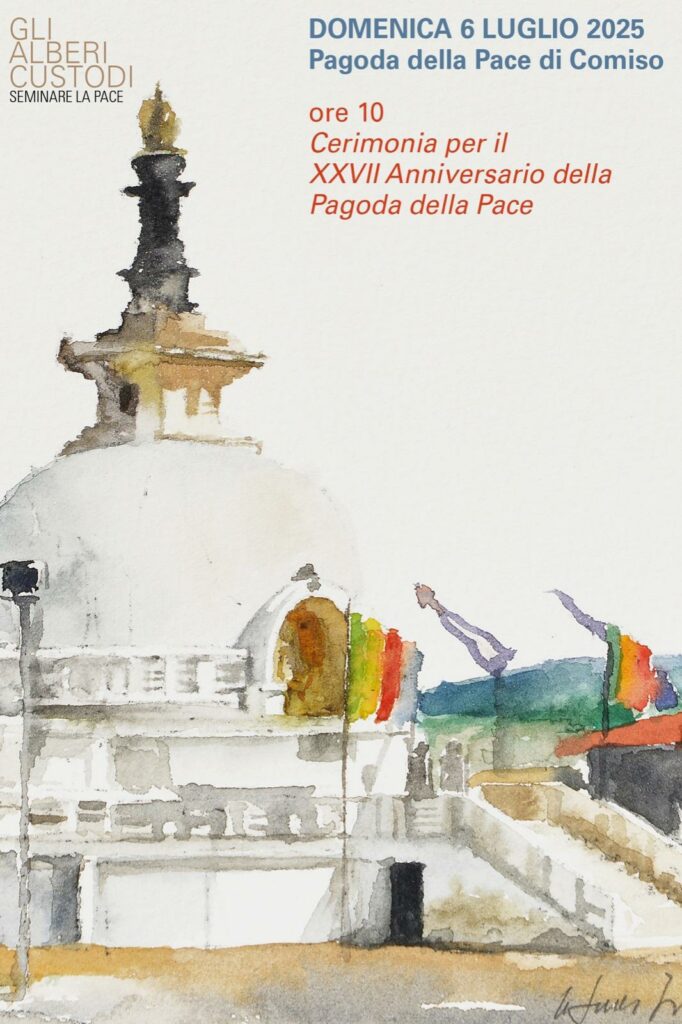
On June 21st, the 40th anniversary grand memorial ceremony of the London Peace Pagoda was solemnly conducted, followed by the 45th anniversary ceremony of the Milton Keynes Peace Pagoda on the 22nd. After a week’s interval, the 42nd anniversary ceremony of the Vienna Peace Pagoda was held on the 29th, and finally, the 27th anniversary ceremony of the Comiso Peace Pagoda took place on the first Sunday of July, the 6th.
Here are some photos of the Peace Pagoda Ceremonies in Europe:
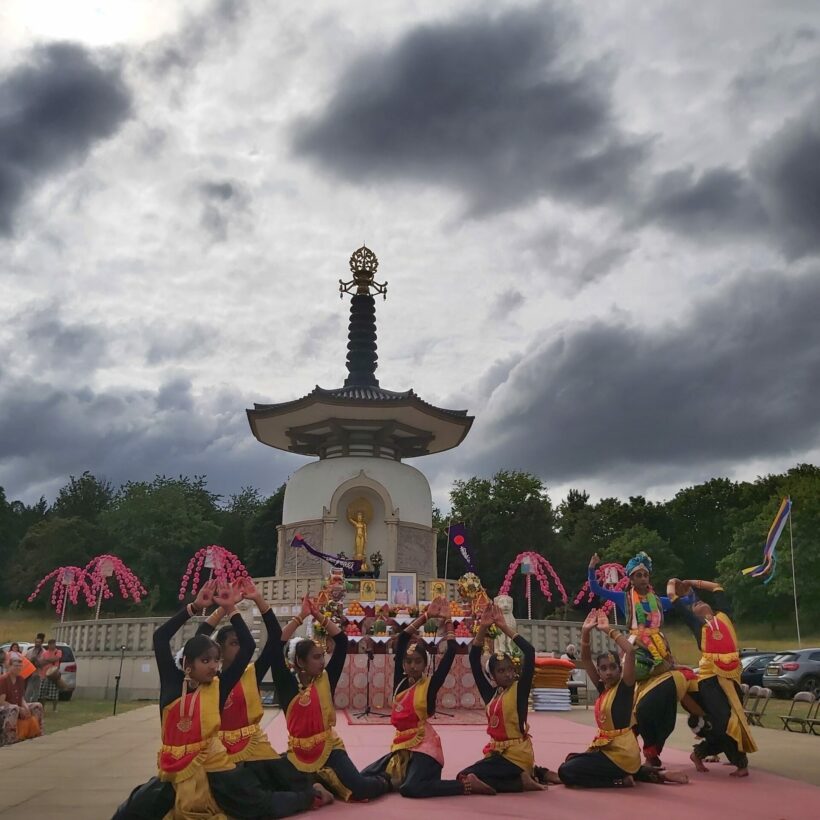
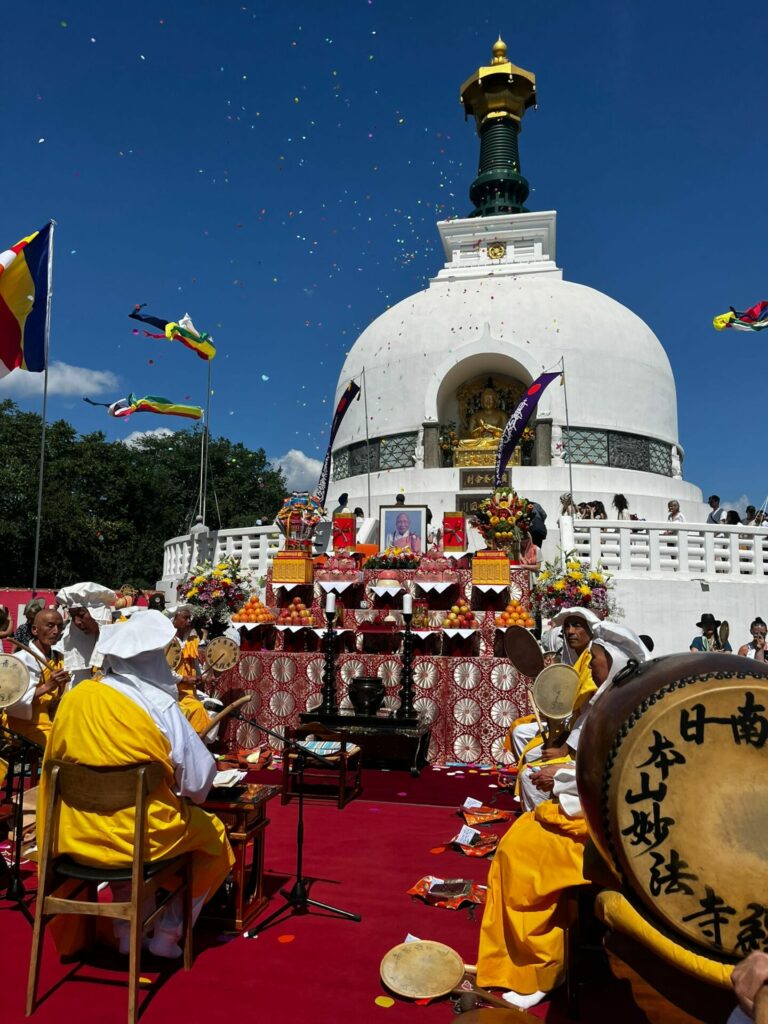
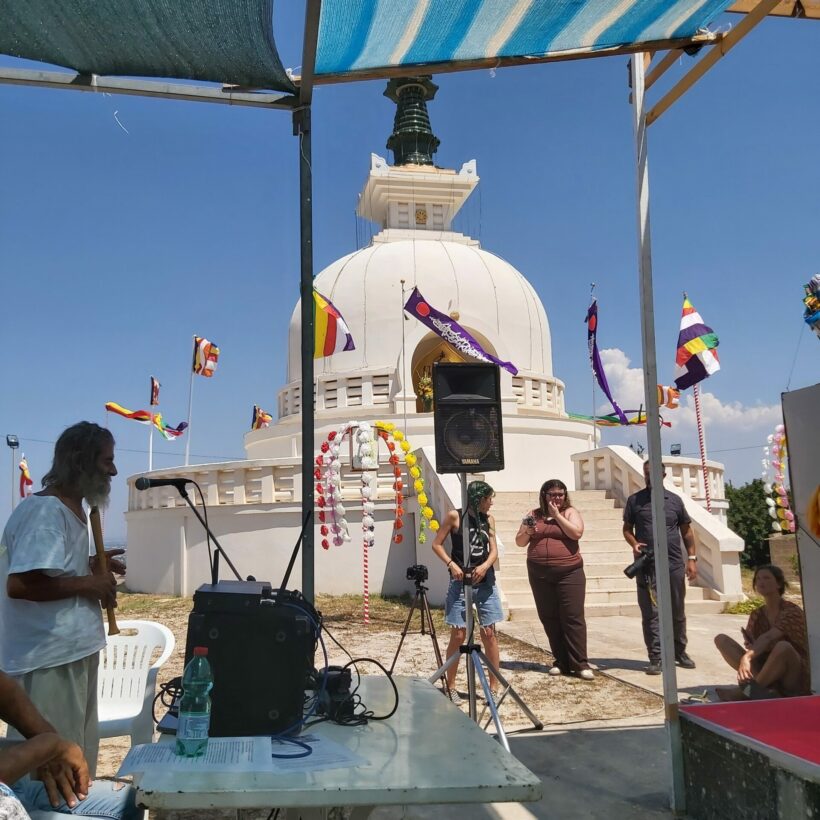
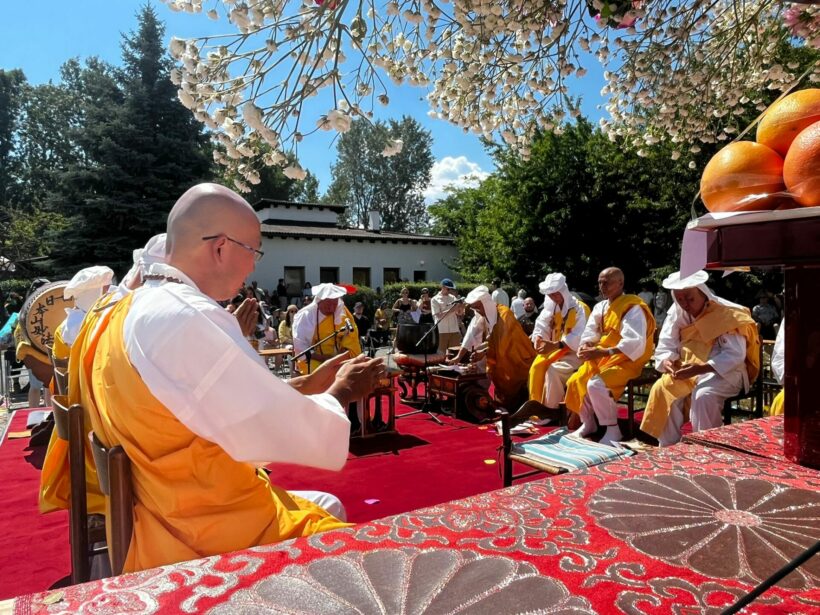
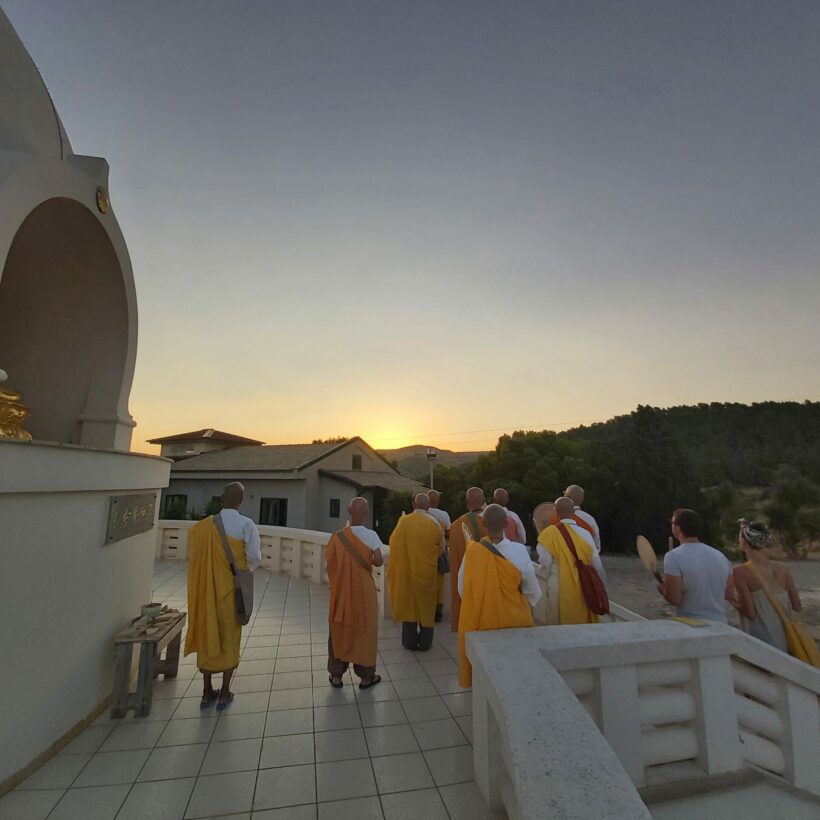
The London Peace Pagoda 40th anniversary grand memorial ceremony drew distinguished monks and nuns from across Europe: Reverend Masunaga, Reverend Morishita Gyosho, Reverend Sasamori, Reverend Nagase, and Nun Maruta. From the United States came Nun Claire from Leverett, Nun Yasuda from Grafton, and Reverend Tim from Maryland. From India, Reverend Ishitani and Nun Kimura traveled from Sankarankoil, Reverend Tanaka from Darjeeling, and from Taiwan came Reverend Otsu. From Nepal, Reverend Ônishi journeyed from Lumbini. Reverend Kamoshita arrived from Okinawa, and Reverend Ikeda, who had been conducting walking pilgrimage (行脚 angya) in Azerbaijan, rushed to attend. The ceremony was conducted under ideal weather conditions, with thin clouds providing natural shade from the blazing sun.
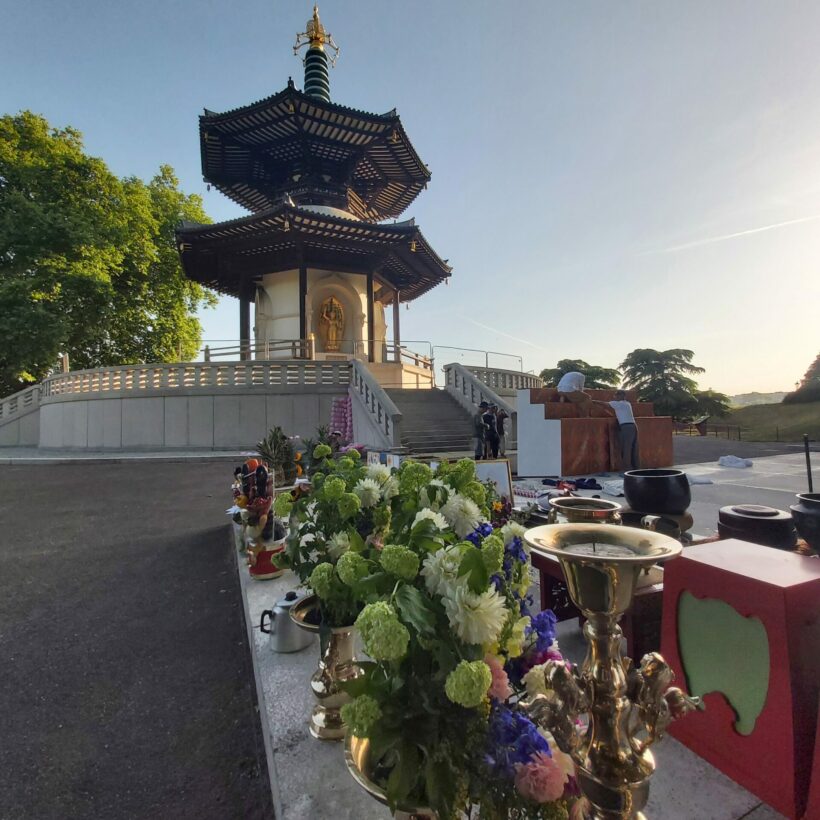
This year’s London was blessed with unusually mild weather, so much so that we didn’t need the jackets we had brought. The lawn around the Peace Pagoda in Battersea Park was filled with people enjoying sunbathing, creating a peaceful scene. Six of us who couldn’t be accommodated at the temple stayed at a church behind Battersea Park, and each morning we went to the Peace Pagoda to greet the sunrise and help with ceremony preparations. On the day of the ceremony, the sky seemed to answer our prayers by covering us with thin clouds that served as natural sun protection. That morning, the interfaith peace march led by Reverend Kamoshita, which had departed from Trafalgar Square toward the Peace Pagoda, arrived as scheduled without being exposed to harsh sunlight. As devotee Aihara Sarasa carefully carried and displayed the daimoku banner, it was installed on the railings of the Peace Pagoda’s front steps, and ritual incense offering by worshippers began.
Sacred Synchronicity Across Three Weeks
The pace of ceremonies across various European locations over three weeks proceeded as briskly as the beating of Nipponzan drums. When the Comiso ceremony concluded, it felt as though the three weeks had passed in an instant. On the day of the Comiso Peace Pagoda ceremony, as we decorated the altar, offered flowers to the inner sanctum, and attached and raised the daimoku banner on the railings of the Pagoda, something mysterious occurred—the scene from London two weeks earlier vividly overlapped before our eyes. The solemnity of the moment when the interfaith peace march arrived and the purple daimoku banner was installed on the railings seemed to be resurrected in Comiso, transcending time and space. We experienced an inexplicable sense of unity, as if the same ceremony was being repeatedly conducted in different locations.
Community Support and Spontaneous Aid
The Battersea Park event coordinator had promised 200 folding chairs, but half of them were diverted to a different event at the last minute, creating a shortage crisis. However, the London Peace Pagoda Support Group, which had arranged our church accommodation, swiftly responded to this emergency through their network, securing an additional 80 chairs. These 80 chairs were considerably old folding chairs that required great effort to open. We had planned to set up all the chairs before lunch, but instead of arranging them, we left the 80 folded chairs leaning against the London plane trees in front of the Peace Pagoda, asked Ms. Jane, one of the supporters, to watch over the decorated altar, and returned to the temple for the meal offering.
After finishing our meal and taking a brief rest, we prepared ourselves for the heavy work and headed back to the Peace Pagoda, only to find that numerous chairs had been beautifully opened and arranged! Under the trees, unknown people were cheerfully struggling with the remaining chairs. When we approached Ms.Jane, who was joyfully teaching the knack of applying force to open the chairs, she told us that a vigorous man who was jogging, young people saving spots for a concert in a different area of the park, couples on a date in the beautiful Saturday weather—everyone who passed in front of the Peace Pagoda had helped. This is how the seating for ceremony participants was prepared.
Interfaith Cooperation at Milton Keynes
The Milton Keynes Peace Pagoda is about 200 meters away if you walk straight from the temple, but since you must cross a small hill, the altar is assembled in front of the temple, loaded onto a cart, and transported by truck along a paved road that goes around. On the morning of the ceremony, local Sai Baba devotees who brought the truck skillfully loaded the altar and unloaded it in front of the Peace Pagoda, carefully aligning it to face forward. They then moved on to transporting the 200 folding chairs from the storage shed behind the temple. While the monks and nuns were decorating the altar and ceremony platform, they finished arranging the 200 chairs through shuttle transport and promptly departed. After the ceremony was conducted and the cultural program ended, they appeared again from somewhere with the cart, briskly transported the altar and chairs back to storage, and after completing this work, entered the temple, enjoyed chatting while standing and drinking tea, then quickly departed. We were impressed by their very pleasant work style.
From Ceremony to Serenity at Vienna
The Vienna Peace Pagoda stands directly in front of the temple, but the chairs are stored in the attic, making their removal and storage laborious. The cleanup involves dismantling and organizing the red and white banner poles and ceremony platform, making it a time-consuming afternoon task. This year, local young men who occasionally attended morning and evening services competed to go up to the attic and organize the chairs being passed up. Additionally, local supporters who remained until the end of the cultural program helped carry the dismantled wooden materials to the back of the temple. Those not cut for heavy work collected the scattered flower petals that had danced down from the Peace Pagoda, and in what seemed like an instant, the white Peace Pagoda returned to its usual appearance of standing quietly by the Danube, as if the grand ceremony had never taken place.
Comiso: Where History Lives
Through these ceremonies across various European locations, we deeply feel how past and present are profoundly connected. Particularly at this year’s Comiso ceremony, we could sense that prayers for peace that began over 40 years ago continue to be passed down through generations. The Comiso Peace Pagoda, which can be beautifully seen from airplane windows atop a hill when landing at Comiso Airport, has deep history carved into this land.
Comiso Airport was built during World War II by Italy’s Fascist regime and used as a bomber base for Axis forces against the Allies. After the war, it was used as a commercial airport by Alitalia, but during the Cold War in 1981, it was designated by NATO as Europe’s largest intermediate-range ballistic nuclear missile base. In 1982, 112 modern ground-launched cruise missiles BGM-109G (ground-launched derivatives of Tomahawk SLCM) were installed, and the U.S. Air Force was deployed in 1983. Each missile had many times the destructive power of the bombs dropped on Hiroshima and Nagasaki, with a range that included Moscow—these were the most advanced weapons of the time. It was said that the 112 missiles at Comiso base could turn all of Europe into a burned wasteland.
Seeds of Peace in Nuclear Shadow
In the midst of this military tension, peace efforts by Reverend Morishita began. After the New York One Million Peace Rally in June 1982, Reverend Morishita, together with Nun Maruta and Ms. Nara (an English woman who was a nun at the time), conducted walking pilgrimage through Italy and Sicily, forming friendships with local peace activists. In 1983, responding to a request from Alberto L´Abate, a professor of nonviolent resistance at the University of Florence and a central figure in the anti-Comiso missile base movement, they entered Comiso. Reverend Morishita began camping on flat ground beside the base entrance, conducting sit-in prayer meditation and street practice, while continuing to travel from Sicily to international conferences including advanced nation summits throughout Italy for prayers for the abolition of Comiso base. He reportedly always traveled by hitchhiking. At the Rome 500,000-person antinuclear march that same year, he led the procession by beating drums at the very front and center, becoming a symbolic figure of the anti-Comiso base movement. Then in 1985, when the landowner of the farm in front of the base donated land for the opposition movement, the peace camp: Verde Vigna (Green Vineyard) was established. Reverend Morishita built a stone stupa within the grounds and began living together with other activists. From here, the foundation for community-rooted peace activities that continues to this day was established.
Living Bridges: Past and Present United
At this ceremony 40 years later, we witnessed firsthand the inheritance of this history. Ms. Renata, who runs a bed and breakfast near the Peace Pagoda and provided accommodation for Reverend Otsu and the Taiwanese devotees, had been active with Reverend Morishita at Verde Vigna and helped with chair cleanup at this year’s ceremony. Turi Vacarro, who was busy repairing the stone steps beside the temple that had begun to loosen while everyone else was arranging chairs, is also someone connected to Reverend Morishita from the Verde Vigna era. As a former Fiat engineer, using his experience, every time missile-loaded sixteen-wheeled transport vehicles left the base during exercises, he would crawl under the vehicles from the roadside and continue destroying the transport vehicles.
Prayers for peace are also being inherited by new generations. Actually, the committee of Comiso Peace Pagoda had planned and was conducting a four-day congress called “Forms of Creative Nonviolence” in conjunction with the Comiso ceremony. Turi Vaccaro was arranging chairs for the congress venue together with Alfonso Navarra, a comrade from the Verde Vigna founding era. Together with newly joined peace activists, they were broadcasting these presentations about the rights of conscientious objection in case military service is reinstated in Italy and the importance of citizen-led disarmament movements through local radio and internet. The peace efforts that began with resistance to nuclear missiles are being inherited in new forms addressing contemporary issues.
Earth-Emerging Bodhisattvas in Action
Such scenes were repeatedly observed. Whether tidying up the platform´s lumbers in Vienna or dismantling sun-shade frames in Comiso, numerous tasks that in some years extended to the day after ceremonies were completed in an instant through the cooperation of many people, regardless of age or gender, as if guided by invisible hands. It was as if earth-emerging bodhisattvas (地湧の菩薩 jiyu no bosatsu) appeared at the right moment, generously lending their compassionate power. Looking back at all these events—from experiences of unknown people willingly lending a hand to the voluntary circles of cooperation at each location—everything seems to have meaning beyond mere coincidence. This might be evidence that the mysterious power of the Dharma nature (法性の不思議力 hosshō no fushigiriki) united the Peace Pagoda memorial ceremonies across Europe, making prayers for peace resonate in people’s hearts across time and space. These inherited prayers for peace will continue into the future. In 2028, the Vienna Peace Pagoda will reach its 45th anniversary and the Comiso Peace Pagoda its 30th anniversary, marking new milestones with expectations for further expansion of dharma connections.
Wisdom for the Flowing Stream
Reverend Masunaga gave the following precious teaching during the evening service on the day before the Comiso ceremony, mentioning the names of all the monks and nuns who had participated in this year’s European commemorative ceremonies:
“Nipponzan should not speak of ‘my temple’ or ‘someone else’s temple.’ Being Nipponzan means giving our all to help with ceremonies we are allowed to attend. By doing so, each individual monk and nun of Nipponzan appears not as separate rocks but as water in one flowing stream, moving toward one purpose. The daimoku chanting of each of us, which gradually became powerfully unified in response during the morning and evening services conducted across European locations over three weeks beginning with preparations for the London Peace Pagoda 40th anniversary memorial ceremony, I am confident is an auspicious sign for future Buddhist services of Nipponzan.”
About the Author:
Mitsutake Ikeda completed a bachelor’s degree in International and Area Studies at the University of California, Berkeley in 2007, and a Master of Arts in Translation Studies at the University of Coimbra in 2017. He is a collaborator member of Unidade de Investigação & Desenvolvimento “Instituto de Estudos Filosóficos” (IEF) and a PhD student in Philosophy at the University of Coimbra.